
Jordan handed her notice in on a Friday. Five years as an employed plumber, a van that was not hers, a wage that stopped going up. On the Saturday her neighbour's mum rang: outside tap leaking, could she have a look? Forty minutes, a new tap, an isolation valve, £140. Jordan did the job beautifully and then stood in the kitchen with no idea how to ask for the money. No invoice, no business name, no separate bank account, and a vague memory that she was supposed to tell HMRC something. Everyone who goes self-employed has a version of that Saturday. Here is the list she needed, in the order it matters.
The admin, in the order it actually matters
You do not need all of this before your first job. You need it within the first few weeks, and some of it has deadlines. Work through it from the top.
1. Register with HMRC for Self Assessment
This is the one that makes you officially a sole trader. You register online, HMRC sends you a Unique Taxpayer Reference (UTR) by post, and from then on you file a tax return each year and pay Income Tax and National Insurance on your profit. At the time of writing you must register by 5 October after the end of the tax year in which you started, but do it in your first week: the UTR can take a couple of weeks to arrive and you will want it for the next step.
You can trade, quote and invoice before the UTR arrives. The UTR goes on invoices to contractors (for CIS), not on invoices to homeowners.
2. Register for CIS if you will work for contractors
If any of your work will be construction work for a contractor (a builder, a developer, a housing association, sometimes a big letting agent), register as a subcontractor under the Construction Industry Scheme. Contractors deduct tax from the labour part of what they pay you: 20% if you are registered, 30% if you are not, 0% if you later qualify for gross payment status. Materials and VAT are not deducted from. The deductions count towards your tax bill and come back through Self Assessment. Work for private homeowners is outside CIS completely, so a plumber doing only domestic jobs can skip this; a plumber doing second fix for a builder cannot. Our CIS invoice example shows what the invoice looks like.
3. Open a separate bank account
Sole traders are not legally required to have a business account, but mixing the van's diesel with the weekly shop makes your tax return a misery. Open a separate account, even a basic one, and have every job paid into it. Then set up a second pot and move a percentage of every payment into it for tax. Your accountant will give you a figure; a quarter to a third is a common starting rule of thumb for a tradesperson with no other income, but check for your own situation.
4. Insurance and the registrations your trade requires
Public liability insurance is not a legal requirement for most trades but customers, agents and contractors will ask for it, and one burst pipe through a ceiling will explain why. Then the trade-specific ones: Gas Safe registration is legally required for any gas work, and Jordan cannot touch a boiler without it; electricians need Part P compliance and usually a competent person scheme such as NICEIC or NAPIT; G3 for unvented cylinders; FENSA or CERTASS for windows. These take time to arrange, so start now if your old employer's registration covered you. Van insurance for business use, and tools cover, round it off.
Your name on the invoice, and your price
Two decisions before the first invoice. First, what are you called? A sole trader can trade under their own name or a trading name, but your own name has to appear too: "Jordan Price trading as JP Plumbing". Pick something you can live with on the side of a van and check nobody local already uses it.
Second, what do you charge? The trap is to take the hourly rate your old boss charged customers and quietly knock a bit off. That rate paid for the van, the fuel, the insurance, the tools, the phone, the training days, the holidays, the sick days, the slow weeks in January and the tax. Now all of that is yours. Add up what you need to earn, add those costs, and divide by the days you will realistically bill, which is not 250; between travel, quoting, admin and quiet weeks, 180 to 200 is nearer the mark for a first year. Compare the answer with what local tradespeople charge. If it looks high, remember that nobody who went bust did it by charging too much. Day rate versus fixed price helps with how to present it.
Your first quote
Jordan's £140 tap job did not need a quote; she told the customer the price and the customer said yes. Anything bigger than a morning does. A quote fixes the scope and the price before you start, which is the single most effective protection against the "I thought that was included" conversation at the end.
A good quote has your details and the customer's, the site address, a quote number and date, each piece of work described in plain English, what is included and what is not, the price (labour and materials, with VAT only if you are registered), how long it is valid for, how much deposit you want and when the balance is due. Then the customer accepts it in writing, even a reply saying "yes please, go ahead". How to write a quote for a trade job goes through it line by line, and quote versus estimate explains why the word matters.
One thing new sole traders find odd: if you agree the job in the customer's home, consumer law gives them a 14-day cancellation right on most contracts over £42. If they want you to start inside those 14 days, get that request in writing (a text will do) so you can charge for work done if they change their mind. Most never do. The paperwork is for the one who does.
Your first invoice
Here is what every UK invoice must have: a unique invoice number, your name or trading name and address, the customer's name and address, the date, a description of the work, and the amount. If you were VAT registered you would add your VAT number, the VAT rate and amount, the tax point and the net total, but as a new sole trader you almost certainly are not, so there is no VAT anywhere on it. At the time of writing registration becomes compulsory at £90,000 of taxable turnover in a rolling 12 months; until then, do not charge it and do not show it. Invoicing when you are not VAT registered covers the detail.
Start your numbering at INV-0001 and never reuse or skip a number; invoice numbering explained has the rules. Here is Jordan's first invoice, written the Sunday after the job.
Invoice INV-0001 from Jordan Price trading as JP Plumbing, 42 Elm Grove, Sheffield S10 1AA. 07700 900123
Bill to: Mrs Margaret Hale, 8 Elm Grove, Sheffield S10 1AA
Invoice date: 8 November 2026. Work carried out: 7 November 2026. Due: on receipt
| Description | Qty | Unit price | Amount |
|---|---|---|---|
| Labour: remove leaking outside tap, fit new bib tap with double check valve, fit isolation valve on supply, test under pressure | 1 hr | £65.00 | £65.00 |
| Materials: outside bib tap with double check valve | 1 | £28.00 | £28.00 |
| Materials: 15mm isolation valve, wall plate, fittings and PTFE | 1 | £22.00 | £22.00 |
| Call-out and travel | 1 | £25.00 | £25.00 |
| Total due | £140.00 | ||
Not VAT registered; no VAT charged. Please pay by bank transfer to Jordan Price, sort code 00-00-00, account 12345678, or by card using the Pay button. Work guaranteed for 12 months. Thank you for your custom.
Labour and materials on separate lines, every time. It shows the customer what they paid for, it is what you will need if you ever work for a contractor under CIS, and it makes your own records easier at year end. Labour and materials on an invoice covers marking up and keeping receipts.
Getting paid on the day
Employed, you never thought about cash flow. Self-employed, it is the whole game: the diesel, the merchant account and the tax pot all come out of money that has actually arrived. So build the habit from job one of invoicing before you leave and making it effortless to pay.
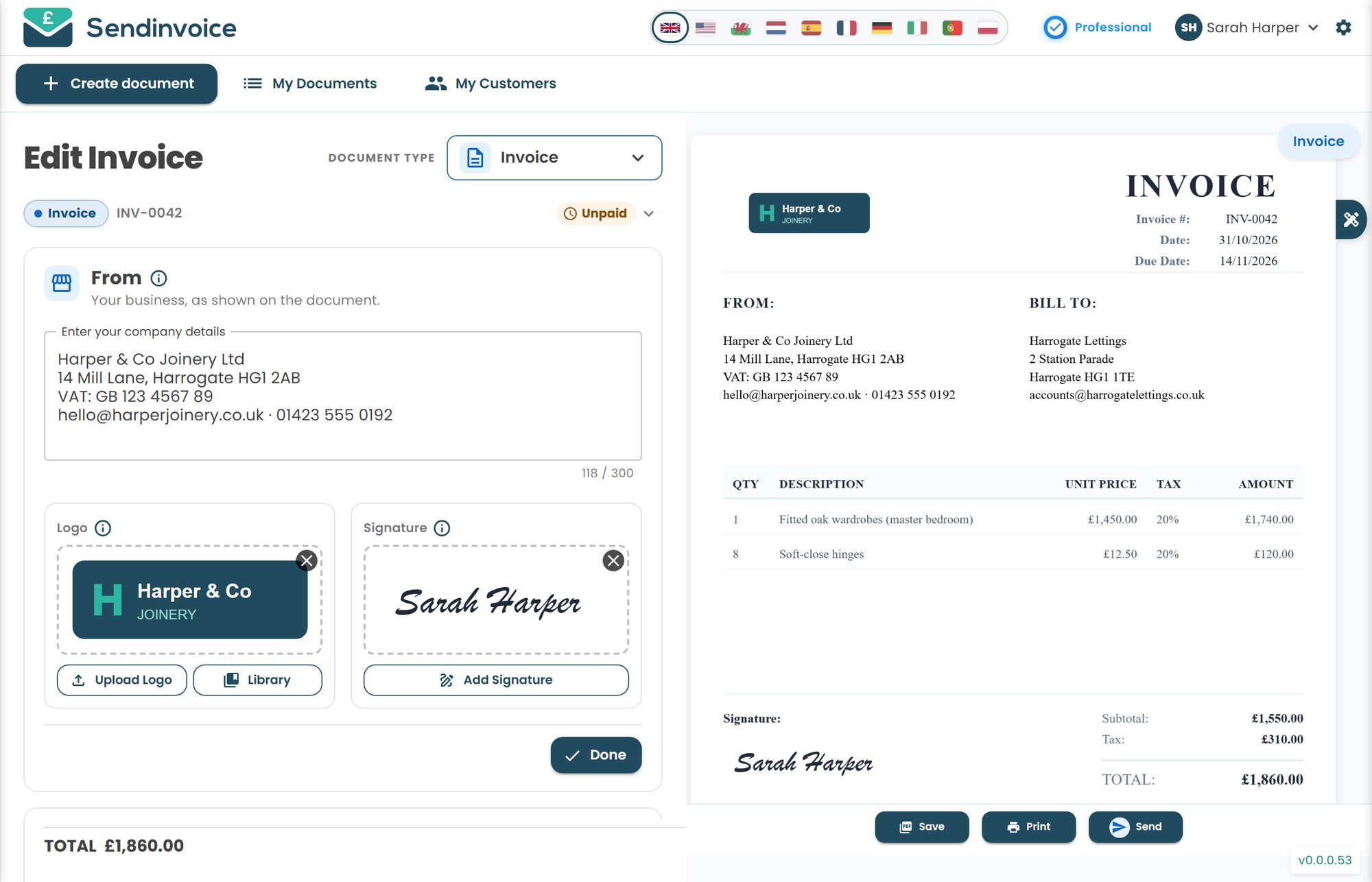
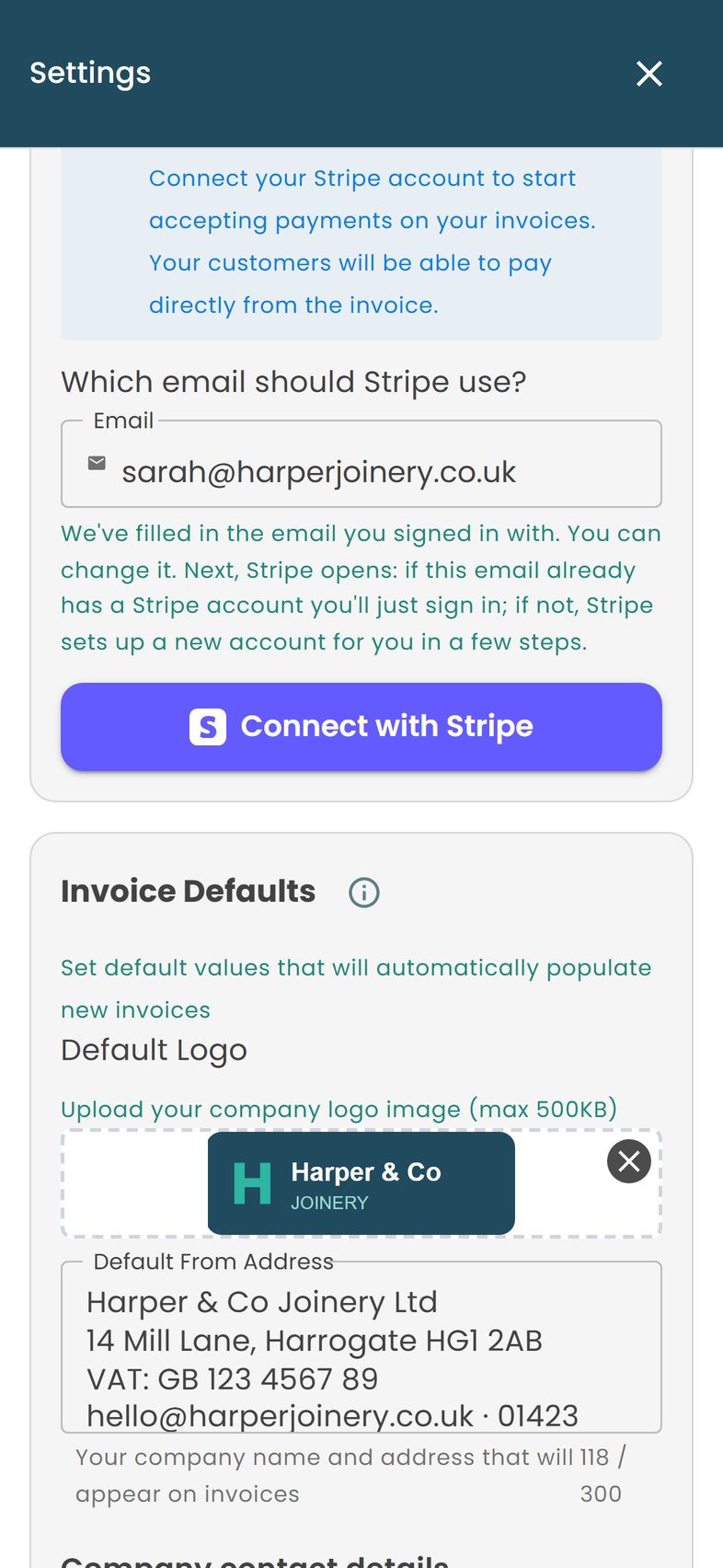
Put your bank details on the invoice, obviously. Better, put a card payment link on it. In SendInvoice, every invoice email and PDF carries a Pay button; the customer taps it, pays by card through Stripe, and the invoice marks itself Paid. For a customer like Mrs Hale you can send it from your phone in her kitchen and watch it turn green before you are back in the van. Bank transfers you mark paid by hand when they land. Getting paid on the day compares the options, and invoicing from your phone shows the whole flow from the van.
The records that keep you out of trouble
From the first job, keep everything: every quote and invoice you issue, every receipt for materials, fuel, tools, phone and insurance, your bank statements, and a mileage log if you claim for the van. Keep them for at least five to six years. Making Tax Digital for Income Tax is arriving in stages: from April 2026 for self-employed income over £50,000, April 2027 over £30,000 and April 2028 over £20,000, at the time of writing. You may be under the line in year one, but the habit of keeping digital records is the thing to start now, not in the week before the deadline. Receipts for cash jobs and HMRC records deals with the cash side, which is legal, as long as it is declared.
Do this in SendInvoice
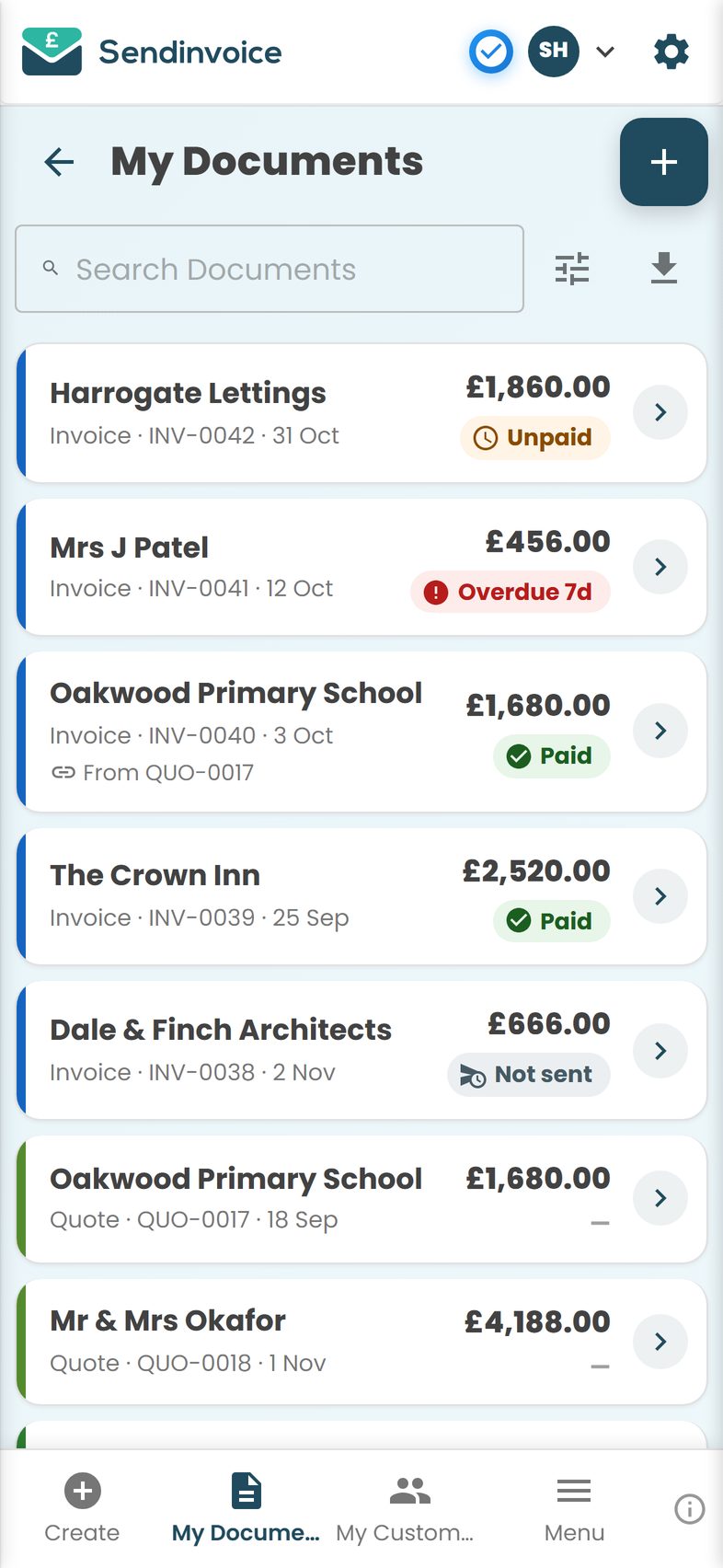
Set up your trading name, address and bank details once, send INV-0001 from your phone before you leave the job, and keep every quote and invoice in one list ready for your first tax return. Free to create and preview; £5 a month to send, remind and get paid by card.
Create a free invoice See the £5/month planFrequently asked questions
Do I need a UTR before I send my first invoice?
No. You can trade, quote and invoice from day one; the UTR is for your tax return and, if you do construction work for contractors, for CIS. Register for Self Assessment as soon as you start so the UTR arrives in good time, and add it to your invoices once you have it. Only put it on invoices to contractors, not to homeowners.
Do I have to register for CIS?
Only if you will do construction work for contractors, including builders, developers and some letting agents and housing associations. Without CIS registration they must deduct 30% from your labour instead of 20%. Work for private homeowners is outside CIS entirely. If in doubt, register; it costs nothing and the deductions come back through Self Assessment.
Do I need a business bank account as a sole trader?
There is no legal requirement, but a separate account for the business makes bookkeeping, tax and Making Tax Digital far simpler, and it looks more professional on an invoice. Many banks offer free or low-cost accounts for sole traders. Set aside a slice of every payment for tax in a separate pot from day one.
Should I charge VAT on my first invoices?
Not unless you are VAT registered. At the time of writing registration becomes compulsory when your taxable turnover passes £90,000 in a rolling 12 months, which few first-year sole traders reach. Until then your invoices show no VAT at all, and you should not add it. Check with your accountant or HMRC if you are near the threshold.
How do I work out my day rate?
Start from what you need to take home, add the costs an employer used to cover (van, fuel, insurance, tools, phone, training, holidays, sick days, pension, the tax you will owe), then divide by the days you will realistically bill, which is fewer than you think. Compare the result with local rates. Most people who get this wrong price too low, not too high.
What records do I need to keep?
Every quote, invoice and receipt you issue, every receipt for materials, fuel, tools and insurance, your bank statements and a mileage log. Keep them at least five to six years. Making Tax Digital for Income Tax applies from April 2026 for income over £50,000, April 2027 over £30,000 and April 2028 over £20,000, so get into digital habits early.