
Most one-person businesses in the UK are not VAT registered, and that is fine. But the invoice templates floating around the internet mostly assume you are, which is how a cleaner in Leeds ends up with a "VAT 20%" line on an invoice for £85 and a very confused customer. Here is exactly how a non-VAT invoice should read, what to leave off, and what to do when someone asks for a VAT invoice you cannot give them.
The threshold, and why most people are under it
You must register for VAT when your VAT-taxable turnover goes over £90,000 in any rolling 12 months, or when you expect it to in the next 30 days alone. That figure is correct at the time of writing; it moves occasionally, so check gov.uk if you are getting close.
Two things trip people up. First, it is rolling, not per tax year: at the end of every month, look back 12 months. Second, it is turnover, not profit. A plumber who bills £95,000 and spends £40,000 on parts is over the line even though they took home far less.
For many sole traders this is a bridge they will not cross for years, if ever. A cleaner on £25 an hour, a tutor, a gardener with a small round: all comfortably under. So for now, VAT is simply not part of your invoice, and the rest of this post is about doing "not part of" properly.
What changes when you register
Once registered, you become an unpaid tax collector: you add VAT (usually 20%) to your prices, hand it to HMRC each quarter, and reclaim the VAT you paid on business purchases. Every invoice you issue must then be a proper VAT invoice showing your VAT number, the rate and amount of VAT per line, the net total, the VAT total and the gross total, and the tax point.
Until that day, none of those things belong on your invoice. Not a VAT number (you do not have one). Not a VAT rate. Not a VAT amount, not even "£0.00". Not "VAT 0%", which means something specific and different. Not "plus VAT". Your price is your price.
Exactly how a non-VAT invoice should read
A non-VAT invoice carries everything a UK invoice must have, and nothing about VAT. That means:
- The word Invoice and a unique, sequential number (INV-0001, INV-0002…).
- Your name, trading name if you use one, and address, with email and phone.
- The customer's name and address.
- The invoice date.
- A clear description of what you supplied, with quantity and price per line.
- The total due. One number. Not "net" and "gross", because there is no difference.
- Payment terms: due date, bank details, card link.
And, optionally, one quiet line near the bottom:
Not VAT registered.
That sentence is not required, but it saves emails. Business customers see it and stop looking for a VAT number; their bookkeeper codes it correctly first time. "No VAT has been charged on this invoice" works too. What you must not do is dress it up as a VAT line.
Example: Bright Mornings Cleaning invoices a letting agent
| Invoice | INV-0117 |
|---|---|
| Date | 3 November 2026 |
| From | Amira Khan trading as Bright Mornings Cleaning 5 Mill Lane, Leeds, LS6 2PQ · [email protected] |
| Bill to | Headingley Lets Ltd, FAO Tom Reid 31 Otley Road, Leeds, LS6 3AA |
| Description | Qty | Price | Amount |
|---|---|---|---|
| End-of-tenancy clean, Flat 2, 31 Otley Road (3 hours) | 3 | £25.00 | £75.00 |
| Oven deep clean | 1 | £45.00 | £45.00 |
| Total due | £120.00 | ||
Terms: Payment due within 14 days. Bank transfer to A Khan, sort code 04-00-04, account 12345678, reference INV-0117, or pay by card via the link in this email. Not VAT registered.
One total. The letting agent's bookkeeper reads "Not VAT registered", enters £120 as a cost with no input VAT, and moves on.
When a customer asks for a VAT invoice
This happens, usually from a company whose accounts software has a mandatory "VAT number" box. It can feel like being caught out. You have not been. Here is what is going on and what to say.
A VAT-registered customer wants a VAT invoice because they can reclaim the VAT on it. But you have not charged any VAT. There is nothing to reclaim. Your ordinary invoice is the correct document for a purchase from an unregistered supplier, and their bookkeeper records it as a cost with no input VAT.
A reply that works:
Hi Tom, thanks for this. Bright Mornings isn't VAT registered, so no VAT has been charged on INV-0117 and there's nothing to reclaim; the £120 is the full amount. I've added a line to the invoice saying "Not VAT registered" so it's clear for your records. Let me know if your accounts team needs anything else.
Occasionally a larger business will say they only deal with VAT-registered suppliers. That is a preference, not a rule, and one reason some people register early (next section). Do not, under any circumstances, add a VAT line to keep them happy. Charging VAT when you are not registered is an offence.
When registering voluntarily can make sense
You can register below the threshold if you want to. For a few businesses it is worth it; for most sole traders selling to the public it is not. The arithmetic goes roughly like this.
It can make sense when:
- Most of your customers are VAT-registered businesses. They reclaim the VAT you add, so your price to them does not really go up, and you get to reclaim VAT on your own purchases. A freelance designer working for agencies, or a subcontractor working for a bigger building firm, often falls here.
- You buy a lot of VATable materials or kit. A joiner spending £30,000 a year on timber and tools is paying £5,000 of VAT they cannot reclaim while unregistered.
- You are heading over the threshold anyway and would rather do it on a quiet month than mid-chaos.
It rarely makes sense when:
- Your customers are households. They cannot reclaim VAT, so registering means either putting your prices up 20% or absorbing it. A cleaner, gardener, tutor or wedding photographer serving the public is usually better off staying unregistered until they have to.
- You buy very little. Nothing to reclaim, all the admin of quarterly returns.
This is genuinely a case-by-case decision, and the Flat Rate Scheme and other wrinkles can change the sums. Check with your accountant or HMRC before registering, and do the arithmetic on your real numbers rather than a hunch.
The gap between applying and getting your number
If you do register, there is usually a wait for your VAT number, and you may owe VAT on sales from your effective date before it arrives. You cannot issue VAT invoices without a number, so the usual approach is to price to include the VAT, note that a VAT invoice will follow, and reissue once the number is in. HMRC publishes guidance on this; follow it rather than improvising.
Non-VAT invoice vs VAT invoice, side by side
The same £120 cleaning job, invoiced by an unregistered business and by a registered one.
| Item | Not VAT registered | VAT registered |
|---|---|---|
| Heading | Invoice | Invoice (or VAT invoice / tax invoice) |
| Invoice number | INV-0117 | INV-0117 |
| Your details | Name, trading name, address | Name, trading name, address, VAT number |
| Customer details | Name and address | Name and address |
| Date | Invoice date | Invoice date and tax point if different |
| Line: clean, 3 hours | £75.00 | £75.00 net, VAT 20% £15.00 |
| Line: oven clean | £45.00 | £45.00 net, VAT 20% £9.00 |
| Totals | Total due £120.00 | Net £120.00 VAT £24.00 Total due £144.00 |
| VAT note | "Not VAT registered" (optional) | Rate and amount shown per line and in totals |
| Customer can reclaim | Nothing (nothing was charged) | £24.00 if they are registered |
| Payment terms, bank details, card link | Yes | Yes |
The left column is shorter, and that is the point. The only decision you are making as an unregistered business is to leave the right-hand column's extras off, cleanly and completely.
The same rule for your other documents
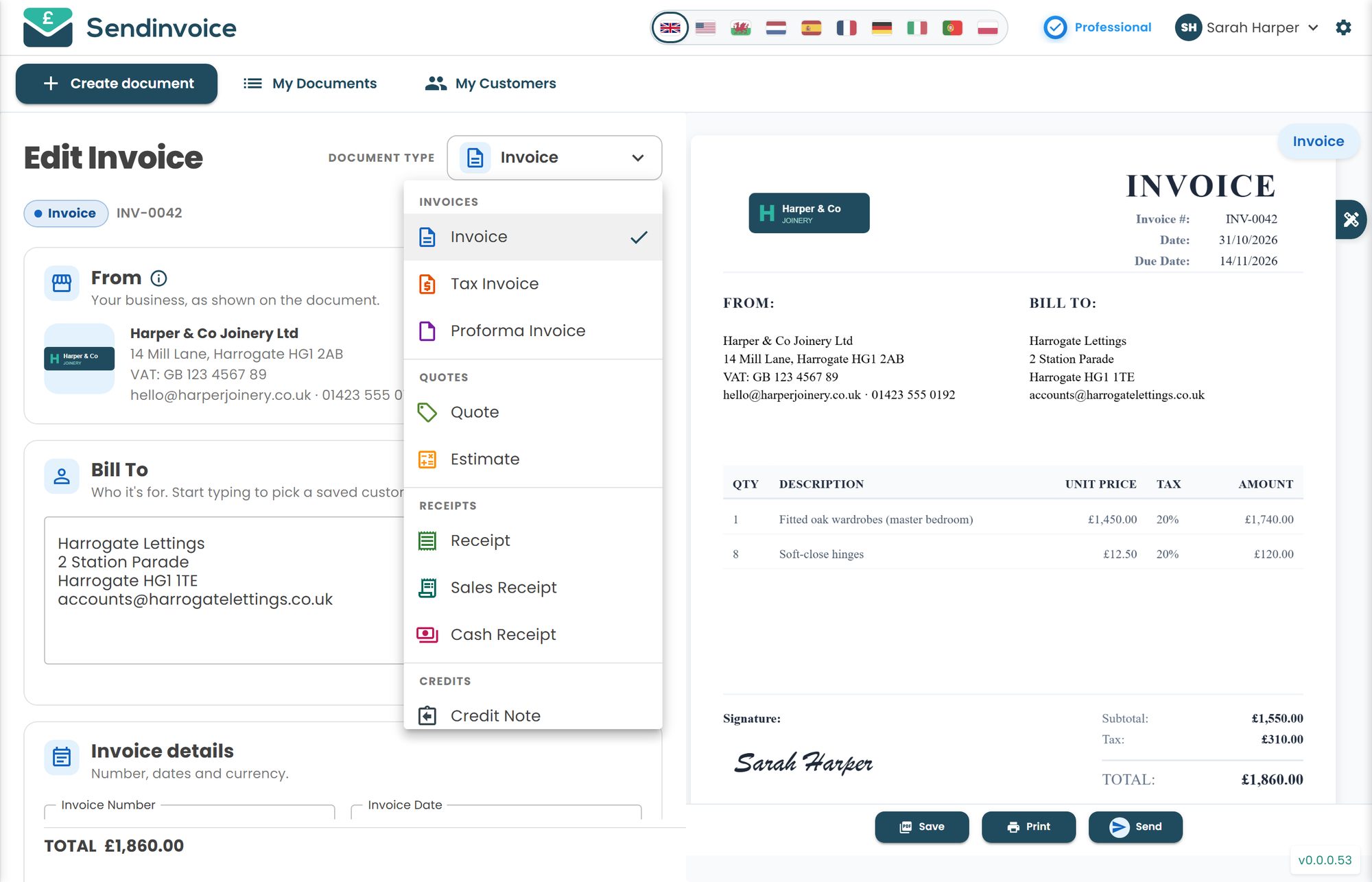
Everything above applies to every document you send, not only invoices. A quote from an unregistered business quotes one price, with no "plus VAT". A receipt shows the amount paid, full stop. A credit note credits the amount, with no VAT element to reverse. Consistency matters: if your quote said £120 and your invoice says £120, nobody has to ask what happened in between.
Keep everything you send for at least 5 to 6 years; digital is fine. A list of every invoice with a running total is also the thing that warns you about the threshold in time, rather than three months too late.
Do this in SendInvoice
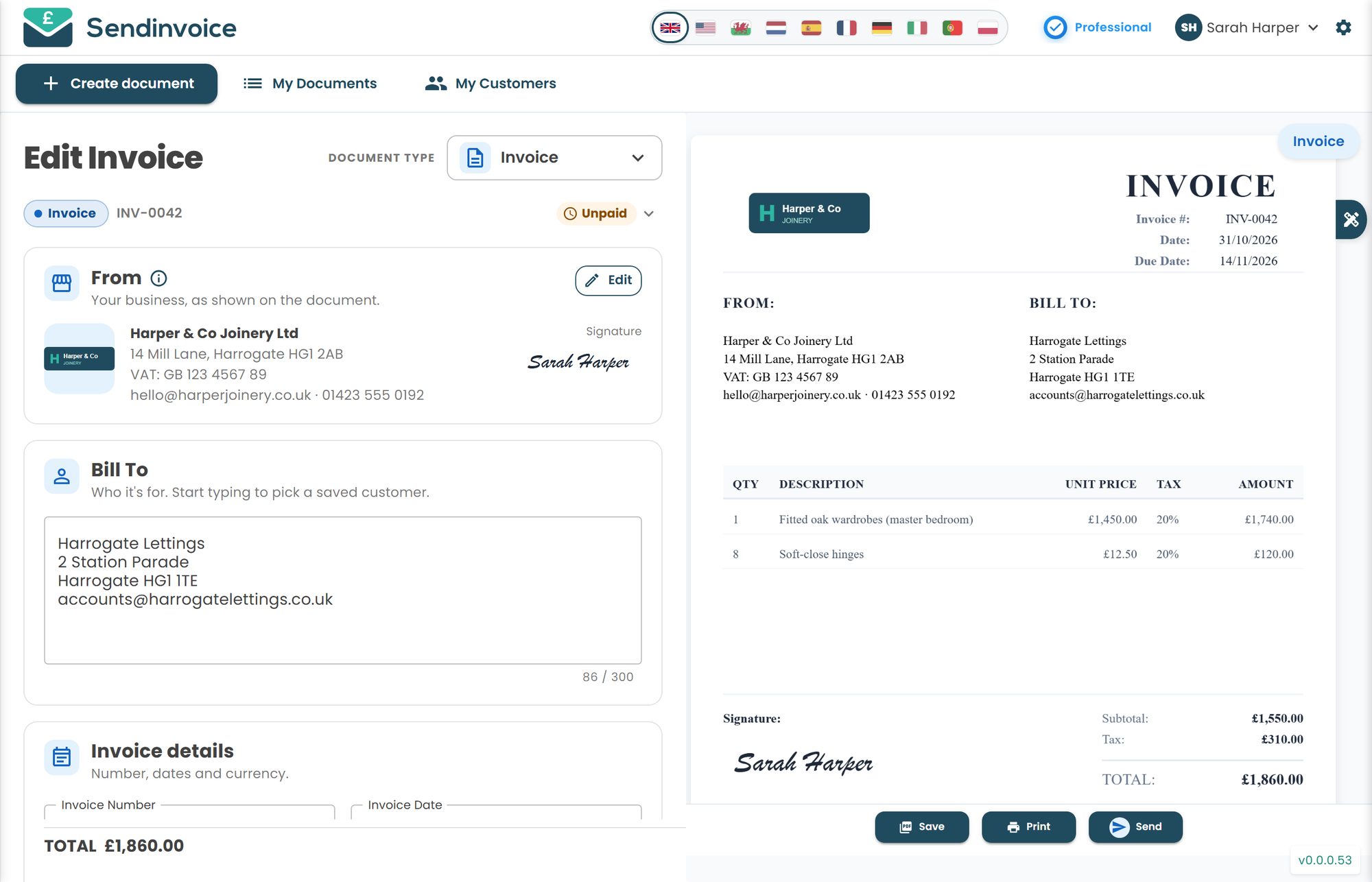
Leave tax at zero and your invoice shows a single clean total with no VAT line; add "Not VAT registered" to your default terms once and it appears on every document. When you do register, switch to a Tax invoice and the VAT fields are already there.
Create a free invoice See the £5/month planFrequently asked questions
Can I send an invoice if I am not VAT registered?
Yes. Any business can invoice. VAT registration only changes what extra information the invoice must carry. If you are not registered, you simply leave VAT off.
Do I write "VAT 0%" on my invoice if I am not registered?
No. "VAT 0%" means zero-rated VAT, which is a specific thing only registered businesses deal with. Leave the VAT column and VAT line off entirely. If you want to say something, write "Not VAT registered".
Should I put my VAT number on the invoice if I am not registered?
You do not have one, so no. Never put a made-up or pending number on an invoice. If you have applied for registration and are waiting, see the section on registering for what to do in the gap.
What is the VAT registration threshold?
£90,000 of VAT-taxable turnover in any rolling 12-month period, at the time of writing. It is a rolling check, not a tax-year one, so look back over the last 12 months at the end of every month once you get anywhere near it.
A customer says they need a VAT invoice. What do I send?
Explain that you are not VAT registered, so no VAT has been charged and there is nothing for them to reclaim. Your ordinary invoice is the correct document. Most accounts departments are satisfied once they understand there is no VAT in the price.
Can I register for VAT voluntarily below the threshold?
Yes. It can make sense if most of your customers are VAT-registered businesses (they reclaim the VAT so your price is unchanged to them) and you buy a lot of VATable materials you could reclaim. It rarely makes sense if your customers are the public. Check with your accountant.
What happens to my invoices when I do register?
From your effective date of registration every invoice must be a VAT invoice: VAT number, VAT rate and amount per line, net total, VAT total and gross total. Your numbering carries on; only the content changes. Invoices issued before that date stay as they were.
Does the £90,000 threshold include VAT?
There is no VAT in your sales to include, since you are not charging it. The threshold is measured on your VAT-taxable turnover, essentially everything you sell that would be standard, reduced or zero rated if you were registered. Exempt sales do not count.