The invoice number is the least glamorous thing on the page, and the thing HMRC, your accountant and your customer's accounts team all care about most. Get it right once and you never think about it again. Get it wrong and you spend a Sunday evening in January explaining why there is no INV-0031. Here is how to number invoices properly, what the rules actually say, and the small decisions worth making now.
What HMRC actually requires
Every UK invoice needs a unique identifying number. That is the whole legal requirement for a non-VAT business: unique. For VAT invoices, HMRC's guidance asks for a number that is "unique and sequential", meaning it follows on from the previous one and no number is used twice. In practice everyone, VAT registered or not, is well advised to follow the sequential rule, for one simple reason: it lets anyone looking at your records see that nothing is missing.
What the rules do not say is just as useful:
- They do not say you must start at 1.
- They do not say a specific format. Letters, numbers, dashes, prefixes, years: all fine.
- They do not say the number has to be purely numeric or a particular length.
- They do not require one single sequence across every kind of document you issue; separate sequences per document type are normal and sensible.
So the test for any numbering scheme is: can I prove every invoice is accounted for, and can I never issue two with the same number? Pass that and you are compliant. The rest is about convenience.
The common formats, compared
Four families of format cover almost every small business. Here they are with the trade-offs.
| Format | Example | Pros | Cons |
|---|---|---|---|
| Simple sequential | INV-0001, INV-0002 | Obvious, impossible to get wrong, easy to sort and search | Reveals how many invoices you have issued (start higher if that bothers you) |
| Year-prefixed | 2026-0001, INV-26-0042 | Easy to find a tax year's invoices; resets neatly each year | Must remember to reset in April or January; which year matters (tax or calendar) |
| Per-customer | ACME-001, SMITH-004 | Customer sees their own tidy run; handy for retainer clients | Not a single sequence, so harder to prove completeness; messy with many customers |
| Date-time stamp | 20261103-1432 | Unique by construction; no counter to maintain | Long, hard to read aloud, and meaningless to the customer |
For a sole trader or micro-business, the simple sequential format with a short prefix wins nearly every time. "INV-0042" is clear on a phone screen, in a bank reference field and over the phone. Year-prefixing is worth it if you issue a few hundred invoices a year and want to find "all of 2025" at a glance. Per-customer numbering is a nice touch for agencies with a handful of retainer clients, but keep a master sequence behind it so your overall records are still complete.
Whichever you pick, pad the number with leading zeros (0042, not 42). Spreadsheets, file lists and export reports sort "INV-9" after "INV-10" if you do not.
Gaps, mistakes and cancelled numbers
This is the part that causes the Sunday-evening panic, so it is worth being clear. A gap in your invoice numbers is not illegal, but it is a question waiting to be asked. The answer HMRC and your accountant want to hear is not "I deleted it".
The rule is simple: once a number has been used, it stays used. You never reuse a number and you never delete an issued invoice. Instead:
- Invoice sent with a mistake (wrong price, wrong VAT, wrong customer). Do not edit and resend under the same number. Issue a credit note for the full amount against the original, then raise a new invoice with the next number. The customer's records and yours now tell the same story: INV-0031 issued, CN-0004 cancels it, INV-0032 replaces it.
- Invoice created and never sent. If you spotted the error before it left the building, it is usually fine to mark it void and keep it, with a one-line note. It still occupies its number. Some accountants prefer a credit note even here, so ask yours.
- Partial correction. Overcharged by £50 on an otherwise correct invoice? A credit note for £50 against that invoice number is cleaner than cancelling the lot.
- A genuine gap you cannot explain. Write a note in your records saying the number was skipped in error and why. That is enough for most purposes; the sin is silence, not the gap.
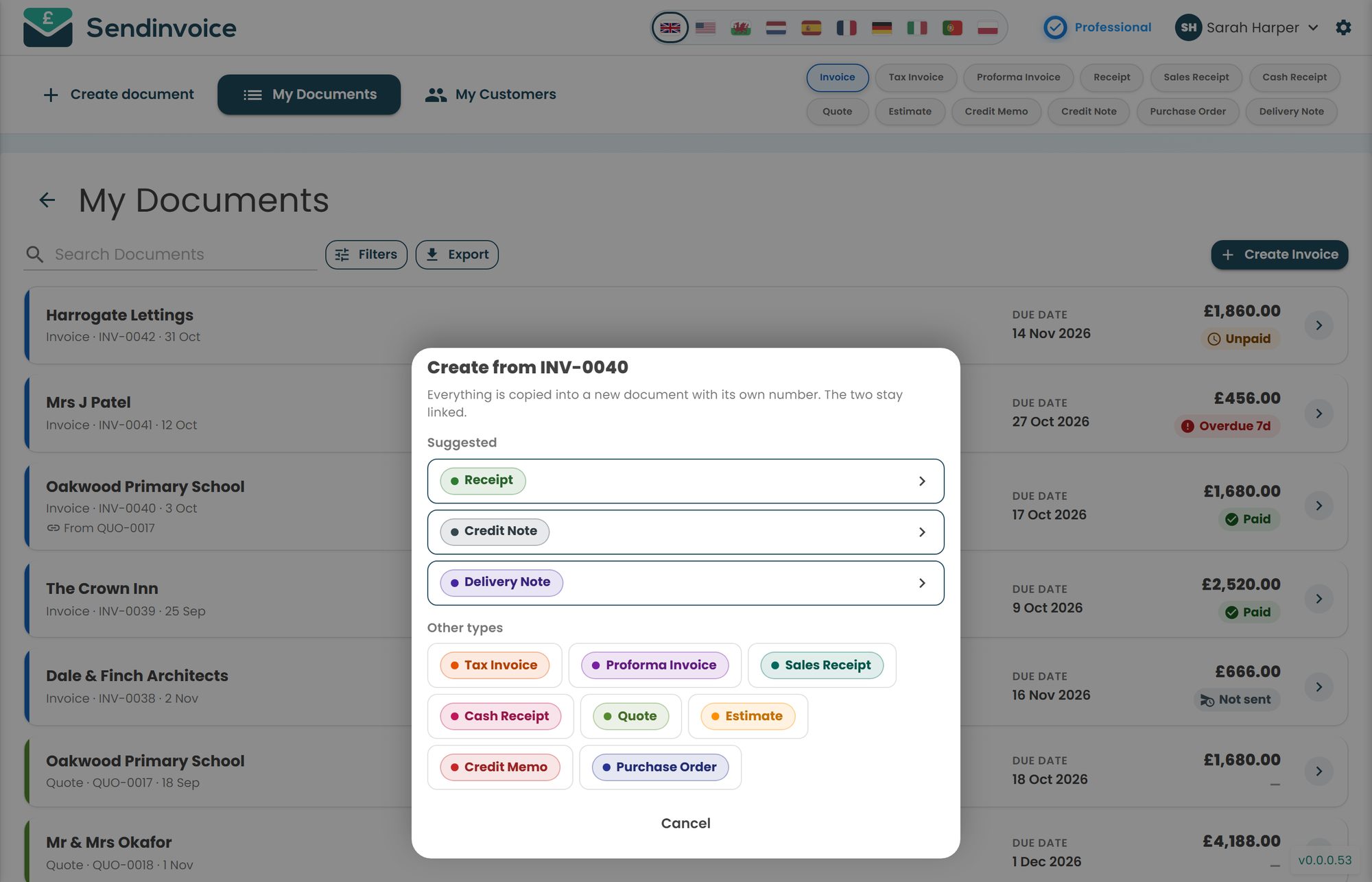
Software makes most of this automatic. In SendInvoice the next number is assigned when the document is created and you cannot issue two with the same number by accident, and creating a credit note from an invoice carries the details across and links the two, so the trail builds itself.
Separate sequences per document type
A quote is not an invoice. A receipt is not an invoice. If you number all of them from one pot, your invoice sequence ends up full of holes that are actually quotes the customer never accepted, and you are back to explaining gaps. The tidy answer is one sequence per document type, each with its own prefix:
- QUO- for quotes and estimates
- INV- for invoices, including tax invoices
- PRO- for proforma invoices (deposits)
- REC- for receipts
- CN- for credit notes
- PO- and DN- for purchase orders and delivery notes, if you use them
The prefixes are a convention, not a rule. What matters is that each type counts up on its own, so the invoice sequence contains only invoices, and the credit note sequence only credit notes.
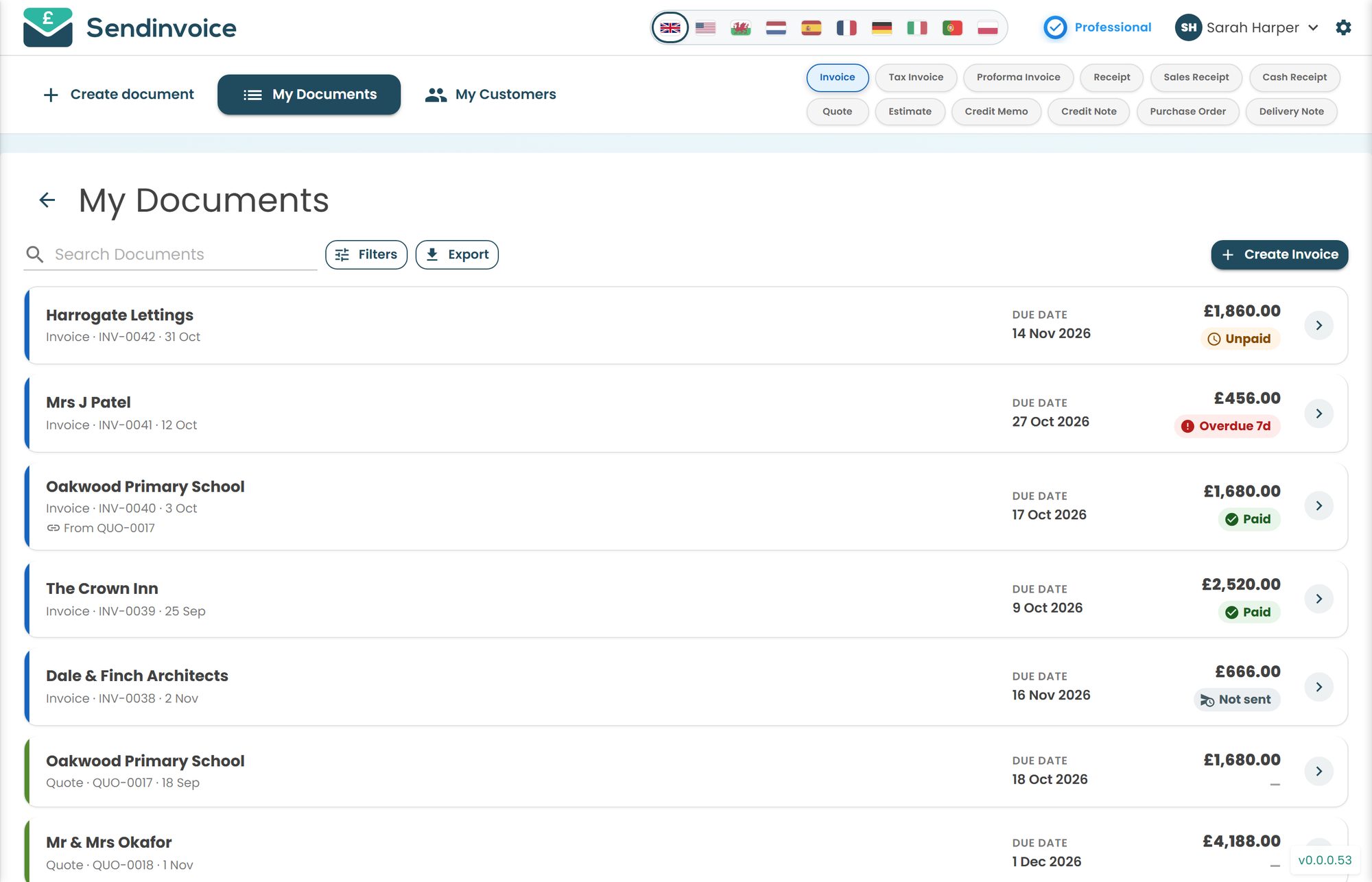
This is also what makes "create one document from another" work properly. When you turn quote QUO-0017 into an invoice, the invoice gets the next number in the invoice sequence (say INV-0042), not QUO-0017 again. The two stay linked, so the invoice shows "From QUO-0017", the customer can match them up, and your quote sequence and invoice sequence both stay complete.
A worked example: one job, four documents
Marcus is a carpenter fitting a set of built-in wardrobes for a customer called Jenna. Here is the paper trail, in order, with the numbers each document takes.
| Step | Document | Number | Linked to |
|---|---|---|---|
| Jenna asks for a price | Quote, £2,400 | QUO-0017 | - |
| Jenna accepts; Marcus asks for 40% up front | Proforma invoice, £960 | PRO-0005 | From QUO-0017 |
| Wardrobes fitted | Invoice, £2,400 less £960 paid | INV-0042 | From QUO-0017 |
| Jenna pays by card | Receipt, £1,440 | REC-0019 | From INV-0042 |
If Marcus had charged an extra £80 for a shelf he never fitted, the fix would be CN-0004 for £80 against INV-0042, not an edited INV-0042. Four sequences, no gaps, every document explains the next one.
Four small decisions worth making now
- Prefix. INV- is universal; some people use their initials (MJC-0042). Keep it under four letters.
- Starting number. 0001 if you do not mind customers seeing it; 1001 if you would rather not. Never change it later.
- Reset or not. If you choose a year prefix, decide now whether it resets on 1 January or 6 April, and stick to it. If you do not, your numbers simply keep climbing, which is the easiest option of all.
- Where the counter lives. Not in your head and not in a spreadsheet you might open on two devices. Pick a system that assigns the next number for you, per document type, and keeps the old ones.
In SendInvoice, running numbers per document type (INV-0001, INV-0002… for invoices; QUO-, REC- and so on for the rest) are the default, with date-based numbers as an alternative if you prefer them. The prefix and starting number are set once in Settings, every new document takes the next number automatically, and My Documents lets you search by number when a customer rings up quoting one.
Keeping the records
Numbering is only half the job; the other half is keeping the numbered set. HMRC expects self-employed records to be kept for at least 5 years after the 31 January submission deadline for the tax year, and VAT records for 6 years, so plan on "at least 5 to 6 years". A complete, sequential run of invoices, with credit notes against anything cancelled, is exactly what an inspector hopes to see and what makes the job quick. If you are unsure how any of this applies to you, check with your accountant or HMRC.
Export from My Documents to Excel or CSV at year end, filter by period and type, and the list of numbers is your audit trail, done.
Do this in SendInvoice
Set your invoice prefix and starting number once, and every invoice, quote, receipt and credit note takes the next number in its own sequence automatically, with linked documents showing where they came from. Free to create and preview; £5 a month to send and get paid.
Create a free invoice See the £5/month planFrequently asked questions
Does HMRC require invoice numbers?
Yes. Every invoice must have a unique identifying number, and for VAT invoices HMRC asks for a number that is unique and sequential. Even if you are not VAT registered, a unique sequential number is the simplest way to keep your records straight.
What number should my first invoice be?
Anything you like, as long as you count up from there. INV-0001 is the honest choice. Some people start at 1001 so the business does not look brand new; that is allowed, just be consistent afterwards.
Can I have gaps in my invoice numbers?
You should avoid them. A gap looks like a missing or deleted invoice to an auditor. If a number is used by mistake, cancel it with a credit note or keep a short note explaining the gap rather than deleting the record.
Can I delete a cancelled invoice?
No. Once an invoice has been issued, keep it. Cancel it with a credit note for the full amount and raise a new, correctly numbered invoice if needed. If it was never sent to anyone, a void record with a note is usually enough, but check with your accountant.
Should quotes and receipts share the invoice number sequence?
No. Give each document type its own prefix and sequence, such as QUO-, INV-, REC- and CN-. Quotes are not sales, so they should not consume invoice numbers, and a linked quote and invoice having different numbers is normal.
Can I use the date as my invoice number?
Yes, as long as the result is unique. A date-time stamp like 20261103-1432 is unique by construction, but a plain date is not if you issue two invoices in one day. Add a sequence or the time to be safe.
How long do I need to keep numbered invoices?
Keep invoices for at least 5 to 6 years: self-employed records for at least 5 years after the 31 January submission deadline of the relevant tax year, and VAT records for 6 years. Your numbering is what lets you prove the set is complete.