Ellie is a joiner. A customer in Bishopston texts her a photo of a chimney breast with two empty alcoves: "Could you do cupboards and shelves either side? Rough price?" The last time Ellie answered that question with a number, the number became the price, the job grew two drawers and a bookcase, and the final invoice turned into a fortnight of awkward messages. This time she measures up, goes home, and writes a proper quote: £2,850 including VAT, four pages of what is in, what is out, and how she gets paid. The customer accepts it the same evening. The difference is not the price. It is the piece of paper.
Quote or estimate: decide before you write a word
A quote is a fixed price for a defined piece of work. Once accepted, that is the price, unless the customer changes the scope. An estimate is an informed guess that can move. Both are legitimate; the mistake is writing "quote" on something you have not pinned down, or "estimate" on something the customer hears as a promise. For fitted furniture, a bathroom, a rewire or a roof where you can see what is involved, a quote wins more work because the customer knows what they are committing to. For opening up a floor you have not seen under, an estimate with a clear range is more honest. Quote versus estimate versus invoice has the detail; this post assumes you are writing a quote.
The corollary: do not give a "rough price" by text. A rough price becomes the price in the customer's head, and every pound above it feels like a betrayal. Say "I'll measure up and send you a proper quote by Thursday", then do.
What a good trade quote contains
A quote has two jobs. It has to make the customer confident enough to say yes, and it has to be clear enough that nobody can argue about what yes meant. Both come from the same thing: specifics. From the top:
- Your details and theirs. Your name or trading name, address and phone; the customer's name; the site address if different. A quote number (QUO-0017), the date and the validity date.
- A one-line summary. "Fitted alcove cupboards and shelving, both sides of chimney breast, living room, 14 Egerton Road."
- The scope, item by item. Each piece of work in plain English, with the spec: materials, sizes, finish, what happens to the old stuff. "Two base cupboards, 1,050mm wide, 450mm deep, 900mm high, 18mm MR MDF, shaker doors, soft-close hinges, finished in primer ready for decorating" leaves nothing to guess.
- Inclusions. Delivery of materials, fixing, scribing to walls, clearing up, disposal of offcuts.
- Exclusions. The list that saves friendships. Decorating. Electrics (the customer wanted a socket in the cupboard; that is a separate electrician). Removing the existing shelves. Parking permits. Skip hire. Anything behind the plaster you cannot see yet.
- Assumptions. Clear access, power and water on site, walls reasonably plumb, someone to let you in at 8am.
- The price. Labour and materials, either per item or as two subtotals; VAT shown only if you are registered, and say so either way. Labour and materials on an invoice explains the split.
- Deposit and payment terms. How much up front, when the balance is due, how to pay.
- Timescale. Lead time for materials, how many days on site, and that the start date is confirmed on receipt of the deposit.
- Variations. One sentence: changes to the scope are agreed and priced in writing before the work is done.
- Guarantee. What you stand behind and for how long.
- How to accept. "Reply to this email with 'accepted' or sign and return." Then it is a contract.
The 14-day cooling-off period, in one paragraph
If you agree the contract with a consumer in their home, or anywhere other than your own premises, and it is worth more than £42, the Consumer Contracts Regulations 2013 give them a 14-day right to cancel. That covers most trade quotes accepted at the kitchen table. The practical point: if the customer wants you to start inside those 14 days, ask them to request that in writing (a reply to the quote email is fine). Then, if they cancel after you have started, you can charge for the work done up to that point. Most customers never cancel; the sentence on the quote is for the one who does. Keep the wording plain and do not overstate it; terms and conditions for tradespeople has a simple version.
A worked example: Ellie's quote for the alcove units
Ellie's business is VAT registered, so VAT is shown at 20% on the whole supply, labour and materials alike. Here is the quote she sent.
Quote QUO-0017 from Ellie Marsh Joinery Ltd, Unit 3, Fishponds Trading Estate, Bristol BS16 3JA. VAT no. GB 987 6543 21
For: Mr and Mrs Okonkwo, 14 Egerton Road, Bristol BS7 8HJ
Date: 4 November 2026. Valid until: 4 December 2026
Work: Fitted alcove cupboards and shelving, both sides of living room chimney breast
| Description | Qty | Unit price | Amount |
|---|---|---|---|
| Two base cupboards, 1,050 x 450 x 900mm, 18mm MR MDF carcasses, shaker doors, soft-close hinges, adjustable shelf, scribed to walls, primed ready for decorating | 2 | £520.00 | £1,040.00 |
| Floating shelves above each cupboard, three per side, 1,050 x 250mm, 32mm MDF, concealed fixings, primed | 6 | £95.00 | £570.00 |
| Labour: site fitting, scribing, fixing, caulking and clean-up (materials above include workshop time) | 2.5 days | £280.00 | £700.00 |
| Delivery, fixings, adhesives and disposal of offcuts | 1 | £65.00 | £65.00 |
| Subtotal | £2,375.00 | ||
| VAT at 20% | £475.00 | ||
| Total | £2,850.00 | ||
Included: measuring, workshop manufacture, delivery, fitting, scribing to walls, primer finish, clearing up each day.
Not included: decorating or top-coat paint; removal of the existing shelving (allow £60 if required); electrical work (a socket inside the cupboard needs an electrician); plastering repairs; parking permits.
Assumed: walls reasonably plumb; clear access to the room; power available.
Payment: 40% deposit (£1,140.00) on acceptance, against a proforma invoice, to cover materials; balance (£1,710.00) on completion, within 7 days, by bank transfer or card.
Timescale: two weeks workshop lead time from deposit; 2 to 3 days on site; start date confirmed on receipt of deposit.
Changes: any changes to the above will be priced and agreed in writing before the work is done.
Guarantee: workmanship guaranteed for 12 months.
Cancellation: as this contract is agreed in your home, you have 14 days to cancel. If you would like work to begin within that period, please confirm in writing; work done up to any cancellation would be chargeable.
To accept: reply to this email with "accepted", or sign and return.
Four things to notice. The price is per item of work, so if the Okonkwos drop the shelves on one side, the arithmetic is on the page. The exclusions name the exact things that usually cause trouble on this kind of job. The deposit covers the materials, which is what Ellie has to buy before she earns a penny. And the VAT is shown on the whole supply, because her business is registered; if she were not, that line would not exist and she would say so. For some specific works, reduced or zero rates can apply; check HMRC's notices or your accountant before relying on them.
Pricing it without underselling yourself
The scope is the easy half. The number is where tradespeople lose money, usually by thinking of the price as a day rate times days and forgetting everything else.
- Materials: list them properly, price them from your supplier today, and add a modest margin for the time you spend sourcing, collecting and returning the wrong hinges. If you would rather not mark up, charge the sourcing time as labour. Either is fine; invisible is not.
- Labour: workshop time as well as site time. Ellie's cupboards take two days to make before anyone sees her van. Include measuring visits and the quote itself if the job is big.
- Sanity check: if the total divided by your days on and off site is below your day rate, something is missing. Day rate versus fixed price goes deeper on this.
Presenting it and following up
Send the quote as a PDF by email the same day or the next; a quote that arrives a week later is competing with the one that arrived the day after the visit. Keep the covering message short and human: "Thanks for having me round. Quote attached for the alcove units. Happy to talk through any of it." Then follow up once, about three days later, with a question rather than a nudge: "Did the quote make sense? Anything you would like changed?" That gives a hesitating customer an easy way back in and an easy way to ask about the price without feeling awkward.
From quote to deposit to invoice
The customer replies "accepted" and asks you to start as soon as the units are ready. Now the quote does its second job. Raise a proforma invoice for the deposit, £1,140, and start the workshop time when it lands; keep the money accessible, because if for any reason the job does not go ahead, the deposit is still owed back. When the fitting is finished and the customer has walked round, raise the final invoice for the balance, with the same lines and figures as the quote, less the deposit. Deposits and staged payments for tradespeople covers bigger jobs with several stages.
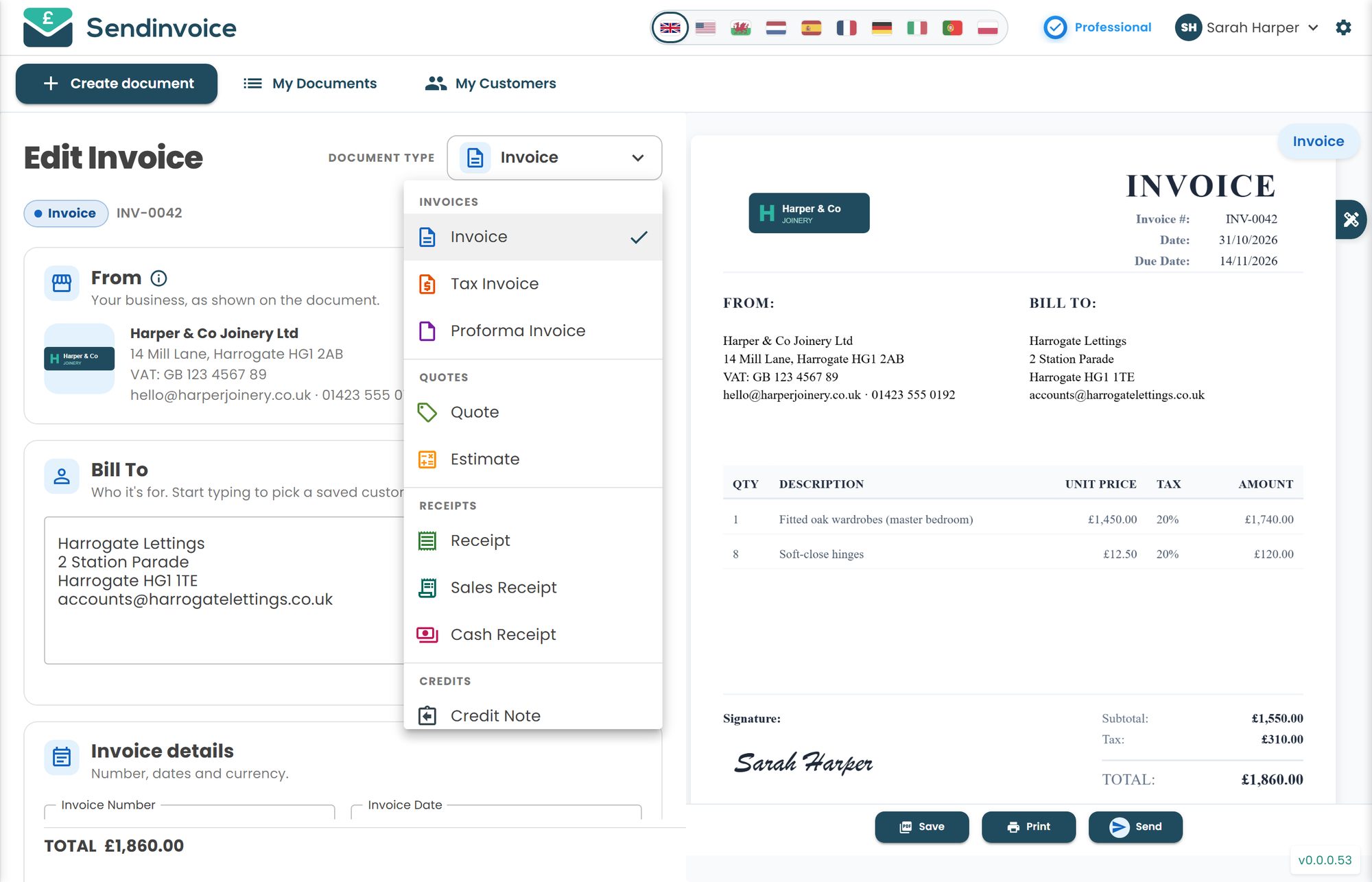
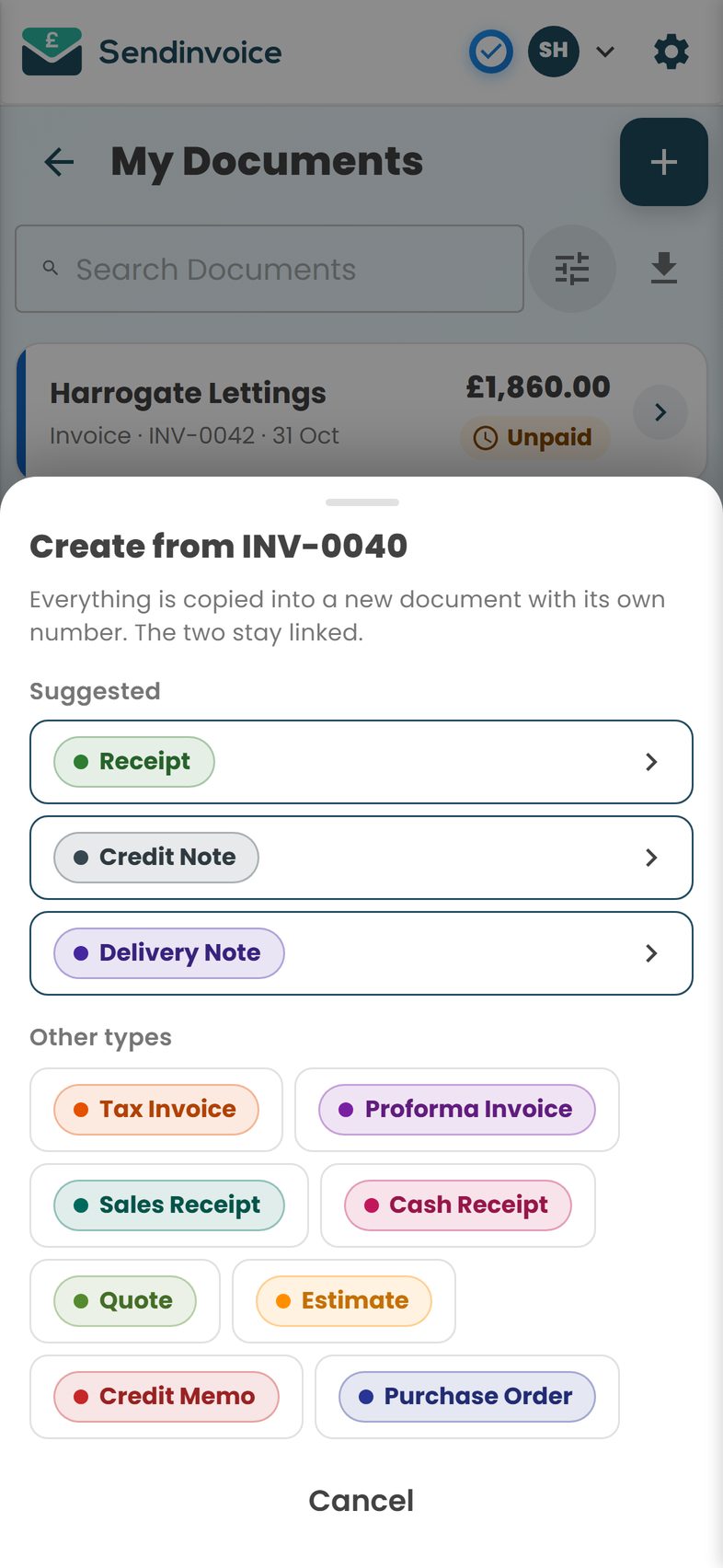
In SendInvoice this is one tap. Open the quote, choose Create from this, pick Invoice, and the lines, customer and figures carry over; it gets its own number and shows "From QUO-0017", so the customer can see that the price they agreed is the price they are being asked to pay. If something changed along the way, add it as a clearly labelled extra line with the date it was agreed, which is the subject of invoicing variations and extras.
Do this in SendInvoice
Write the quote on your phone after the site visit, send it as a PDF the same day, then create the proforma and the final invoice from it in one tap when it is accepted. Free to create and preview; £5 a month to send, remind and get paid by card.
Create a free invoice See the £5/month planFrequently asked questions
What is the difference between a quote and an estimate?
A quote is a fixed price for a defined scope of work; once the customer accepts it, that is the price unless the scope changes. An estimate is your best guess and can go up or down. Use the right word on the document. If you call something a quote, be ready to stand by the figure, so make sure the scope is pinned down first.
How long should a quote be valid for?
Thirty days is the common choice and suits most domestic work. It is long enough for the customer to decide and short enough to protect you against material price rises. Put the validity date on the quote itself. If a customer comes back after it has lapsed, issue a fresh quote rather than honouring an old price out of politeness.
Should I show labour and materials separately on a quote?
Usually yes, or at least show the total for each. Customers like to see what they are paying for, it makes variations easier to price later, and it matches how the invoice will look. If you prefer not to reveal your materials mark-up, show a single price per item of work rather than a bare lump sum for the whole job.
How much deposit can I ask for on a trade job?
There is no legal maximum for consumer work. Between 10% and 30%, or the cost of the materials, is common and reasonable. State it on the quote, take it against a proforma invoice, and keep the money accessible, because it is still owed back if you cannot do the job. Avoid asking for most of the money up front; it puts customers off.
Does the 14-day cooling-off period apply to my quotes?
If you agree the contract with a consumer in their home or away from your premises and it is worth more than £42, the Consumer Contracts Regulations 2013 give them a 14-day cancellation right. If they want you to start within those 14 days, get that request in writing. You can then charge for work done if they cancel. Keep the wording simple and factual.
How do I turn an accepted quote into an invoice?
Keep the same lines and figures, give it an invoice number and date, and add payment details. In SendInvoice you create the invoice from the quote in one tap; the details carry over, it gets a new number and shows "From QUO-0017", so the customer can see the price they agreed is the price they are being asked to pay.