
Jamal is a groundworker. For most of October he has been on a site in Walsall for Carver Construction, digging and shuttering footings for a row of six houses: twelve days of his labour at £200 a day, plus £650 of concrete, rebar and type 1 he bought himself. The invoice says £3,050. The money that lands is £2,570. The £480 difference is not a mistake and it is not lost; it is the Construction Industry Scheme doing exactly what it is meant to. Here is how to write the invoice so that the number on the bank statement is the one you expected.
What CIS is, in one breath
The Construction Industry Scheme is HMRC's way of collecting tax from construction subcontractors at source. When a contractor (a building firm, a developer, or any business that spends heavily on construction) pays a subcontractor for construction work, the contractor must deduct a slice of the payment and hand it to HMRC on the subcontractor's behalf. At the time of writing the rates are:
| Your CIS status | Deduction | Who this is |
|---|---|---|
| Registered subcontractor | 20% of the labour element | Most sole-trader subbies who have registered with HMRC |
| Not registered (or could not be verified) | 30% of the labour element | Anyone who has not registered, or whose details did not match HMRC's record |
| Gross payment status | 0% | Subcontractors who have applied for and been granted gross status (turnover and compliance tests apply) |
Two facts that matter for every invoice. First, the deduction applies to labour only. Materials you bought for the job are not deducted from, and neither is VAT if you charge it. Second, CIS only applies between a contractor and a subcontractor. If you dig a soakaway for Mrs Patel at number 12, she is a private homeowner, not a CIS contractor, and there is no deduction; you invoice her like any other customer.
The deductions are not a cost. They are tax paid in advance, and they come back at the end of the year (more on that below). But they do take money out of your account now, so you need to know they are coming.
What goes on a CIS invoice
A CIS invoice is a normal UK invoice with three additions. Start with the basics every invoice needs: a unique number, your name or business name and address, the contractor's name and address, the date, a description of the work and the amount. Then add:
- Labour and materials on separate lines. The contractor needs your labour figure to calculate the deduction, and you need it to check their statement. One line for "groundworks, 12 days" and one for "materials: concrete, rebar, type 1" is enough. If you have several labour lines (different rates, different weeks), that is fine; what matters is that materials are never mixed in with them.
- Your UTR (Unique Taxpayer Reference). The contractor uses it, with your name and National Insurance number, to verify you with HMRC and find out which rate to apply. Put it in your business details so it appears on every invoice to a contractor.
- The deduction and the amount payable. A line reading "Less CIS deduction, 20% of £2,400 labour" with the figure, and a clear "Amount payable" below it. The contractor is the one legally responsible for calculating and deducting, but showing it yourself means you both agree the number before the payment run.
Materials should be shown at what they actually cost you. Contractors are entitled to ask for evidence, and HMRC expects the materials figure to reflect the direct cost, so keep the merchant receipts with the invoice. If you have marked materials up, the mark-up is really labour, and the contractor may treat it that way. Ask your accountant how to handle it if your margins on materials are significant.
The worked example: Jamal's October invoice
Jamal is a registered subcontractor (20%) and is not VAT registered. Twelve days on site at £200 a day, plus materials he bought at the merchant with the contractor's agreement.
J. Hussain Groundworks · Jamal Hussain, sole trader · UTR 12345 67890 · Invoice INV-0071 · Date 31 October 2026 · Due 30 days
Bill to: Carver Construction Ltd, Unit 4, Bentley Business Park, Walsall · Site: Plots 1-6, Mill Lane, Walsall · Order no.: CC-2211
| Description | Qty | Unit price | Amount |
|---|---|---|---|
| Labour: groundworks to plots 1-6, excavation and shuttering of strip footings, 1-28 October | 12 days | £200.00 | £2,400.00 |
| Materials: ready-mix concrete, rebar and mesh, MOT type 1 (receipts attached) | 1 | £650.00 | £650.00 |
| Invoice total | £3,050.00 | ||
| Less CIS deduction, 20% of £2,400.00 labour | -£480.00 | ||
| Amount payable | £2,570.00 | ||
Notes: Not VAT registered. CIS deduction applies to labour only; materials shown at cost. Please provide a payment and deduction statement for this payment. Bank details below.
Follow the arithmetic once and it never confuses you again. The deduction is 20% of the labour (£2,400), which is £480. It is not 20% of the invoice total (that would be £610, and a contractor who deducts that is deducting from your materials, which they should not). The amount that should land in Jamal's account is £3,050 less £480: £2,570.
If Jamal had not registered, the same invoice would read "Less CIS deduction, 30% of £2,400.00 labour: -£720.00" and the amount payable would be £2,330. Same work, £240 less in the bank this month, all of it recoverable eventually, none of it worth lending to HMRC.
With gross payment status there is no deduction line at all and the amount payable is the full £3,050; Jamal would settle his tax through Self Assessment like any other sole trader.
How to show the deduction on the invoice
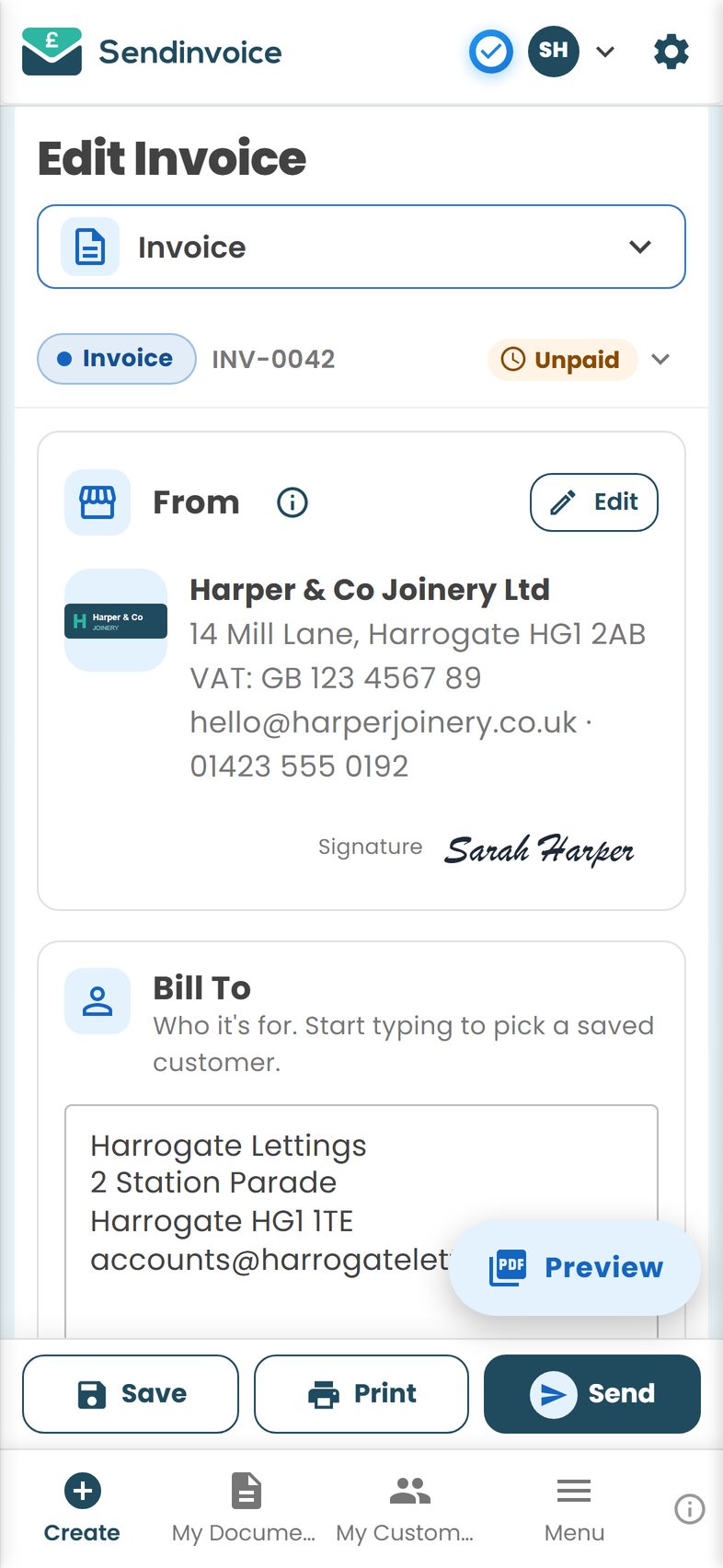
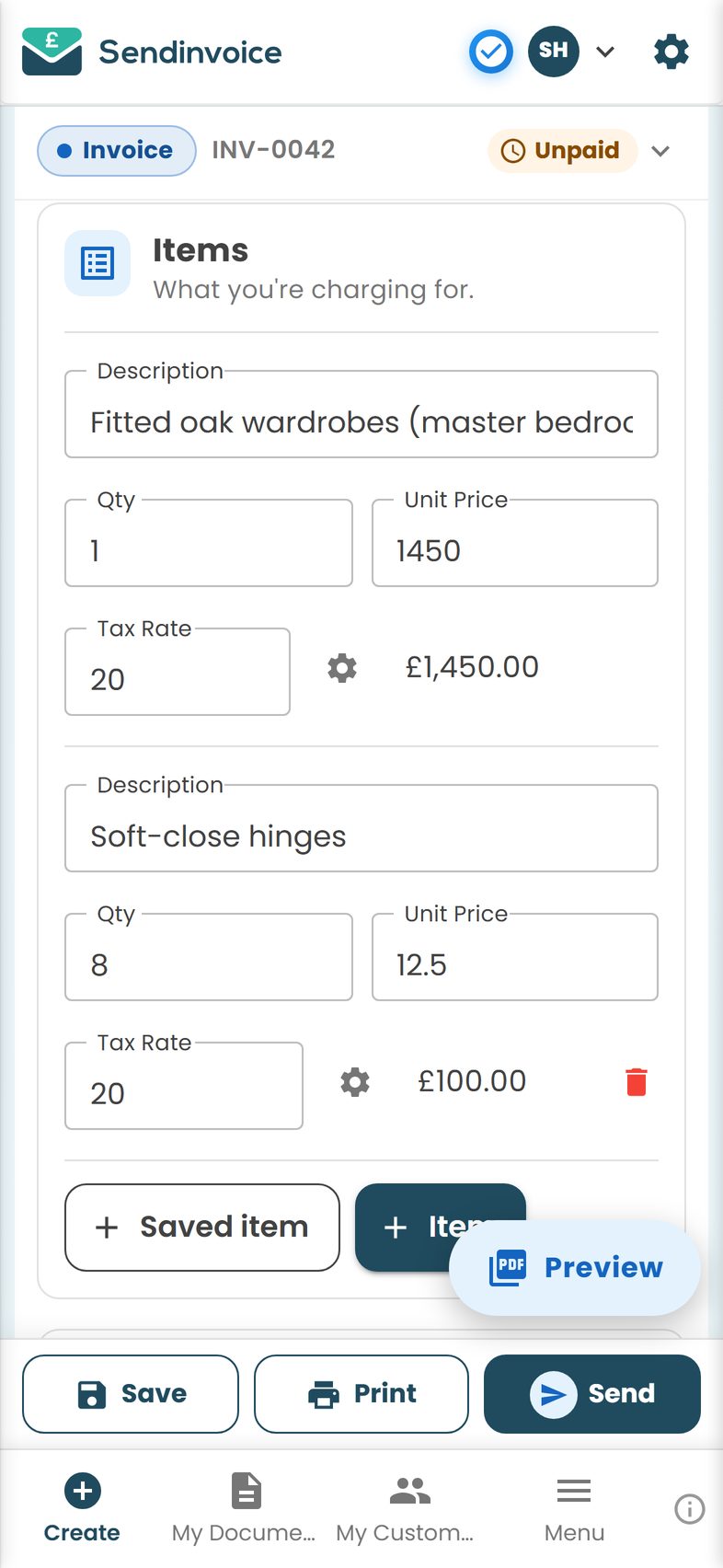
SendInvoice does not calculate CIS for you, and nor does it need to; the sum is one line of arithmetic and you want to see it. Add the labour and materials as ordinary lines, then add a line for the deduction with a negative amount ("Less CIS deduction, 20% of £2,400 labour", -£480.00), so the total at the bottom is the amount payable. If you would rather keep the gross total as the invoice total, put the deduction and the amount payable in the notes instead. Either way, the contractor sees the labour figure, the rate and the net amount, which is all they need to match it to their payment run.
Save "Labour: groundworks, day rate" and "Materials at cost" as saved items and the next month's invoice is a quantity change and a date. Your UTR lives in your saved business details so it is on every invoice without thinking about it.
How the deductions come back
This is the part new subbies worry about most, so here it is plainly. Every CIS deduction is tax paid in advance on your behalf. At the time of writing, the process for a sole trader is:
- The contractor sends you a payment and deduction statement for each payment (or each tax month), showing the gross amount, the materials, the labour and the deduction. They must give you this; if they do not, ask. Keep every one. Photograph it and store it with the invoice.
- At the year end you fill in your Self Assessment return, reporting your full income (the £3,050, not the £2,570) and, in the CIS box, the total deducted across the year.
- HMRC sets the deductions against the tax and Class 4 National Insurance you owe. If more was deducted than you owe (common in a first year, or any year with big expenses), the difference is refunded. If less, you pay the balance.
For Jamal, that means twelve months of 20% deductions on labour have very likely covered most or all of his tax bill before he fills in a single box. The refund, where there is one, is real money; subbies who lose their statements lose the evidence for it. Check your own position with your accountant or HMRC, especially if you trade through a limited company, where the rules differ.
Getting paid by a contractor
CIS tells you how much will be deducted. It says nothing about when you will be paid, and that is where subcontractors get hurt. A few protections:
- Agree the terms before you start, and put them on the invoice. 30 days is common; some contractors run "end of month following", which can mean nearly 60 days from the work.
- Quote their order number and the site on every invoice. A contractor's accounts office cannot pay "groundworks, October".
- You are a business invoicing a business, so the Late Payment of Commercial Debts (Interest) Act 1998 applies in full: statutory interest at 8% above the Bank of England base rate and a fixed sum (£40, £70 or £100 depending on the debt, at the time of writing) if they pay late. You rarely need to use it; knowing it, and saying so politely at 14 days overdue, usually does the job. The ladder is in how to chase an unpaid invoice.
- Construction contracts between businesses are also covered by the Housing Grants, Construction and Regeneration Act 1996, which gives you a right to staged payments on longer jobs, a payment notice process and adjudication. It is worth knowing it exists if a contractor is holding money back; the basics are in invoicing a main contractor as a subcontractor.
Contractors do not pay by card button, as a rule; they pay by BACS on a run. Mark the invoice paid when it arrives, and check the amount against your "amount payable" line. If it is short by exactly 10% of your labour, they have deducted 30%; ring the accounts office and get re-verified before the next run.
If you are VAT registered
CIS and VAT are separate, but they meet on the same invoice. Two points. The CIS deduction is always worked out on the labour excluding VAT, so the VAT never gets deducted from. And if you and the contractor are both VAT registered, most CIS work falls under the VAT domestic reverse charge, under which you do not charge VAT at all and the contractor accounts for it. The invoice looks different enough that it has its own post: the VAT reverse charge for construction invoices, with a full example.
The records to keep
For every CIS job: the invoice, the materials receipts, the contractor's payment and deduction statement, and the bank entry showing what landed. Keep them for at least five to six years. Making Tax Digital for Income Tax applies from April 2026 for the self-employed with income over £50,000 (£30,000 from April 2027 and £20,000 from April 2028), and quarterly updates are far easier when the invoices already show labour and materials separately and the statements are filed next to them.
Jamal's £480 is sitting with HMRC with his name on it. In January it will come off his tax bill, and the bit that is left over will come back. The invoice that made that painless took four minutes in the van: two lines, a deduction, a UTR, and the number he expected on the bank statement.
Do this in SendInvoice
Put your UTR in your saved business details, keep labour and materials on separate lines, add the CIS deduction as a line so the amount payable is right there, and send it to the contractor from the site. Free to create and preview; £5 a month to send, track what has been paid and export the year for your accountant.
Create a free invoice See the £5/month planFrequently asked questions
Does CIS apply to work I do for homeowners?
No. CIS deductions are made by contractors, which means construction businesses and certain other businesses that spend heavily on construction. A private homeowner having their own house worked on is not a CIS contractor, so you invoice them normally with no deduction line. The scheme only comes into play when you are paid by a contractor for construction work.
Is the CIS deduction taken from the whole invoice?
No. The deduction applies to the labour element only. Materials you bought for the job are excluded, and so is any VAT if you are VAT registered. That is why a CIS invoice shows labour and materials on separate lines: the contractor needs the labour figure to work out the deduction, and so do you to check their statement.
Why has the contractor deducted 30% instead of 20%?
Because HMRC could not verify you as a registered subcontractor, so the contractor had to use the higher rate. Usually that means you have not registered for CIS, or the details the contractor used (name, UTR, National Insurance number) did not match HMRC's records. Register, give the contractor the exact details on your HMRC record, and ask them to re-verify you.
How do I get the CIS deductions back?
They are not lost; they are tax paid in advance. As a sole trader you report your income and the total CIS deducted on your Self Assessment return, and the deductions are set against the tax and National Insurance you owe. If more was deducted than you owe, HMRC refunds the difference. Keep every payment and deduction statement, because that is your evidence. Check with your accountant or HMRC for your own position.
Does my invoice have to show the CIS deduction?
Strictly it is the contractor who must calculate and deduct it, and they must give you a payment and deduction statement. But showing the deduction and the net amount payable on your invoice avoids the 'why is this £480 short?' conversation and makes it easy to match their statement to your invoice. Most contractors expect it, and your UTR should be on there too.
I am VAT registered. Does CIS change how I charge VAT?
Not the deduction itself, which ignores VAT entirely, but VAT-registered subcontractors invoicing VAT-registered contractors usually fall under the domestic reverse charge for construction, which means you do not charge VAT and the contractor accounts for it. That changes the look of the invoice; our separate reverse charge guide covers it with a worked example.