You have looked at the job, you have a figure in your head, and now the customer asks: "Can you put that in writing?" What you send next matters more than most people think. A quote commits you to a price. An estimate does not. An invoice asks for money. Mix them up and you can end up doing a bigger job for the smaller number, or arguing about a bill the customer never agreed to. Here is the difference, in plain English, and the way the three fit together on a real job.
Three documents, one job
Think of a quote, an estimate and an invoice as the same job seen at three moments.
- Before you start, you tell the customer what it will cost. If you are sure, that is a quote. If you are not, that is an estimate.
- After you finish, you ask for the money. That is an invoice.
Everything else, the numbers, the VAT, the wording, follows from which moment you are in.
What is a quote
A quote is a fixed price for a defined piece of work. When Sam the electrician writes "Replace consumer unit, 12 circuits, including certificate: £640" and the customer says yes, that is the price. If the job turns out fiddlier than expected, that is Sam's problem, not the customer's.
Because it is a commitment, a good quote is specific:
- exactly what is included (and, often more usefully, what is not);
- the price, and whether VAT is included if you are registered;
- how long the price is valid for;
- when payment is due and whether a deposit is needed;
- a reference number and the date.
Use a quote when you can see the whole job and are confident of the cost: standard installations, a logo with two rounds of revisions, a hedge cut you have done fifty times. The quote page has a template and the fields SendInvoice fills in for you.
What is an estimate
An estimate is your best guess. It says "roughly this much, but it could change". Sam might estimate a rewire at "£3,200 to £3,800 depending on what we find under the floor", because nobody knows what is under the floor until the boards are up.
An estimate is not binding in the way a quote is. The final bill can be higher, as long as the increase is reasonable and you explained the uncertainty up front. The unwritten rule is that a final figure within about 10 to 15 per cent of the estimate is fair; beyond that, customers expect to have been warned before you carried on.
An estimate carries the same details as a quote, but the price is a figure or a range, and it should say clearly that it is an estimate and what might change it. Use one when the scope is uncertain: repairs where you cannot see the fault yet, renovation work, anything "while you are here, could you also...".
The estimate page has a ready-made layout that makes the "this is an estimate" wording obvious.
What is an invoice
An invoice is a request for payment for work done or goods supplied. It is the only one of the three that is a formal bill, and the only one HMRC has rules about.
In the UK an invoice must show a unique number, your name or business name and address, the customer's name and address, the date, a description of what was supplied and the amount due. If you are VAT registered, add your VAT number, the VAT rate and amount, the tax point and the net total. If you are not VAT registered, do not show VAT at all; it is not yours to charge.
If no payment terms are agreed, the law assumes 30 days. After that, the Late Payment of Commercial Debts (Interest) Act 1998 lets you charge statutory interest at 8% above the Bank of England base rate plus a fixed fee (£40 for debts under £1,000, at the time of writing). It helps to say on the invoice that you can.
Quote vs estimate vs invoice at a glance
| Quote | Estimate | Invoice | |
|---|---|---|---|
| When sent | Before the work, when the scope is clear | Before the work, when the scope is uncertain | After the work (or at agreed stages) |
| Binding? | Yes, once accepted | No, a guide only | Yes, it is a demand for payment |
| Needs a number? | Not by law, but strongly recommended | Not by law, but strongly recommended | Yes, unique and sequential |
| Shows VAT? | If registered, say whether prices include VAT | If registered, say whether prices include VAT | If registered, VAT number, rate, amount and tax point are required |
| Creates a tax point? | No | No | Yes (for VAT-registered businesses) |
| Customer action | Accept or decline | Accept the approach, expect a final figure | Pay by the due date |
| Typical validity | 30 days | 30 days | Due in 7 to 30 days |
The real-world flow: quote on site, accepted, invoiced, paid
Here is how it goes for Sam on a Tuesday.
- 9.40am, on site. Sam counts the circuits on the old fuse board and opens SendInvoice on her phone. She picks Quote, starts typing the customer's name and it suggests "Mrs Okafor, 14 Linden Road" from a job last year. She adds "Replace consumer unit, 12-way, incl. EICR certificate" from her saved items at £640, sets "Valid for 30 days" in the terms, and sends it from the van as QUO-0017.
- Thursday. Mrs Okafor replies "Yes please, can you do next week?" The quote is accepted. Nothing changes on the document; Sam just knows the price is now fixed.
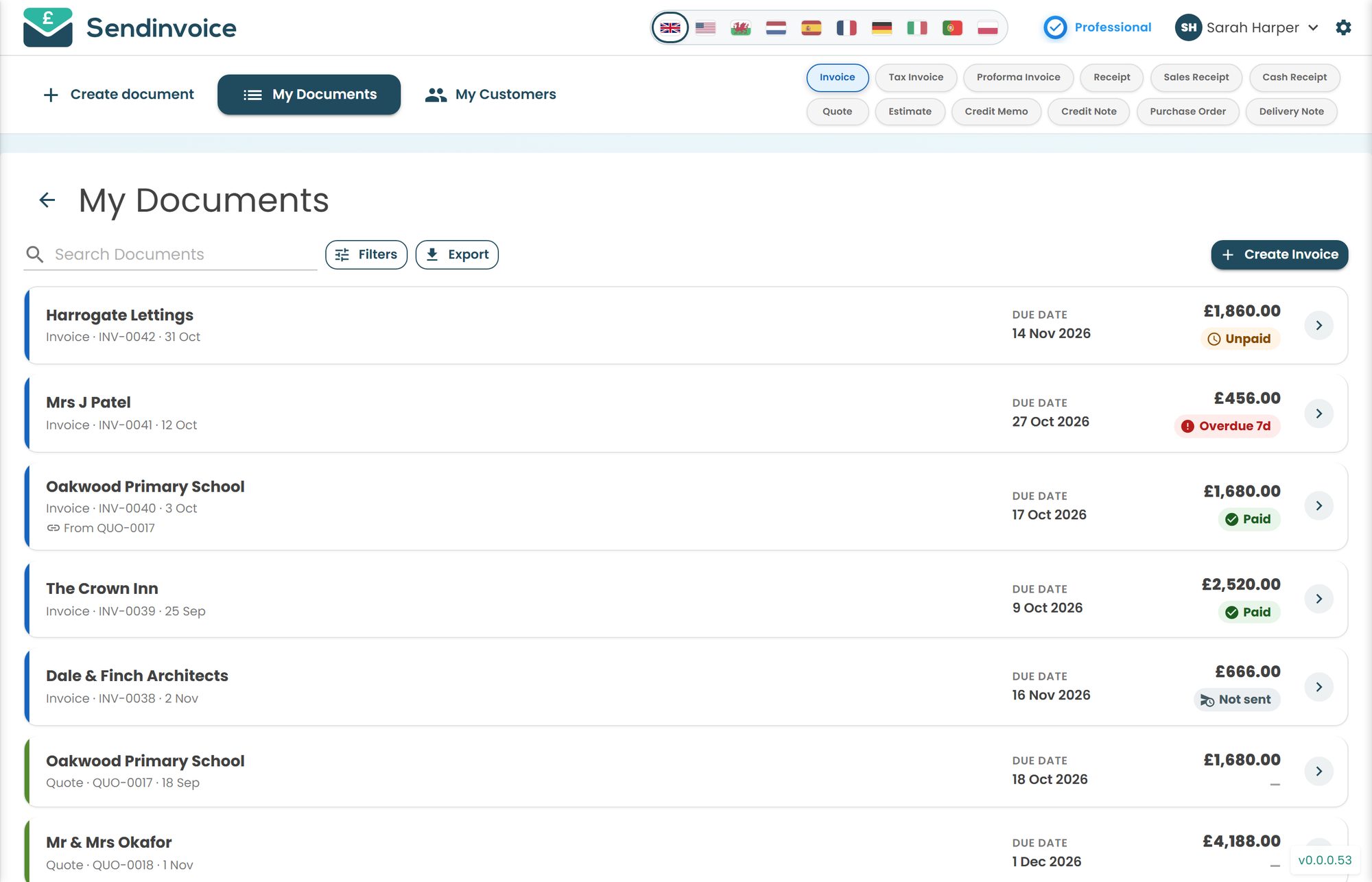
- Following Wednesday, 3.15pm. Job done, certificate signed. Sam opens QUO-0017 in My Documents, taps Create from this and chooses Invoice.
- 3.16pm. A new invoice, INV-0042, appears with the customer, the item, the £640 and the tax already filled in. Sam adds the payment terms, taps Send. The email has the PDF attached and a Pay button.
- That evening. Mrs Okafor pays by card from her sofa. INV-0042 flips to Paid with a green tick. Sam did not type her address once.
The quote and the invoice are the same facts at two moments, so you should only have to type them once.
Turning an accepted quote into an invoice in one tap
In SendInvoice every document has a Create from this action. On a quote it suggests what normally comes next: Invoice, Proforma invoice and Tax invoice, with the other types underneath.
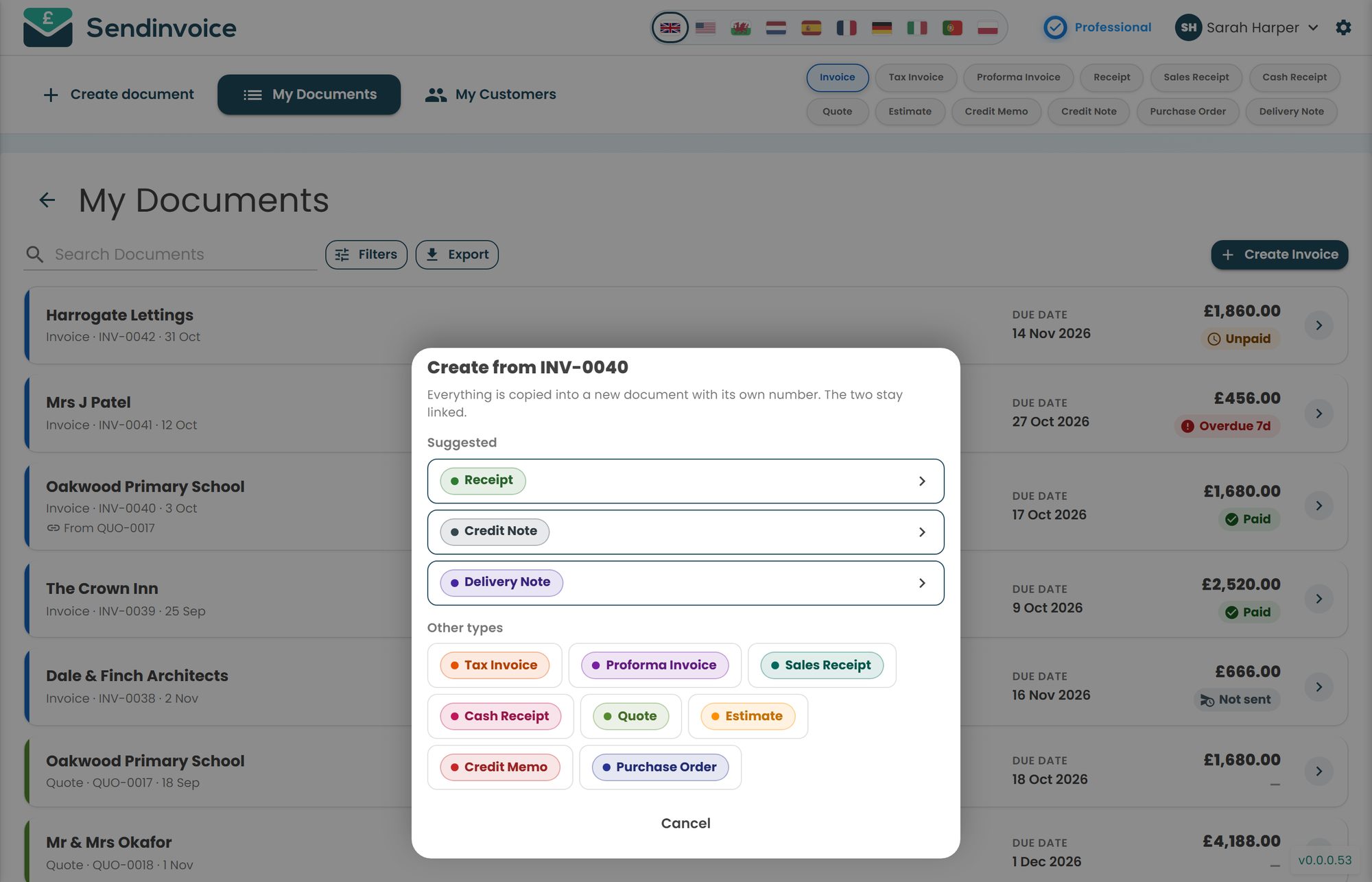
Choose Invoice and three things happen:
- the customer, items, quantities, prices, tax rates and currency are copied across;
- the new document gets the next number in your invoice sequence (INV-0042, not QUO-0018), because invoices and quotes are numbered separately;
- the two stay linked. The invoice shows From QUO-0017, and in My Documents you can see which quote each invoice came from.
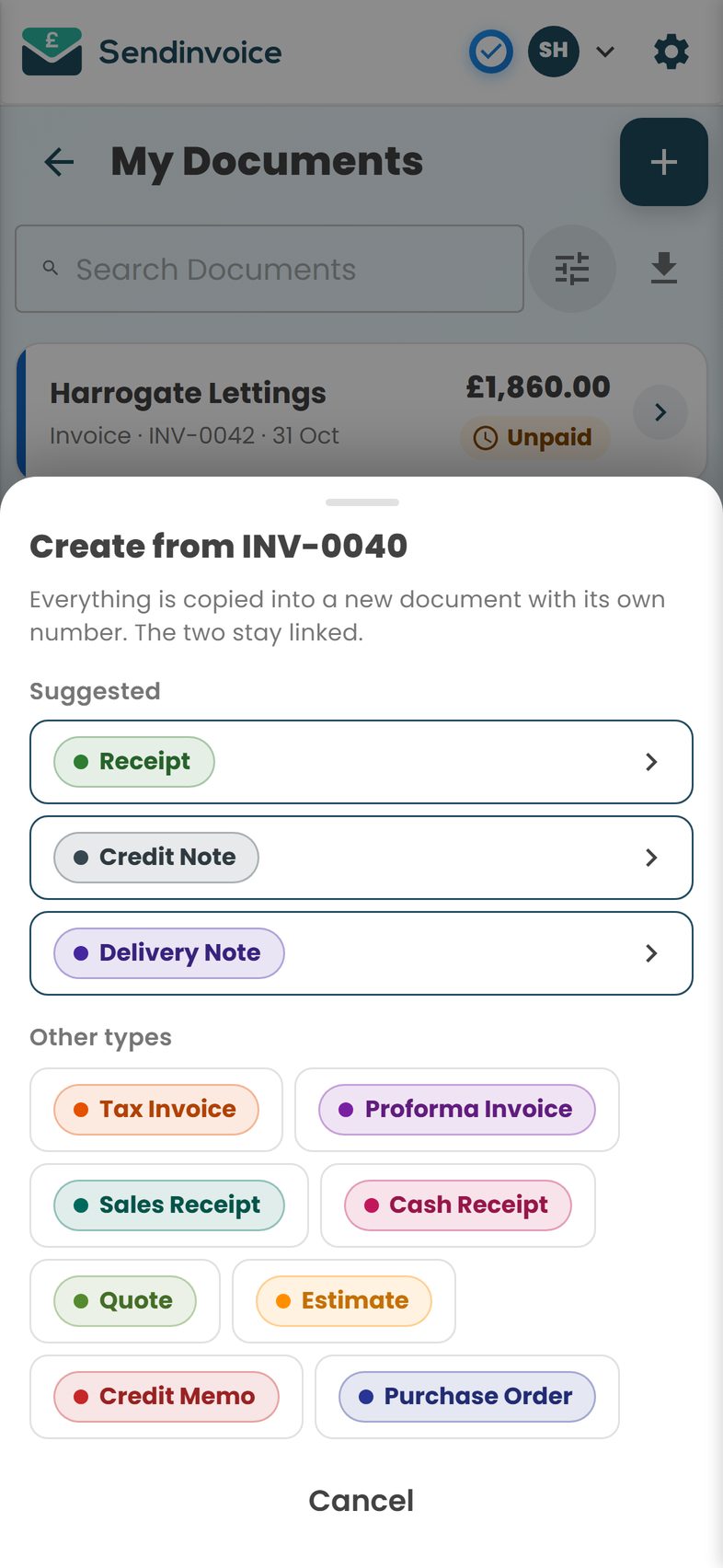
You can still edit the invoice before sending it. The quote stays untouched, so there is always a record of what was originally agreed.
The deposit step: where a proforma invoice fits
Sam does not want to buy a £180 consumer unit on a promise. The document for money up front is a proforma invoice.
A proforma is a request for payment that is not yet a real invoice. It looks like one and can carry a Pay button, but it does not create a tax point or go into your invoice sequence as a sale. You issue it for the deposit, the customer pays, and when the job is finished you issue the proper invoice showing the deposit already paid.
So the flow becomes: quote accepted; Create from this to a proforma for the deposit; deposit paid; job done; Create from this on the quote again for the final invoice, with a line deducting the deposit. Every document links back to the quote, so when Mrs Okafor asks in March what she paid and when, the answer is one search away.
Worked example: the paper trail for one job
| Document | Number | Amount | Purpose |
|---|---|---|---|
| Quote | QUO-0017 | £640.00 | Fixed price, valid 30 days |
| Proforma invoice | PRO-0005 (From QUO-0017) | £192.00 | 30% deposit, to order parts |
| Invoice | INV-0042 (From QUO-0017) | £448.00 | Balance on completion (£640 less £192 deposit) |
Mistakes that cost real money
- Calling an estimate a quote. If the word "quote" is on the document, the customer will hold you to it. Not sure of the price? Say estimate, and say what might move it.
- Sending the quote as an invoice. Now you have an unpaid invoice for work you have not done, and if you are VAT registered you may have triggered a tax point early. Use a quote, then a proforma if you need money up front.
- Doing extras without a word in writing. "Happy to add the outside socket, that is an extra £85, OK?" takes ten seconds and saves an argument on the invoice.
Do this in SendInvoice
Send the quote from site, then turn it into the invoice in one tap when the job is done, with the customer, items and prices carried over and a link back to the original quote. Quotes, estimates and proformas are all included.
Create a free invoice See the £5/month planFrequently asked questions
Is a quote legally binding in the UK?
Once the customer accepts it, a quote is generally treated as a fixed-price offer that forms part of the contract, so you cannot simply charge more later. An estimate is only a rough figure and is not binding in the same way. If something unexpected comes up on a quoted job, agree any extra in writing before you do the work.
Can I charge more than my estimate?
Usually yes, within reason. An estimate is your best guess, not a promise, and the final bill can go up or down. Customers tend to accept a final figure that is roughly 10 to 15 per cent over an estimate if you explained why; much more than that and you should have warned them before carrying on.
Does a quote need a number?
There is no legal rule that a quote must be numbered, but it is a very good habit. A number such as QUO-0017 makes the quote easy to refer to when the customer accepts it, and lets you link the invoice back to it.
Should I show VAT on a quote?
If you are VAT registered, yes: show whether prices are inclusive or exclusive of VAT and the rate, so there are no surprises on the invoice. If you are not VAT registered, do not mention VAT at all; you cannot charge it.
What is the difference between a quote and a proforma invoice?
A quote is an offer of a price. A proforma invoice is a request for payment before the work or goods are delivered, usually for a deposit. Neither is a VAT invoice, so neither creates a tax point. Once the job is done, you send a proper invoice.
Can I turn a quote into an invoice without retyping it?
Yes. In SendInvoice you open the accepted quote, tap Create from this, choose Invoice, and a new invoice is created with the customer, items, prices and tax carried over. It gets the next invoice number and shows a From QUO-0017 link back to the original quote.
How long should a quote be valid for?
Thirty days is common, but it is your call. Put the validity period on the quote itself, for example "Valid for 30 days from the date above", so that if material prices move you are not held to an old figure.