Aisha is a plumber in Leicester, VAT registered, one van and a lad two days a week. She has just finished a bath replacement: new acrylic bath, mixer tap, waste, and a re-route of the hot and cold because the old pipework came up through the wrong side. Her materials bill from the merchant was £487. The customer looks at the invoice and says, "The bath is £380 on here. I saw the same one online for £329." It is a fair question, and the answer lives in how you lay out labour and materials on the invoice.
Why labour and materials belong on separate lines
You could put one line on the invoice: "Bath replacement, £1,302." Some trades do. It is almost always a mistake, for four reasons.
- The customer can follow it. A bill that says what the parts were and what the time was reads as honest. A single number reads as a guess.
- You can see your own margin. If every invoice is one lump, you have no idea whether the job made money on labour, on materials, or at all.
- Tax rules care about the split. If you work for a contractor under the Construction Industry Scheme, the deduction applies to labour only, not materials, so the invoice has to show both. The CIS invoice example shows the layout.
- Disputes get smaller. When Aisha's customer queries the bath, they are querying £51 on one line, not the whole £1,302. That is a two-minute conversation, not a stand-off.
The habit is simple: labour as its own line (or lines), each significant part as its own line, and small bits bundled as "sundries".
How to show materials
There is a judgement call on how far to itemise. The rule that works: anything the customer could Google gets its own line; anything they would not recognise gets bundled.
On Aisha's job that means the bath, the tap and the waste each get a line, because they are the things the customer chose or could have chosen. The 15mm copper, the fittings, the solder, the PTFE and the silicone go on one line as "pipe, fittings and sundries". Nobody wants a 40-line invoice for a bathroom, and nobody is going to argue about 60p of PTFE.
Three things to put on each material line:
- What it is, specifically enough to identify. "Bath, 1700 x 700 acrylic, reinforced" rather than "bath". If the customer picked a particular model, name it; it shows they got what they asked for.
- Quantity and unit price where there is more than one of something: "Isolation valves, 15mm, 4 @ £3.80".
- Who supplied it, if it was not you. "Tap supplied by customer" on a line with a nil price makes it clear it is not covered by your guarantee.
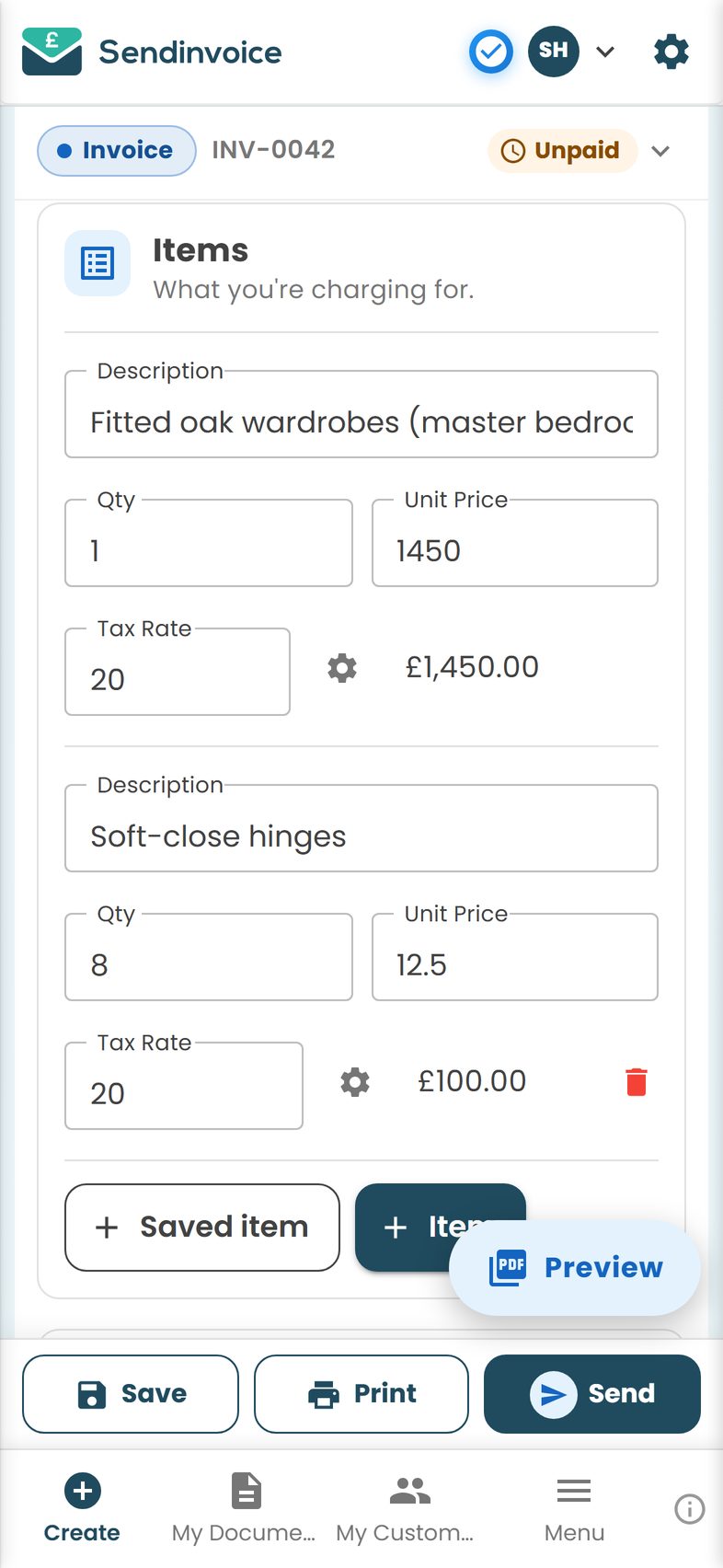
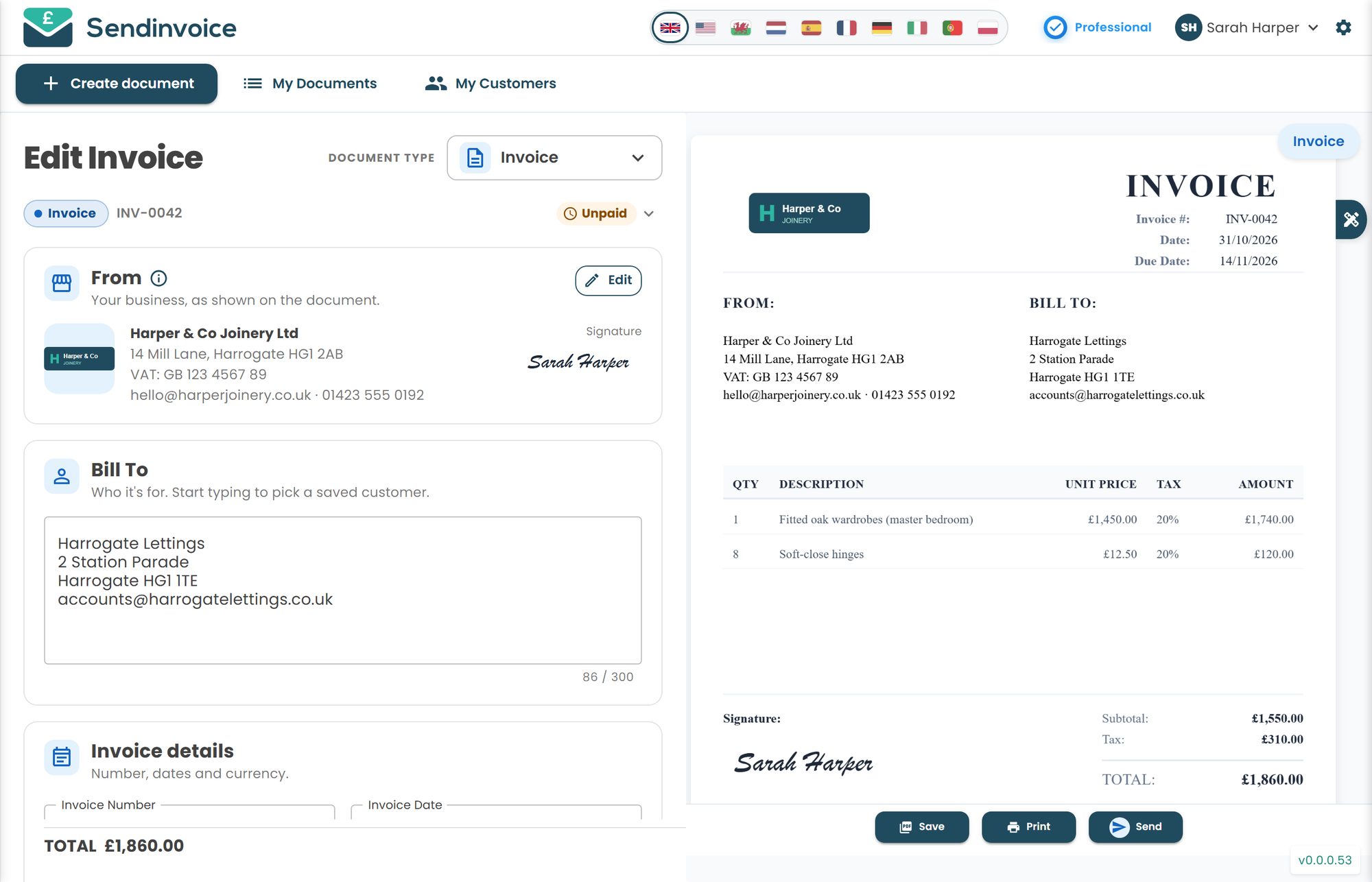
In SendInvoice each line has a description, quantity, unit price and amount, and you can save the parts you fit every week as saved items so "Isolation valve 15mm" is one tap rather than typing it in the van for the fortieth time.
Marking up materials, and how to explain it
Here is the honest answer to Aisha's customer. The bath cost her £312 at trade. She charged £380. The difference is a mark-up of about 22%, and it is entirely legitimate, because the customer is not buying a bath from a website. They are buying a bath that Aisha chose for the space, collected in the van, carried up the stairs, fitted, and will come back and sort out if it cracks in a year. If they buy it online and it arrives damaged, that is their afternoon on the phone. If Aisha buys it, it is hers.
How much is reasonable? Most trades sit between 10% and 25% on trade price. The bigger the item and the more of your time it absorbs (sourcing, collecting, returning the wrong one), the more the mark-up earns its keep. On a £4 fitting it is pennies and nobody minds. On a £2,000 boiler, 25% is £500 and you should be ready to explain it, or charge less mark-up and more labour.
Two rules that keep you on the right side of your customers:
- Never claim a price was your cost if it was not. You do not have to disclose what you paid. You must not lie about it.
- Be consistent. A fixed percentage across every job is easier to defend than a number you make up per customer.
Some customers, especially landlords and letting agents, ask for materials "at cost". That is fine as long as you then charge for the time you spend getting them, as a visible line: "Collection and handling of materials, 1 hour, £45". Cost plus nothing is a job you are doing for free.
What to do with the merchant receipts
Your merchant invoices and till receipts are your purchase records. They matter for two people: you, because they are the evidence of your costs when you do your Self Assessment; and HMRC, if they ever ask. They do not belong to the customer, and you are not obliged to hand them over unless you agreed to charge at cost.
What does matter is keeping them. Paper receipts from a merchant counter fade to nothing in a hot van within a summer. The habit that saves you at tax time:
- Photograph every receipt the day you get it, in the van, before it goes in the door pocket.
- File the photo by job or by month. A folder per month on your phone is enough.
- Note which customer invoice the materials went on. When you look back in January, "£487 at the merchant on 9 October" means nothing; "£487, Mrs Patel's bath, INV-0231" does.
- Keep everything for at least five to six years.
From April 2026, Making Tax Digital for Income Tax applies to the self-employed with income over £50,000 (then £30,000 from April 2027, £20,000 from April 2028, at the time of writing), and digital records stop being optional. Photos filed by month are a perfectly good start; you do not need full accounting software to be ready. Check with your accountant on what they want from you.
VAT: it applies to the whole supply
This is the part that catches people who have just registered. When you supply labour and materials together, you are making one supply of "fitting a bath", and VAT applies to the whole of it at the normal rate. It does not matter that the merchant already charged you VAT on the bath; you reclaim that as input tax, and you charge your customer VAT on your price, materials and labour together. Aisha's £380 bath line gets 20% on it, just like her labour.
Some specific work qualifies for reduced or zero rates: certain energy-saving materials, some work on new builds, some work for people with disabilities. Do not guess; check HMRC's notices or ask your accountant before putting anything other than 20% on a line, because getting it wrong is your problem, not the customer's.
If you are not VAT registered, none of this applies and you must not show VAT on the invoice at all. But note the hidden cost: the VAT the merchant charged you is simply part of what the bath cost, and you cannot reclaim it, so price your materials accordingly. The invoicing when not VAT registered post goes through the layout.
Worked example: Aisha's bath replacement
Aisha is VAT registered, so VAT at 20% appears on every line and in the totals. She charges labour as a day rate (the day rate vs fixed price post explains when that makes sense) and shows the half day as 0.5.
Invoice INV-0231 from A. Khan Plumbing, VAT no. shown, to Mrs R. Patel, 22 Cedar Road, Leicester. Date 10 October 2026. Payment due within 7 days.
| Description | Qty | Unit | Amount |
|---|---|---|---|
| Labour: remove old bath, re-route hot and cold supplies to tap end, fit new bath, waste and tap, seal and test | 1.5 days | £320.00 | £480.00 |
| Bath, 1700 x 700 acrylic, reinforced, with legs and frame | 1 | £380.00 | £380.00 |
| Bath/shower mixer tap, chrome, as chosen by customer | 1 | £145.00 | £145.00 |
| Bath waste and overflow, pop-up, chrome | 1 | £38.00 | £38.00 |
| Pipe, fittings, isolation valves, silicone and sundries | 1 | £42.00 | £42.00 |
| Subtotal (net) | £1,085.00 | ||
| VAT at 20% | £217.00 | ||
| Total due | £1,302.00 | ||
Notes: Old bath removed and disposed of. All parts guaranteed 12 months, workmanship 24 months. Pay by card using the link in this email or by bank transfer to the details below.
Aisha's margin on that invoice, for her own eyes only: materials cost her £487 and she billed £605, so £118 on parts, plus her labour. If she had billed one line for £1,302 she would never have known, and neither would the customer.
When the customer supplies the materials
It happens more and more: the customer has bought a tap from a showroom, or a bathroom suite in a sale, and wants you to fit it. Invoice labour only, and put a nil-price line on the invoice that says the item was supplied by the customer. Then protect yourself in three ways, ideally on the quote before you start:
- You do not guarantee customer-supplied items, only your fitting of them.
- If the item turns out to be wrong, incomplete or faulty, time spent is chargeable, including a return visit.
- Many trades add a modest fitting surcharge on customer-supplied items because the risk of a wasted morning is real. If you do, say so up front.
Showing it this way means that when the £329 online bath turns up with a cracked rim, the conversation is about the retailer, not about you.
A word on the labour line
Describe what you did, not just how long it took. "Labour, 1.5 days" invites the question "doing what?". "Remove old bath, re-route supplies, fit new bath, waste and tap, seal and test" answers it before it is asked, and reads well if the invoice is ever in front of a third party. If you charge by the hour, show hours and rate; if it was a fixed price, say "as per quote QUO-0198" so the customer can match it. For emergency work, the call-out is its own line too; see call-out fees and emergency work.
Everything else about a trade invoice, from numbering to bank details, is in how to invoice as a plumber, and the same layout works whatever your trade.
Do this in SendInvoice
Labour and each part on its own line, VAT per line where you need it, and saved items for the fittings you use every week, all from your phone in the van. Free to create and preview; £5 a month to send with a Pay button and track what is paid.
Create a free invoice See the £5/month planFrequently asked questions
Should labour and materials be on separate lines on an invoice?
Yes, almost always. Separate lines make the invoice easier for the customer to follow, make your own margins visible to you, and matter for tax: if you are a CIS subcontractor the deduction applies to labour only, and if a customer queries a figure you can discuss one line rather than the whole bill. Bundle only small sundries, never the main parts.
Can I mark up materials I buy for a customer?
Yes. You are supplying the materials as part of your service, and the mark-up covers your time sourcing and collecting them, your trade account risk, and the fact that you stand behind the part if it fails. A mark-up of 10% to 20% on trade price is typical. You are not obliged to tell the customer what you paid, but never claim a price was your cost when it was not.
Do I have to give the customer my merchant receipts?
Not unless you agreed to charge materials at cost, in which case you should show them. Otherwise the merchant invoice is your purchase record, kept for your own accounts, and your invoice is the customer's record of what they bought from you. If a customer asks, offering to charge at cost plus a visible collection fee is a fair alternative.
If I am VAT registered, do I charge VAT on materials as well as labour?
Yes. When you supply labour and materials together, the whole supply is normally charged at the standard rate, whatever rate the merchant charged you. Some specific work qualifies for reduced or zero rates, for example certain energy-saving measures, so check HMRC's notices or your accountant before applying anything other than 20%.
What if the customer supplies their own materials?
Invoice labour only and say on the invoice that materials were supplied by the customer. Make clear, ideally on the quote, that you cannot guarantee customer-supplied parts, and that if a part turns out to be wrong or faulty the time spent is chargeable. Many trades add a small fee for fitting customer-supplied items because of the risk.
How long do I keep receipts for materials?
Keep merchant invoices, receipts and bank records for at least five to six years. A photo of the receipt taken in the van, filed by job, is enough; paper fades and gets lost. Under Making Tax Digital for Income Tax, which starts in April 2026 for the self-employed with income over £50,000, digital records become a requirement rather than a convenience.