
Gavin services boilers from October to Christmas almost without stopping: six a day, £85 each, and about half of them paid in cash at the door. At the fourth house on a Tuesday the customer hands him four twenties and a five, says "no need for a receipt, love", and closes the door. Gavin has done nothing wrong, and neither has she. Whether anything goes wrong depends entirely on what he does with that £85 before he starts the van.
Cash jobs are legal; undeclared ones are not
Let's clear this up first, because the phrase "cash in hand" has picked up a smell it does not deserve. Being paid in cash is legal. Preferring cash is legal. Your customer handing you notes is not doing anything wrong, and neither are you by taking them.
What is not legal is the thing people actually mean when they wink and say "cash job": income that never gets written down and never reaches your tax return. That is tax evasion, and HMRC does not grade it by size. It treats a tradesperson with £8,000 of unrecorded boiler services the same way it treats a bigger fish, with the added disadvantage that if your records are poor HMRC can estimate your income and charge you tax, interest and penalties on its estimate, not yours. The burden then falls on you to prove it was less.
So the rule is simple: cash is just another way of being paid. It gets a receipt, it gets recorded, and it gets declared. Do that and there is nothing to worry about, ever.
Why you want a receipt even when they do not
The customer who waves away a receipt is thinking of it as a bit of paper for her. It is at least as much for you.
- It proves what was done and paid. If the boiler stops in February and she says "he never serviced it", the dated receipt with the serial number is your answer.
- It is her evidence too. Landlords need proof of gas work; buyers' solicitors ask for boiler service history; insurers ask for it after a leak. "No need for a receipt" becomes "can you send me that receipt?" in April with surprising regularity.
- It is your record. A numbered receipt in your document list is an entry in your books. Without it, the £85 is a memory, and memories do not survive to the 31 January deadline.
- It looks professional. A branded receipt emailed from the doorstep says more about you than the sticker on the van.
Default to issuing one every time, and make it easy: "I'll email the receipt over now, what's the best address?" Nobody refuses that.
What goes on a cash receipt
A receipt is proof of payment, where an invoice is a request for it; invoice vs receipt explains the difference. For a cash job where you did not invoice first, the receipt carries the detail an invoice would:
- Your name or business name, address and contact details (and your VAT number if registered)
- The customer's name and address (the address of the property is useful for gas work)
- The date and a receipt number that follows on from the last one
- What you did: the appliance, the work, any parts
- The amount, and the words Paid in cash with the date
- Anything the customer needs to keep: a Gas Safe registration number, a note that the Benchmark record was completed, a serial number
If you invoiced first and the customer later paid cash, you have two choices: mark the invoice paid and send that as confirmation, or create a receipt from the invoice so the two documents are linked and the receipt quotes the invoice number. Either is fine; the point is that the money and the document match.
Worked example: Gavin's cash receipt
Gavin is a sole trader and not VAT registered, so no VAT appears. He found a tired thermocouple on the service and replaced it while he was there, which went on as a part and ten minutes of extra labour, agreed at the door.
Cash receipt REC-0062 from G. Morgan Heating (Gas Safe reg. shown) to Mrs J Hughes, 7 Mill Street. Dated 4 November.
| Description | Qty | Unit price | Amount |
|---|---|---|---|
| Annual boiler service: Worcester Greenstar 30i, serial no. noted, combustion check, flue test, safety checks | 1 | £85.00 | £85.00 |
| Part: replacement thermocouple | 1 | £24.00 | £24.00 |
| Labour: fit thermocouple and retest | 1 | £20.00 | £20.00 |
| Total paid (no VAT; not VAT registered) | £129.00 |
Paid in cash, 4 November. Thank you. Service record completed in the boiler's Benchmark log. Next service due November next year.
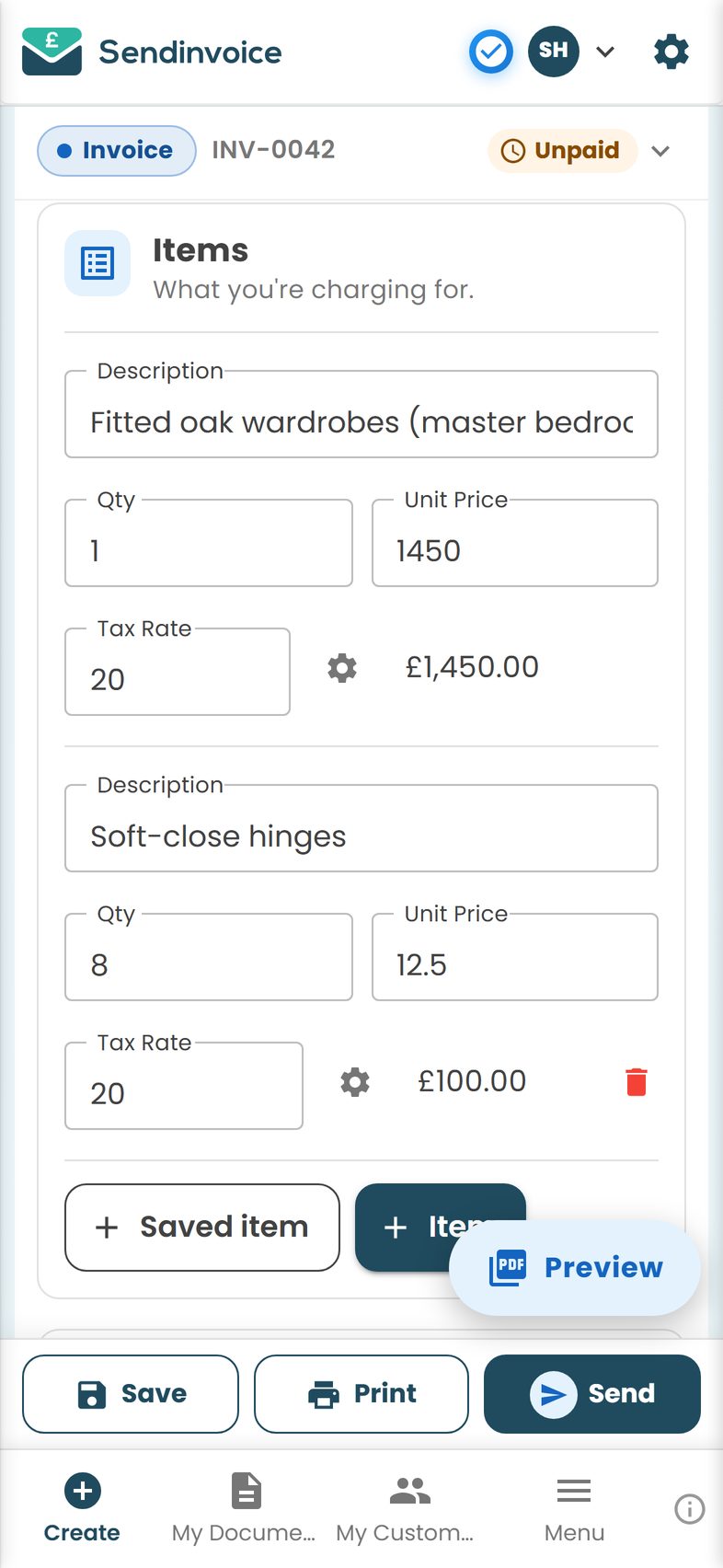
Gavin builds this on his phone in the van in about a minute: the From details are already saved, Mrs Hughes comes up as he starts typing in Bill To because he serviced the same boiler last year, the service is a saved item, and he adds two lines for the part. Email, done, next house. The number REC-0062 follows REC-0061 from the house before, and the sequence is his audit trail.
Recording it the same day
The receipt is half the job. The other half is making sure the cash shows up in your records as income, and the only reliable way is to do it before the next house.
- Number every receipt and never skip one. A gap in the sequence is a question you will have to answer later. Invoice numbering explains the habit; receipts follow the same rule.
- Keep a cash log. Date, receipt number, customer, amount. It can be a page in a notebook or a column in your exported document list; what matters is that it exists and matches the receipts.
- Bank the cash, or at least account for it. Paying cash into your business account with the receipt numbers in the reference makes your bank statement match your receipts, which is the cleanest possible record. If you use some of it for diesel and fittings, those are expenses and need their own receipts; the full £129 is still income.
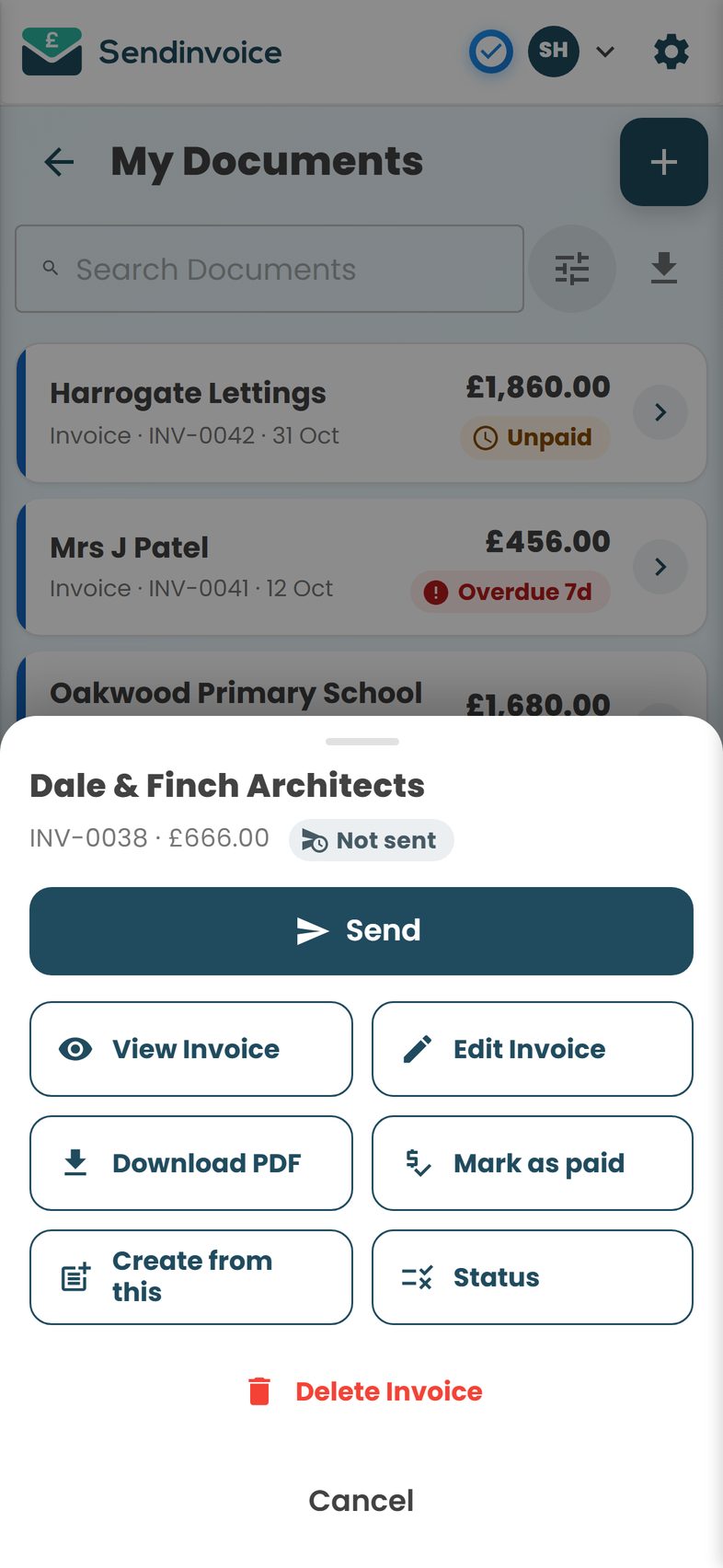
- Mark it paid in your documents. If the job was invoiced and paid in cash, mark the invoice Paid by hand so your list of unpaid work is true. Chasing a customer for an invoice they paid in cash at the door is a bad look.
What to keep for Self Assessment
As a sole trader you report your income and expenses on a Self Assessment return each year, and HMRC expects you to be able to back up every figure. The records that matter for a trade are not complicated:
| Record | Why it matters |
|---|---|
| Every invoice and receipt you issued | Your sales income, including cash |
| Cash log | Ties cash receipts to the money and to your bankings |
| Business bank statements | Confirms income received and expenses paid |
| Receipts for materials, parts, tools, fuel, insurance, Gas Safe registration, phone | Your allowable expenses |
| Mileage log (if you claim mileage) or vehicle costs | Vehicle expenses |
| CIS deduction statements, if you subcontract to builders | Tax already deducted, reclaimed through your return |
Keep them for at least five years after the 31 January filing deadline of the tax year they belong to; most accountants say six to be safe. Digital copies are fine, so a photo of a merchant's receipt taken in the car park is a valid record, as long as it is readable and you can find it. A folder per tax year, on a service that backs itself up, is enough.
Most sole traders use the cash basis for Self Assessment, which means income counts when you receive it, not when you invoice it. A job invoiced in March and paid in cash in April falls into the new tax year under the cash basis. If that matters to you, or you are not sure which basis you are on, check with your accountant or HMRC; tax points like this are exactly where a quick question saves a slow correction.
Making Tax Digital, without the panic
Making Tax Digital for Income Tax is HMRC's move from one annual return to digital records and quarterly updates sent through compatible software. At the time of writing the timetable for sole traders is April 2026 for income over £50,000, April 2027 for over £30,000 and April 2028 for over £20,000. If you are below those thresholds nothing changes yet, but the thresholds are gross income, not profit, and a busy one-van heating business clears £50,000 of turnover sooner than you might think.
Cash income is treated exactly like any other income under MTD; it simply has to be in your digital records. The habit described above, a numbered receipt for every cash job and a log that matches, is already most of the way there: an export of your documents to Excel is a digital sales record, and your accountant or MTD software takes it from there. SendInvoice does not file MTD updates itself and is not accounting software, so you will still need something that submits to HMRC when your turn comes, but you will not be starting from a shoebox. The post on going self-employed as a tradesperson covers setting up records from day one.
The habit, in practice
Here is Gavin's version, which takes him under two minutes per cash job and has survived three busy winters:
- Service done, cash in hand. Build the receipt on the phone before leaving the drive, email it, and quote the Gas Safe number on it.
- Once a week, filter My Documents to Receipts for the week, export to Excel, and paste the cash ones into his cash log with the banking reference.
- Friday afternoon, pay the week's cash into the business account with "REC-0058 to REC-0064" in the reference.
- Materials receipts photographed on the day and dropped in the tax-year folder.
- January: send the folder and the exports to the accountant and go back to work.
None of it is clever. All of it is the difference between a cash job and an undeclared one. And the receipt, the thing the customer said she did not need, is where it all starts.
One last thought: if you would rather have less cash to log, give customers an easy alternative. A Pay button in an emailed invoice, or a bank transfer done while you are still there, lands in your account with a reference already attached, and you can see which jobs are paid at a glance. Getting paid on the day compares the options.
Do this in SendInvoice
Issue a numbered cash receipt from the doorstep with your Gas Safe number on it, turn an invoice into a linked receipt in one tap, and export the lot to Excel for your cash log and your accountant. Free to create and preview; £5 a month to send, track and take card payments.
Create a free invoice See the £5/month planFrequently asked questions
Is it legal to be paid cash in hand for a job?
Yes. Cash is a perfectly legal way to be paid, and a customer paying in notes is not doing anything wrong. What is illegal is not recording the income and not declaring it to HMRC. A cash job that goes on a receipt, into your records and onto your tax return is just a job. One that does not is tax evasion, however small.
Do I have to give a receipt for cash?
There is no general law that forces a sole trader to hand over a receipt, but you should always offer one and your customer may insist on it. A receipt protects you both: it proves what was paid and for what, it is the customer's evidence for a landlord, a house sale or an insurance claim, and it is the record HMRC expects you to have.
What should a cash receipt include?
Your name or business name and address, the customer's name and address, the date, a receipt number, a description of the work, the amount, and the words paid in cash. If you are VAT registered it must also show your VAT number and the VAT. If you invoiced first, quote the invoice number so the two tie together.
How long do I need to keep records as a sole trader?
HMRC expects self-employed people to keep records for at least five years after the 31 January filing deadline of the tax year they relate to; many accountants say keep six to be safe. That covers invoices, receipts, bank statements, a cash log and materials receipts. Digital copies are fine, as long as they are complete and readable.
What is Making Tax Digital and does it affect cash jobs?
Making Tax Digital for Income Tax requires sole traders over an income threshold to keep digital records and send quarterly updates to HMRC through compatible software. At the time of writing it applies from April 2026 for income over £50,000, April 2027 for over £30,000 and April 2028 for over £20,000. Cash income counts the same as any other; it just has to be recorded digitally.
What if a customer asks for a cash price with no VAT?
If you are VAT registered, every sale carries VAT whatever the payment method, and knocking off the VAT for cash is evasion for both of you. If you are not VAT registered there is no VAT to knock off anyway, so the honest answer is that your price is your price. Offer a card link or bank transfer alongside cash and the question usually goes away.