
Dean fits a new fence panel, swaps a kitchen tap and replaces a smoke alarm at a two-bed terrace in Headingley for a letting agent. Three hours, £185 all in. He emails the invoice that night, feels quietly pleased with himself, and is paid eleven weeks later, after four phone calls, because the invoice had no works order number and no property address and sat in the wrong landlord's file. Agents and landlords are some of the best repeat customers a tradesperson can have. They also have their own way of doing things, and if you learn it, you get paid in 30 days instead of eleven weeks.
Why letting agents pay differently from homeowners
A homeowner pays you from their own bank account, usually on the day or the day after, because they have just watched you do the work. A letting agent is a different animal. The person who booked you is a property manager with 150 properties on their list. The person who pays you is in accounts, possibly in another office, and has never heard of you. Between the two sits a works order, a landlord's account and a payment run that happens on set days of the month.
Most agents pay contractors out of the rent they hold for each landlord. So your invoice has to be matched to the right property and the right landlord before anyone can release the money. If it cannot be matched, it does not get rejected; it just stops. Nobody emails you. It sits in a tray, physical or digital, until you ring.
The fix is not to chase harder. It is to send an invoice that matches itself.
What to put on every landlord or agent invoice
On top of the usual legal basics (your name and address, a unique invoice number, the date, a description and the amount; see how to write an invoice for the full list), an invoice to an agent or landlord needs:
- The property address, in full, including the flat number. Put it at the top of the description, not buried in a line item. "Flat 3, 14 Cardigan Road, LS6 1LJ" is the single most important thing on the page.
- The works order or purchase order number. Most agents issue one when they book you, by email, text or through a contractor portal. If they did not, ask for one before you start. Put it in its own field or on the first line.
- The branch and the person who instructed you. "Instructed by Sam Reed, Hartley Lettings, Headingley branch." Accounts can then find the booking in thirty seconds.
- The date of the visit, separate from the invoice date. Agents reconcile against the tenant's reported issue and the day you attended.
- Short, specific descriptions. "Replaced kitchen mixer tap (Bristan, supplied), tested, no leaks" tells the landlord what they paid for when they read it three months later.
- Your payment terms and bank details, and a Pay button if you can offer one.
Who is actually your customer
This matters more than it sounds. If the agent books you in its own name and pays you from its client account, the agent is your customer, and the invoice is addressed to the agent. If the agent says it is acting only as a go-between and the landlord will pay you direct, then the landlord is your customer, and you want the landlord's name and address on the invoice before you start.
Ask the question when you take the booking: "Is this invoiced to you or to the landlord?" The answer tells you whose name goes in Bill To, whose terms apply, and who you chase. Most agents will say "to us, with the property address and the works order number on it", which is exactly what you want.
A worked example: Dean's invoice to a letting agent
Dean is a sole trader handyman in Leeds. He is not VAT registered, so there is no VAT anywhere on the invoice (if that is you too, read invoicing when you are not VAT registered). Here is the same £185 job, invoiced properly.
Invoice INV-0218 from Dean Walsh trading as DW Property Maintenance, 9 Moor Lane, Leeds LS7 3AB
Bill to: Hartley Lettings Ltd, Headingley branch, 102 Otley Road, Leeds LS6 3PX
Property: Flat 3, 14 Cardigan Road, Leeds LS6 1LJ
Works order: HL-WO-44871 (instructed by Sam Reed)
Date of visit: 3 November 2026. Invoice date: 3 November 2026. Due: 3 December 2026 (30 days)
| Description | Qty | Unit price | Amount |
|---|---|---|---|
| Labour: replace rear garden fence panel, refix post, clear debris | 1.5 hrs | £38.00 | £57.00 |
| Labour: replace kitchen mixer tap, test, no leaks | 1 hr | £38.00 | £38.00 |
| Labour: replace hallway smoke alarm, test | 0.5 hr | £38.00 | £19.00 |
| Materials: 6 ft featheredge fence panel | 1 | £34.00 | £34.00 |
| Materials: Bristan kitchen mixer tap | 1 | £29.00 | £29.00 |
| Materials: 10-year sealed battery smoke alarm | 1 | £8.00 | £8.00 |
| Total due | £185.00 | ||
Not VAT registered; no VAT charged. Payment within 30 days by bank transfer (sort code and account number on this invoice) or by card using the Pay button. Photos of completed work available on request.
Everything accounts needs is on one screen: which property, which order, who booked it, what was done, what it cost. Labour and materials are separate lines because landlords like to see them that way, and because some pass the materials cost through their own records. There is more on that split in labour and materials on an invoice.
Payment terms: 30 days is normal, so start the clock early
Homeowners pay in days. Agents and landlord companies pay on terms, and 30 days is the usual expectation. You can put 14 days on your invoice, and some agents will honour it, but most will pay on their next run after 30 days regardless. Rather than fight that, work with it:
- Invoice the same day as the job. The 30 days runs from when they receive the invoice, not from when you did the work. An invoice sent a fortnight later is paid a fortnight later.
- Ask about their payment run. "Do you pay contractors on a set date?" If it is the 25th, an invoice that arrives on the 26th waits a month. Send it on the 24th.
- Get onto the approved contractor list. Most agents keep one, and being on it usually means a smoother route through accounts, plus a steady flow of work. They will want your public liability insurance certificate and sometimes a trade registration.
- Put the terms in writing on the invoice and in your quote. "Payment within 30 days of invoice date. Late payments may incur statutory interest and compensation under the Late Payment of Commercial Debts (Interest) Act 1998." See payment terms for UK invoices for wording.
Chasing a letting agent that has not paid
When an agent invoice goes past 30 days, the cause is almost always a matching problem, not a refusal. So chase in that order:
- Day 31: resend the invoice to accounts, not to the property manager, with the works order number and property address in the subject line: "Overdue: INV-0218, Flat 3 14 Cardigan Road, WO HL-WO-44871". Ask them to confirm it is on the system.
- Day 38: ring the property manager who booked you. They have a direct line to accounts and a reason to keep you sweet; you are the person who answers the phone when a tenant has no hot water on a Friday.
- Day 45: send a statement. If you have several unpaid invoices with the same agent, one list with numbers, properties, dates and amounts is far easier for accounts to action than six separate reminders. Export your unpaid documents for that customer and attach it.
- Day 60: a formal reminder mentioning interest and compensation, then a letter before action if it comes to it. Our guide to chasing an unpaid invoice has the templates.
Here is the part that is different from homeowner work. A letting agent is a business, and a landlord's limited company is a business, so the Late Payment of Commercial Debts (Interest) Act 1998 applies: statutory interest at 8% above the Bank of England base rate, plus fixed compensation of £40 per invoice under £1,000, £70 from £1,000 to £9,999.99 and £100 at £10,000 or more, at the time of writing. Mentioning this in a reminder tends to get an agent's accounts team moving, because they know it applies.
A private individual landlord is a greyer area. Letting property is normally treated as a business activity, so the Act will usually apply, but if you are unsure, lean on the terms you put on the invoice. For a private homeowner, by contrast, the Act does not apply at all: you can only ask a court for interest under the County Courts Act, at its discretion (typically 8%), and you cannot add the £40, £70 or £100 fixed sums. If a homeowner job goes wrong, read what to do when a homeowner will not pay instead.
Keeping track of a dozen small invoices a month
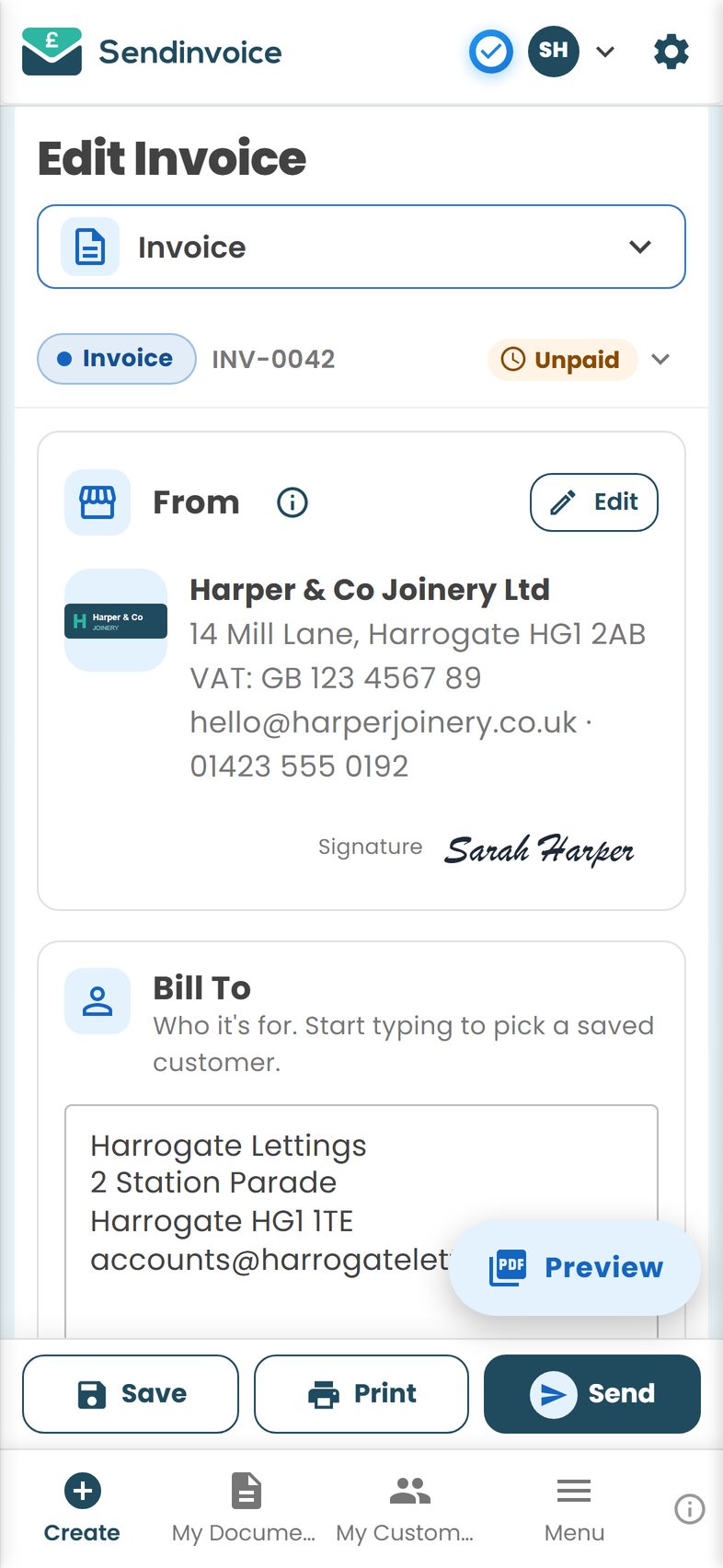
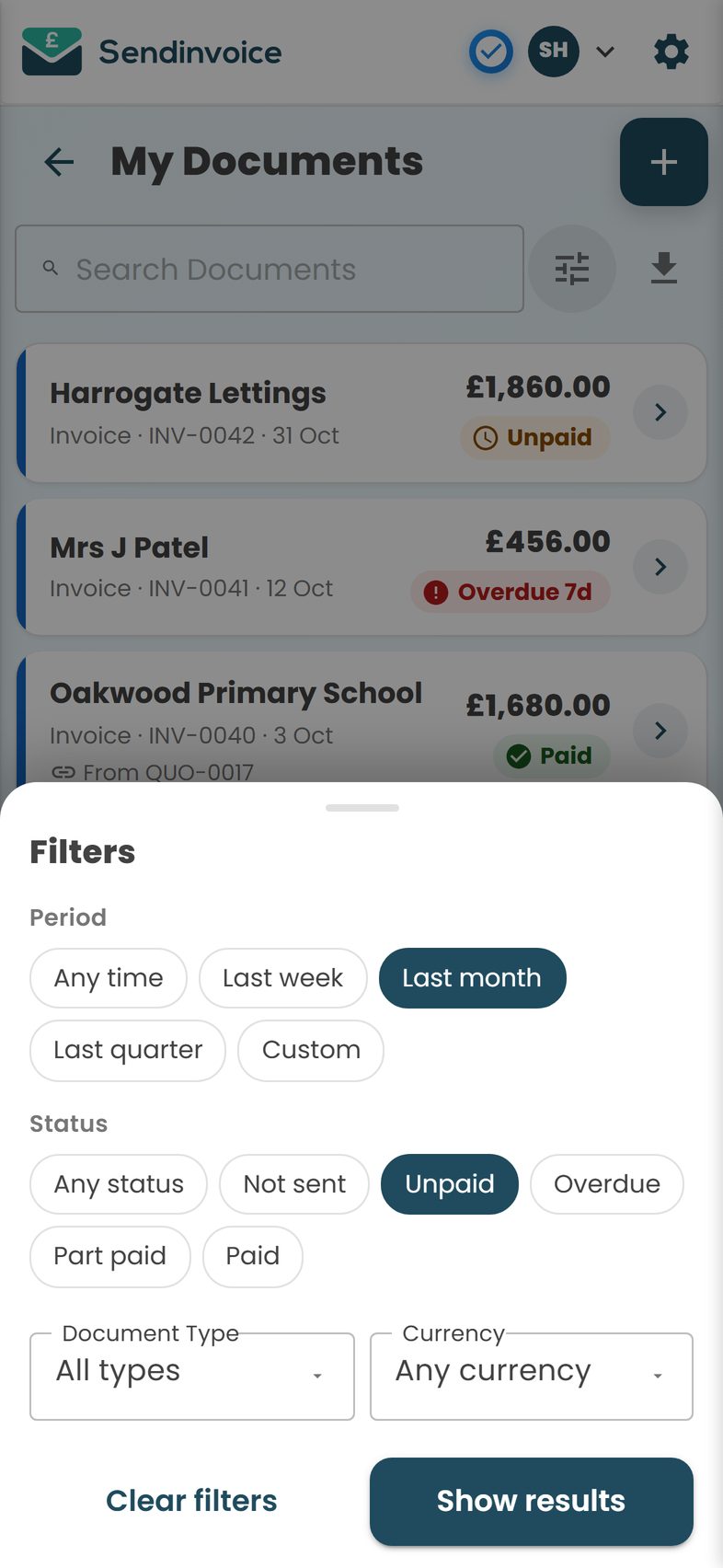
Agent work is lots of small invoices rather than a few big ones, which is where a notebook or a folder of PDFs falls apart. You want to see, at a glance, which of Hartley's invoices are paid, which are unpaid and which are overdue, and to filter by customer when their accounts team asks for a statement.
In SendInvoice every invoice sits in My Documents with a Paid, Unpaid or Overdue badge. Filter by customer and status and you have the agent's statement; export it to Excel or a PDF report and attach it to the reminder. Bill To remembers each agent and landlord as you type, so the second and the twentieth invoice to the same branch is a few taps on your phone in the van. If the agent pays by card from the Pay button, the invoice flips to Paid on its own; when a bank transfer lands, you mark it paid by hand.
One last habit: keep the photos. Before and after shots of every job, saved against the invoice number, settle nine out of ten landlord queries by return email. "Was the fence panel really replaced?" Yes, here it is, dated, with the old one in the skip.
Do this in SendInvoice
Save the agent once, put the property address and works order on every invoice, and see which of their invoices are paid, unpaid or overdue from your phone. Free to create and preview; £5 a month to send, remind and get paid by card.
Create a free invoice See the £5/month planFrequently asked questions
Do I invoice the letting agent or the landlord?
Ask when you take the booking. If the agent instructs you in its own name and pays from its client account, the agent is your customer and goes in Bill To. If the agent says the landlord will pay you direct, get the landlord's name and address before you start. Either way, put the property address and the works order number on the invoice.
What is a works order number and do I need one?
A works order (or purchase order) number is the reference an agent creates when it books a job. Accounts use it to match your invoice to the right property and landlord. Without it, your invoice can sit unmatched for weeks. If the agent has not given you one, ask for it before you start, and put it on the invoice.
Can I charge a letting agent interest on a late invoice?
Yes. A letting agent, or a landlord trading through a company, is a business, so the Late Payment of Commercial Debts (Interest) Act 1998 applies: 8% above the Bank of England base rate plus fixed compensation of £40, £70 or £100 per invoice depending on its size, at the time of writing. For a private homeowner none of that applies; only a court can award interest, at its discretion.
Should I put the property address on every invoice?
Always, in full and with the flat number, even if the agent only has one property with you. Agents and landlords file by property, not by tradesperson. Put the address at the top of the description, add the date you attended, and name the person who instructed you so accounts can find the booking in seconds.
How long do letting agents take to pay tradespeople?
Thirty days is typical, and many pay on a fixed run each month. Invoice on the day of the job so the clock starts straight away, ask what date their run is, and get onto their approved contractor list. A well-matched invoice sent on the right day is paid in one cycle; a vague one can take three.
Can I send one invoice for several properties?
You can, but it slows you down. Each property usually belongs to a different landlord, and accounts has to split your invoice between them before anyone can pay. One job, one property, one invoice is the fastest route to the money, and it takes a minute per invoice once the agent is saved as a customer.