Marcus has a Tuesday morning at Mrs Okafor's in Bristol: a heavy mirror to hang, a kitchen tap that drips, a garden gate that has dropped on its hinges, and a letterbox that lost its flap in last week's wind. Four jobs, one visit, £227.70. None of it is complicated. The invoicing should not be either, and yet handymen produce some of the messiest invoices in the trades, because the work is messy by nature. Here is how to keep it tidy and get paid before you leave.
The handyman pricing problem
An electrician invoices a consumer unit. A tiler invoices square metres. A handyman invoices "a morning of whatever needed doing", and that is harder to put on a page. Three ways to price it, and most handymen use all three depending on the visit:
| Method | When it suits | How it looks on the invoice |
|---|---|---|
| Hourly (say £40-£55 an hour, with a minimum) | Unknown lists, "while you're here" jobs, diagnosing before fixing | One labour line: hours x rate, with the jobs listed in the description |
| Half day or full day (say £180 / £320) | A planned list that will fill the time; customers like a known figure | One labour line for the half day, jobs listed underneath |
| Per job (a shelf £45, a door £120) | Things you have done fifty times and can price blind | One line per job, each with its own price |
Whichever you pick, the rule is the same: say it before you start, and show it the same way on the invoice. Mrs Okafor was told "half day, £180, plus any bits I have to buy" when she booked, so that is exactly what the invoice says. The surprise is what customers object to, not the number.
Several jobs on one invoice
For a single visit, send a single invoice. Four jobs do not need four invoices; they need one invoice with four things visible on it. Two ways to do that:
- Half-day or hourly rate: one labour line for the time, and the jobs listed in the description so the customer remembers what they got. This is what Marcus does.
- Per-job pricing: one line per job with its own price. Good when the customer is comparing you to "the man who quoted £60 for the gate".
Either way, materials sit on their own lines below the labour, not buried in it. Customers trust an invoice that separates "your time" from "the stuff you bought". The worked example below shows the half-day version.
Materials, receipts and the bits drawer
Handyman materials come in two kinds. There are the things you buy for this customer (a tap cartridge, a letterbox, a pair of hinges), which go on the invoice as lines at the price you paid or with a modest mark-up for the trip to the merchant. And there is the bits drawer: screws, rawlplugs, a squirt of silicone, cable ties. Nobody wants a line for "6 x 40 mm screws, £0.38". Either build the drawer into your rate, or add one "sundries" line at a few pounds and say so in your terms. Marcus builds it into the half-day.
Keep every merchant receipt, even for £11.20 of hinges. Photograph it on the spot so it is on your phone next to the invoice. Customers almost never ask to see them, but HMRC can, and they are your proof of the cost against your income for Self Assessment. For a deeper look at mark-ups and VAT on materials, read labour and materials on an invoice.
A quick note on VAT: Marcus is not VAT registered, like most sole-trader handymen, so there is no VAT on his invoice and no mention of it. If you are not registered, resist the urge to put "VAT: 0%" or "no VAT" on the page; just leave it out. Our guide to invoicing when you are not VAT registered explains why.
The worked example: a Tuesday morning at Mrs Okafor's
Here is the invoice Marcus sends from his phone at 12:40, standing in Mrs Okafor's hallway with a newly flapped letterbox behind him.
Bell's Handyman Services · Marcus Bell, sole trader · Invoice INV-0347 · Date 10 November 2026 · Due on receipt
Bill to: Mrs A. Okafor, 7 Redland Terrace, Bristol
| Description | Qty | Unit price | Amount |
|---|---|---|---|
| Half-day labour (08:30-12:30) covering: hang large mirror in hall on masonry fixings; replace kitchen tap cartridge and stop drip; re-hang side gate on new hinges and adjust latch; fit new letterbox to front door | 1 | £180.00 | £180.00 |
| Tap cartridge (receipt available) | 1 | £14.50 | £14.50 |
| Heavy-duty gate hinges, pair, and coach screws | 1 | £11.20 | £11.20 |
| Letterbox, chrome, with brush seal | 1 | £22.00 | £22.00 |
| Total due | £227.70 | ||
Notes: Not VAT registered. Payment on the day by card (Pay button in the email) or bank transfer to the details below. Fixings and sundries included in labour. Workmanship guaranteed 6 months; parts under manufacturers' guarantees.
Notice what the labour line does. It is one figure, so the customer is not totting up four separate charges and wondering if the gate was really £60, but it lists the four jobs, so when Mrs Okafor's daughter asks what the £180 was for, the answer is on the page. The time range is a small detail that heads off "was it really a half day?" before it is asked.
Getting paid before you leave
This is where handymen lose the most money. Not to bad customers, but to good ones who meant to pay the £227.70 and then had a week. Small amounts are the easiest to forget and the most awkward to chase; nobody wants to send a formal reminder about a letterbox.
The fix is to invoice while you are still in the house. Marcus has a routine:
- Tools in the van, then back to the hallway with his phone.
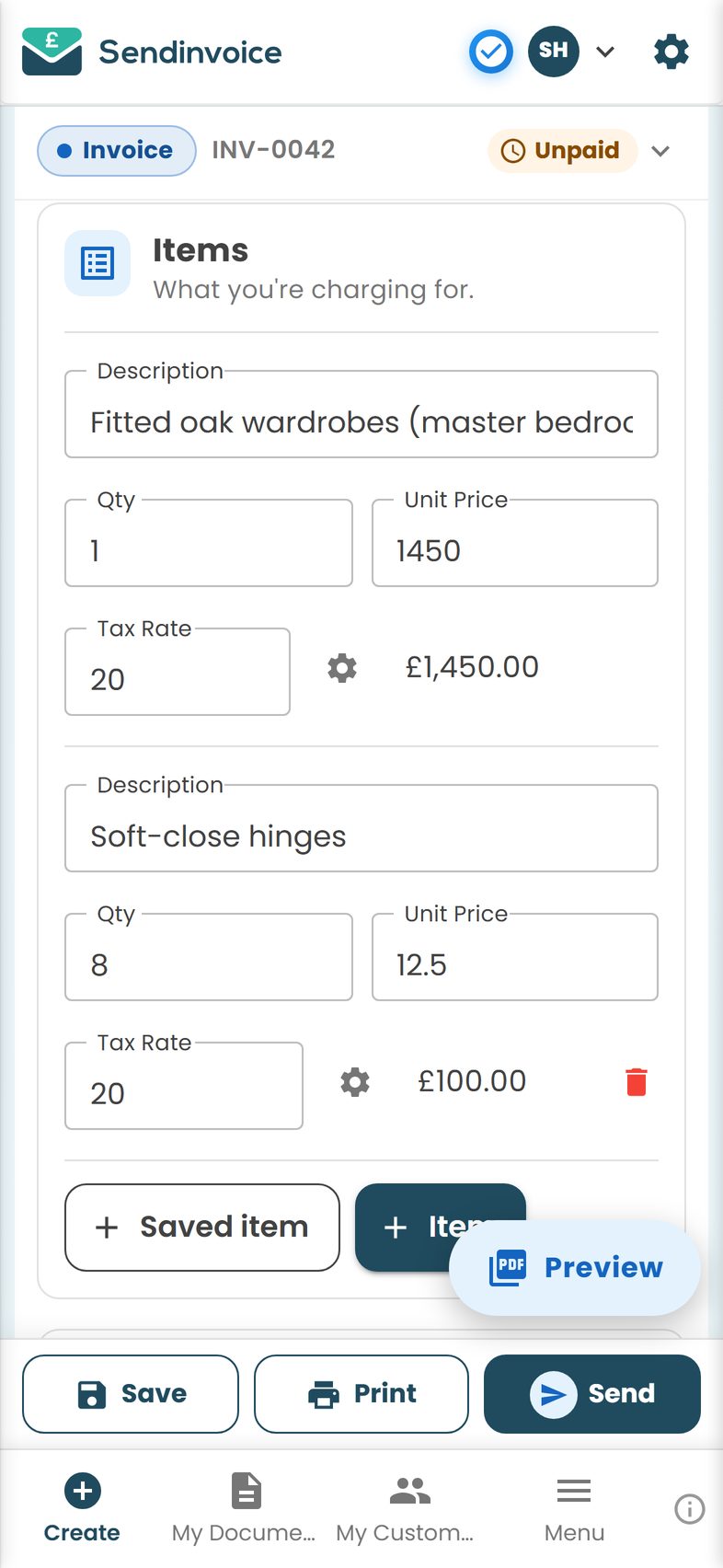
- Open the invoice he started in the van that morning (customer details already filled from last time), add the parts, check the total.
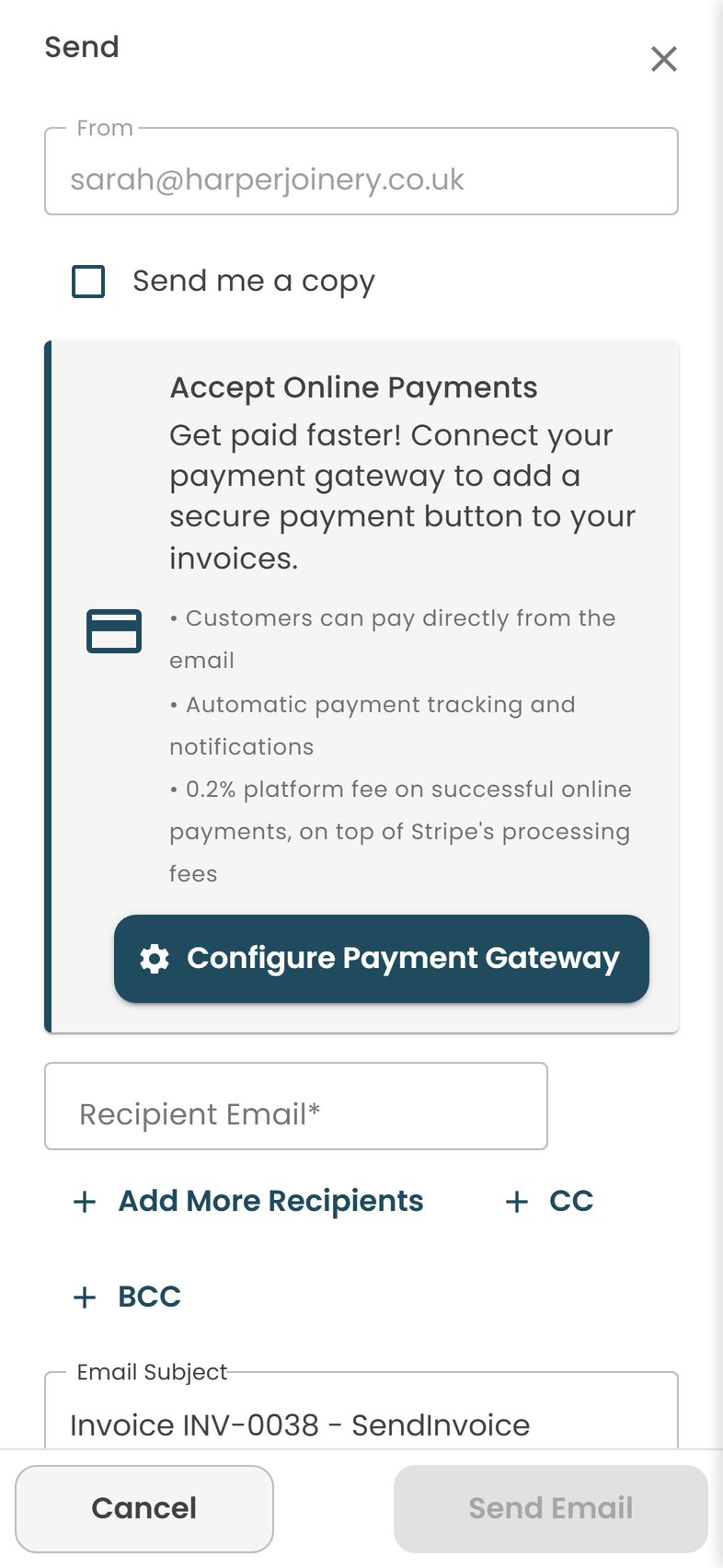
- Send it to Mrs Okafor's email, with the PDF attached and a Pay button in the message.
- Say: "That's the invoice sent over; there's a card button on it if that's easier, or the bank details are at the bottom."
About half his customers pay by card there and then. Most of the rest transfer that evening. He marks those paid from the document's action sheet when the notification arrives. The handful that drift get a friendly reminder on day three and a firmer one on day seven, and that is almost always the end of it. See getting paid on the day for how the fees compare with a card reader.
Cash is fine too, and legal; just give a receipt and record it the same day, because an undeclared cash job is the illegal part, not the cash. There is more on this in receipts for cash jobs and HMRC records.
Landlords, letting agents and the 30-day problem
A lot of handyman work comes from letting agents: a dripping tap in a rental, a gate at a tenanted house, a list of pre-tenancy snags. The work is the same; the invoicing is different.
- Put the property address on every invoice, separate from the agent's billing address. An agent managing 200 properties cannot pay an invoice that just says "gate repair".
- Quote their works order or PO number if they gave you one. Invoices without it go to the bottom of the pile.
- Expect 30-day terms, and agree them up front rather than discovering them.
- You have more rights. An agent or a landlord's company is a business customer, so the Late Payment of Commercial Debts (Interest) Act 1998 applies: statutory interest at 8% above base rate plus a fixed sum (£40 for a debt under £1,000, at the time of writing). For Mrs Okafor, a private homeowner, it does not; you could ask a court for interest at its discretion, but not the fixed sum.
Keep a customer record for each agent so the billing details and the PO habit are already there next time. The full picture is in invoicing landlords and letting agents.
Call-outs, emergencies and the lockout at 9 pm
If you do emergency work, say a burst pipe shut-off or a boarded-up window, state the call-out fee and the out-of-hours rate when the phone rings, and put them on the invoice as their own lines: "Out-of-hours call-out, £75" and then the labour. Customers who were quoted it on the phone pay it; customers who find it on the invoice feel ambushed. More in call-out fees and emergency work invoices.
Keeping the records light
A handyman can send twenty invoices a week. The temptation is to let them pile up and sort it at the year end. Instead, three habits that take less time than finding a lost receipt:
- Number everything in one sequence (INV-0347, INV-0348) and never reuse or skip. See invoice numbering explained.
- Glance at Paid / Unpaid / Overdue every evening. Small invoices drift because nobody looks; the red badges are your list.
- Export the month for your accountant or your own Self Assessment folder, and keep invoices, receipts and bank records for at least five to six years. Making Tax Digital for Income Tax starts to apply from April 2026 for the self-employed with income over £50,000 (lower thresholds follow), so quarterly tidy records are becoming the norm anyway.
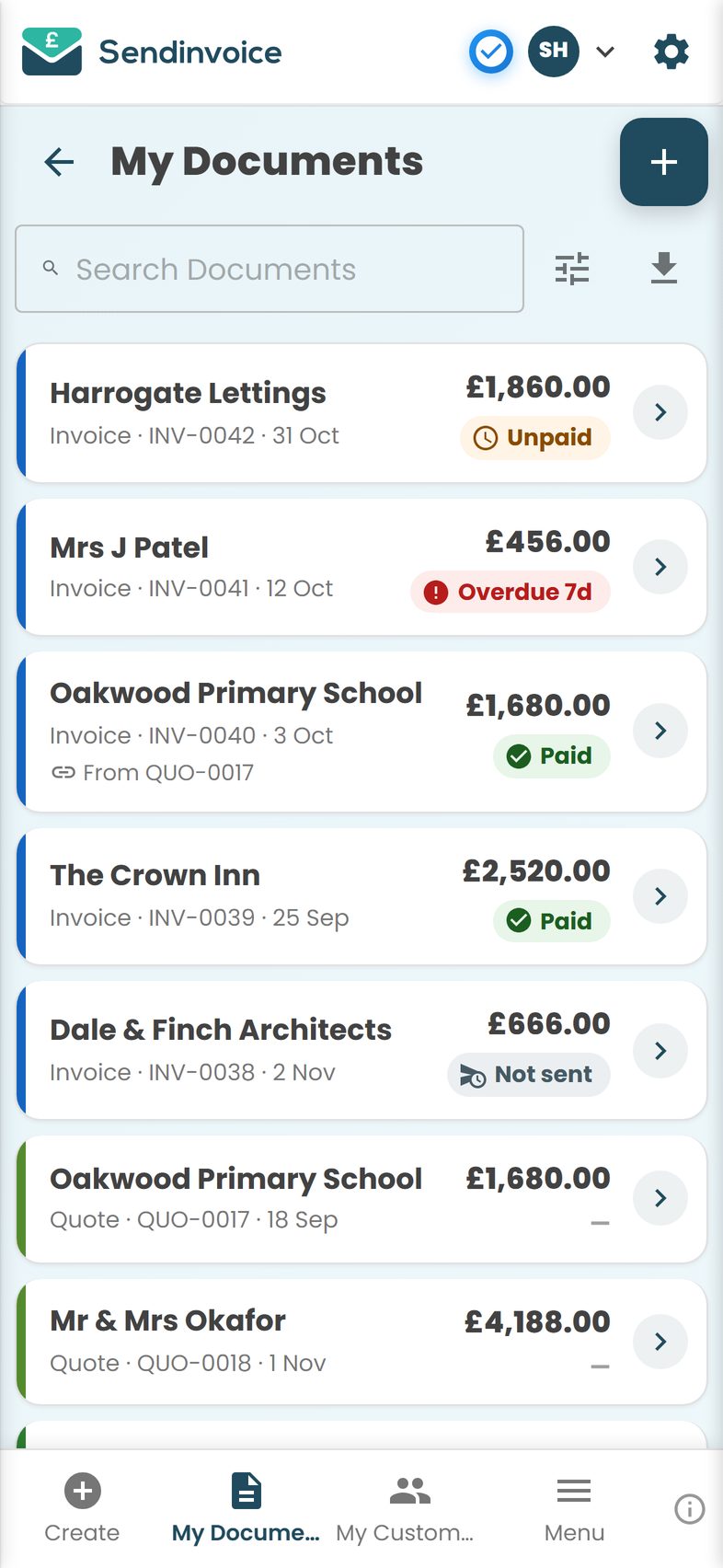
The work will always be a bit of everything. The invoices do not have to be. One visit, one invoice, labour and parts separated, sent before you leave, paid by card in the hallway. Mrs Okafor's £227.70 was in Marcus's account before he had found somewhere to park for lunch.
Do this in SendInvoice
Start the invoice in the van, add the parts in the hallway, and send it with a Pay button before the van door shuts. Customers you have invoiced before fill in as you type. Free to create and preview; £5 a month to send, take card payments and see what is still unpaid at a glance.
Create a free invoice See the £5/month planFrequently asked questions
Should a handyman charge by the hour or by the job?
Most handymen do both: an hourly or half-day rate for a list of small jobs where the time is hard to predict, and a fixed price for anything they have done fifty times, like hanging a door or fitting a shelf. Whichever you choose, say it before you start and show it the same way on the invoice, so the customer sees exactly what they agreed to.
Can I put several different jobs on one invoice?
Yes, and for a single visit you should. One invoice for the visit, with each job on its own line (or listed under a single labour line if you charged a half-day rate), plus materials. It is cleaner for the customer, easier to pay in one go, and simpler for your records than four invoices for one Tuesday morning.
Is it worth having a minimum charge?
Yes. A single small job still costs you travel, parking and the gap in your day. A one-hour or two-hour minimum, stated when you book the visit, is normal and customers rarely object. Put it on your quote or your confirmation text so it is not a surprise on the invoice.
Do I need to charge VAT as a handyman?
Only if you are VAT registered, which most sole-trader handymen are not because their turnover is below the threshold (£90,000 at the time of writing). If you are not registered, do not add VAT, show a VAT number or mention VAT on the invoice. Keep an eye on your rolling twelve-month turnover and check with HMRC or an accountant if you get close.
How do I get paid on the day for small jobs?
Send the invoice from your phone while you are still in the house, with a card payment link in the email, and ask. 'I've sent the invoice over, there's a Pay button on it' works far better than 'I'll pop it in the post'. Bank transfer is fine too; mark it paid when it arrives. Cash is legal, but give a receipt and record it.
Can I add late payment interest if a customer does not pay?
If the customer is a business, a landlord's company or a letting agent, the Late Payment of Commercial Debts (Interest) Act 1998 lets you add statutory interest and a fixed sum. For a private homeowner it does not apply; you can ask a court for interest at its discretion, but you cannot add the fixed £40 sum. Polite reminders sort most of it long before that.