An invoice is a short, polite, legally recognised way of saying "the work is done, here is what you owe me". Get the handful of details right and it will get paid without a conversation. Miss one and you will be fielding "sorry, what's this for?" emails for a week. Here is exactly what to put on a UK invoice, in what order, with a worked example you can copy.
What an invoice is (and what it is not)
An invoice is a request for payment. It records what you supplied, to whom, when, and how much they owe. It is not a receipt (that comes after they pay), it is not a quote (that comes before the work), and it is not a contract on its own, though it is strong evidence of one.
There is no official UK invoice form. HMRC does not care whether it is a PDF or a sheet torn from a duplicate book, only that it carries the right information and that you keep a copy.
What a UK invoice must include
The requirements step up depending on what kind of business you are. Most people reading this will be in the first group.
Every invoice, including sole traders and freelancers
- The word Invoice, clearly, so nobody files it as a quote.
- A unique invoice number that runs in sequence (INV-0001, INV-0002 and so on).
- Your name, business name (if you trade under one) and address. A sole trader trading as "Harper & Co Joinery" should show both "Harper & Co Joinery" and the owner's name, for example "Dan Harper trading as Harper & Co Joinery".
- The customer's name and address.
- The invoice date.
- A clear description of the goods or services, with quantities where they make sense.
- The amount for each line and the total due.
- Payment terms and how to pay: due date, bank details or a card payment link. Not strictly a legal requirement, but leave them off and you are inviting delay.
If you are a limited company
Add the full registered company name as it appears at Companies House, the company registration number, and the registered office address (even if you work from somewhere else).
If you are VAT registered
Your invoice becomes a VAT invoice (sometimes called a tax invoice) and must also show:
- Your VAT registration number.
- The tax point (time of supply), if it differs from the invoice date.
- For each line, the net amount, the VAT rate and the VAT amount.
- The total net, total VAT and total including VAT.
- Any discount offered, per line.
For sales under £250 including VAT you may issue a simplified VAT invoice with less detail. And if you are not VAT registered, do not charge VAT, do not show a VAT line and do not put a VAT number on it. We have a whole post on invoicing when you are not VAT registered.
How to write an invoice, step by step
- Head it "Invoice" and give it the next number. If this is your first, start at INV-0001. Never reuse a number, even for a cancelled job; raise a credit note instead.
- Put your details at the top. Name, trading name, address, email, phone. Add your logo if you have one. If you are a company or VAT registered, add the extra details above.
- Add the customer's details. Name and address, and the name of the person who approved the work if it is a bigger organisation. Invoices addressed to "Accounts" with no contact name tend to go for a wander.
- Date it. Today, ideally. The invoice date starts the payment clock.
- Describe the work in plain words. "Supply and fit two fitted wardrobes, Bedroom 1, as per quote QUO-0017" beats "Joinery works". Reference the quote or purchase order number if there was one; it stops queries before they start.
- List quantities and prices. One line per thing. Materials and labour on separate lines is a kindness to the customer and to your future self at tax time.
- Add VAT, if and only if you are registered. Show the rate and the amount per line and in the totals.
- Total it. Make the amount due the biggest number on the page.
- State the terms. "Payment due within 14 days of the invoice date." Add your bank details (account name, sort code, account number) or a card payment link, or both. If you intend to charge late payment interest, say so here.
- Check it, then send it the same day the work finishes. Email with a PDF attached is standard. Keep a copy.
A worked example
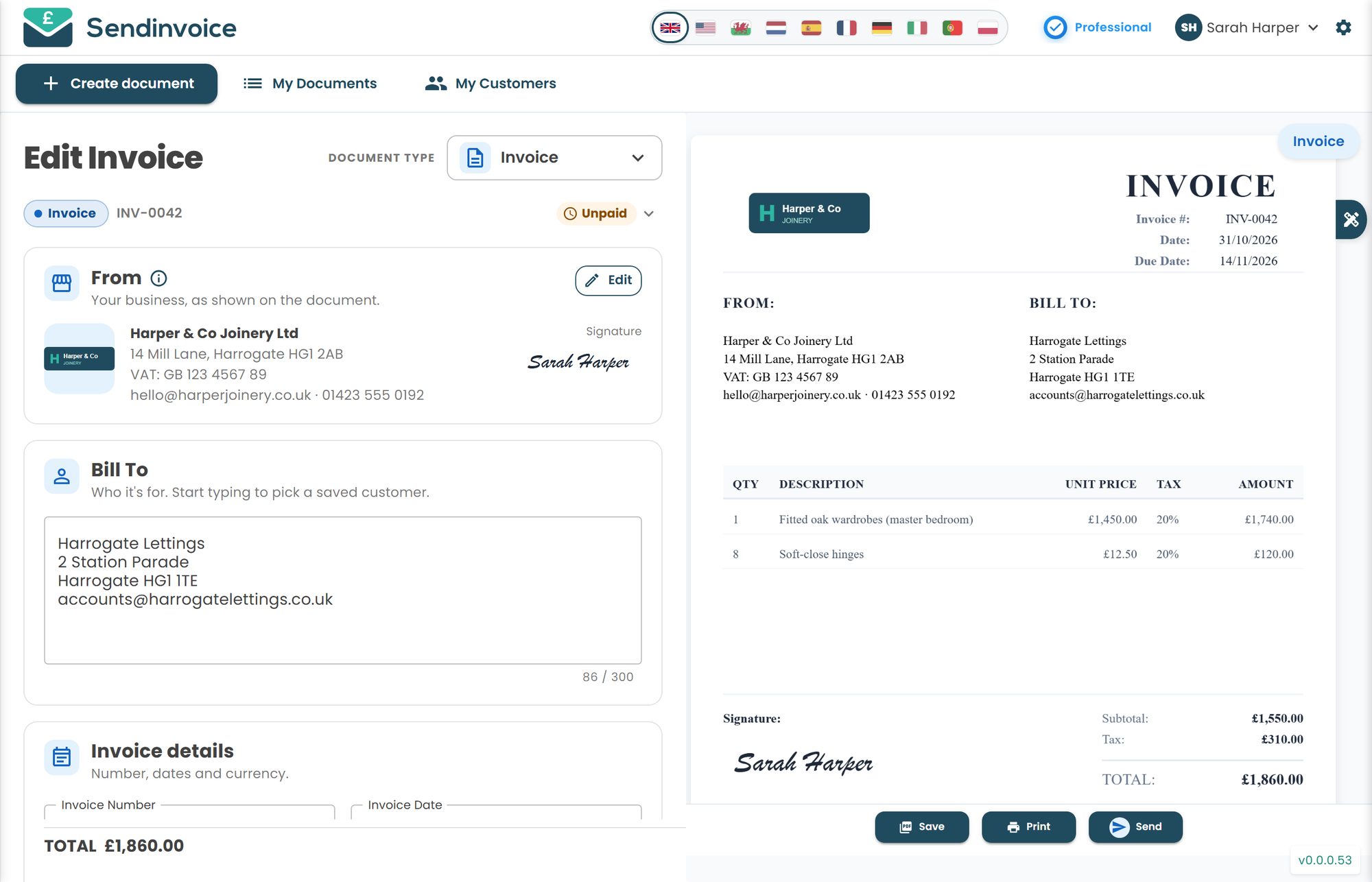
Dan Harper is a sole trader, VAT registered, trading as Harper & Co Joinery in Knaresborough. He has just finished fitting wardrobes in a rental property for Harrogate Lettings, who accepted his quote QUO-0017 for £1,450 plus VAT. Here is what his invoice says.
| Invoice | INV-0042 |
|---|---|
| Date | 3 November 2026 |
| From | Dan Harper trading as Harper & Co Joinery 14 Abbey Road, Knaresborough, HG5 8HY [email protected] · 07700 900123 VAT no. GB 123 4567 89 |
| Bill to | Harrogate Lettings Ltd FAO Priya Shah 22 Station Parade, Harrogate, HG1 1UE |
| Reference | Your quote QUO-0017, accepted 14 October 2026 |
| Description | Qty | Unit price | VAT | Amount |
|---|---|---|---|---|
| Fitted wardrobe, Bedroom 1, oak veneer, supply and fit | 2 | £575.00 | 20% | £1,150.00 |
| Labour: fitting, trimming and finishing | 1 | £300.00 | 20% | £300.00 |
| Net total | £1,450.00 | |||
| VAT at 20% | £290.00 | |||
| Total due | £1,740.00 | |||
Terms: Payment due within 14 days, by 17 November 2026. Bank transfer to Harper & Co Joinery, sort code 04-00-04, account 12345678, reference INV-0042, or pay by card using the link in this email. We reserve the right to charge statutory interest and compensation on late payments under the Late Payment of Commercial Debts (Interest) Act 1998.
Notice what is doing the work here. The reference to the accepted quote means nobody at Harrogate Lettings has to go looking for authority to pay. The named contact means it lands on Priya's desk, not in a shared inbox. And the terms give a specific date, two ways to pay, and a quiet reminder that late payment has a cost.
If Dan were not VAT registered, the VAT column, VAT number and "VAT at 20%" row would vanish and the total due would be £1,450.00.
Common mistakes (and the fix for each)
- No invoice number, or numbers out of order. It looks amateur and it confuses everyone's bookkeeping. Use a running sequence per document type and let your software increment it.
- Charging VAT when you are not registered. This is not a slip, it is an offence. If you are below the threshold and unregistered, VAT does not appear anywhere.
- Vague descriptions. "Work as discussed" is a query waiting to happen. Say what, where, how many.
- No due date, or no way to pay. "Payment on receipt" means different things to different people. Give a date, your sort code and account number, and a card link if you can.
- Sending it a fortnight later. The longer the gap between finishing and invoicing, the longer the gap between invoicing and being paid. Send it from the van before you drive off.
- Arithmetic errors. A hand-typed total that does not match the lines will be sent back. Let the software add up.
How long to keep invoices
Keep every invoice you send and receive; HMRC can ask to see them. The rule of thumb is at least 5 to 6 years: self-employed people need records for at least 5 years after the 31 January filing deadline for the relevant tax year; limited companies and VAT-registered businesses need 6. A PDF stored in your invoicing app counts.
From April 2026, Making Tax Digital for Income Tax applies to self-employed people and landlords with income over £50,000 (dropping to £30,000 in April 2027 and £20,000 in April 2028, at the time of writing). You do not need full accounting software to be ready, but you do need your invoices stored digitally and easy to total up. If any of this is close to home, check the current position with your accountant or HMRC.
A thirty-second check before you send
Says "Invoice", next number in sequence, both parties' details with a named contact, dated today, a description a stranger could follow, lines that add up, VAT only if registered, due date and payment details, copy saved. Eight ticks and it goes. Then the only thing left to feel is the small, specific pleasure of a payment notification landing a few days later.
Do this in SendInvoice
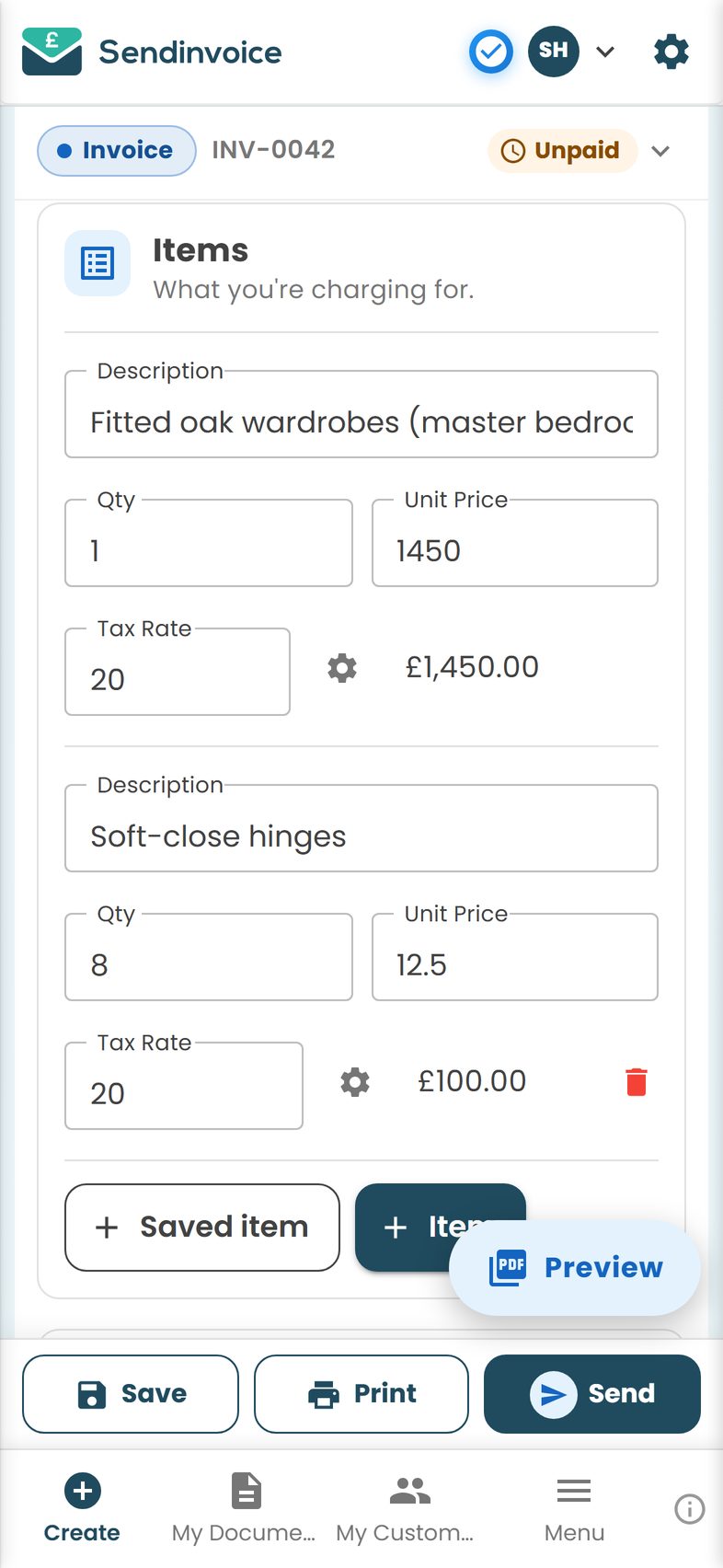
Enter your business details once, pick a template, add your lines and the numbering, totals and VAT are handled for you. Send it from your phone with a Pay button in the email and watch it flip to Paid.
Create a free invoice See the £5/month planFrequently asked questions
Do I need to be registered as a business to send an invoice in the UK?
No. Anyone who sells goods or services can issue an invoice. If you are self-employed you should register with HMRC for Self Assessment, but you do not need a company, a VAT number or any special licence to invoice a customer.
What does an invoice legally have to include in the UK?
A unique invoice number, your name or business name and address, the customer's name and address, the invoice date, a clear description of what you supplied and the amount due. Limited companies must also show the registered company name, number and registered office. VAT-registered businesses must add their VAT number, the VAT rate and amount per line, the net total and the tax point.
Can I write an invoice if I am not VAT registered?
Yes. Just leave VAT off entirely: no VAT line, no VAT number, no "plus VAT". Your total is simply the amount you are charging. Some people add a line saying "Not VAT registered" so customers know not to expect one.
What is the default payment term if I do not state one?
If you have not agreed anything with the customer, the law treats 30 days as the default for business-to-business invoices. It is far better to state your own terms on the invoice, for example "Payment due within 14 days".
Can I charge interest on a late invoice?
For business customers, yes. The Late Payment of Commercial Debts (Interest) Act 1998 lets you charge statutory interest of 8% plus the Bank of England base rate, plus fixed compensation of £40, £70 or £100 depending on the size of the debt (at the time of writing). You do not need a clause in the contract, though stating it on the invoice helps.
How long do I need to keep invoices?
Keep them for at least 5 to 6 years. Self-employed people need records for at least 5 years after the 31 January submission deadline of the tax year they relate to; limited companies and VAT-registered businesses need 6 years. Digital copies are fine.
Should my invoice numbers be in order?
Yes. Numbers must be unique and should run in sequence with no gaps, for example INV-0001, INV-0002. HMRC may ask about missing numbers, so if you cancel an invoice keep a record rather than reusing the number.
Is a PDF invoice legally valid?
Yes. There is no requirement for paper. A PDF sent by email is a perfectly good invoice in the UK, as long as it contains the required information.