Marcus painted the outside of a semi in Reading over four days in September: fascias, soffits, render and the front door. The quote was £1,480, the customer paid a £300 deposit, and the balance of £1,180 was due on completion. Three weeks later it is still unpaid. First it was "I'll do it tonight", then "my husband deals with that", then a message saying the fascia colour "isn't quite what we expected". Marcus has done nothing wrong, and he has a mortgage. Here is what he can do, in order, and what he must not.
First, work out which kind of non-payment this is
There are three different situations hiding behind "they haven't paid", and each needs a different first move.
- They forgot or are disorganised. By far the most common. A clear reminder with the amount and a way to pay fixes it.
- They are short of money. They meant to pay, cannot right now, and are embarrassed. A payment plan gets you more than a threat does.
- They are disputing the work. Real or invented, a dispute stops the clock. You have to deal with the complaint before the money, because a court will ask whether you did.
Marcus's customer drifted from the first to the third. The colour comment arrived after two reminders, which is the usual pattern when someone is looking for a reason not to pay. He still has to take it seriously: a short, calm reply asking exactly what is wrong, an offer to come and look, and a note that the colour was the one named on the quote (it was), puts the dispute on the record and, usually, ends it.
The ladder: reminder, firm reminder, phone call, letter before action, claim
The method is the same one in how to chase an unpaid invoice, tuned for a private customer. Every step is polite, every step is written, and each one is a little firmer than the last. Keep the same rhythm for every customer so it never feels personal.
The day after the due date: a friendly reminder
Short, warm, and with a way to pay in the message. If your invoice email has a Pay button, say so. If you take bank transfer, repeat the details.
Hi Sarah, Marcus here. Just a reminder that the balance of £1,180.00 on invoice INV-0117 for the exterior painting was due on completion. You can pay by card using the Pay button in the invoice email, or by bank transfer to the details on the PDF. If it has already gone, thank you and ignore this. Marcus
Seven days later: name it as late and ask for a date
"When can I expect payment?" is the key sentence. It is hard to ignore and easy to answer, and the answer, or the silence, tells you which of the three situations you are in.
Hi Sarah, I have not received the £1,180.00 balance on INV-0117, which was due on 19 September. I have attached the invoice again. Could you let me know when I can expect payment? If there is anything about the work you want to talk through, please tell me now and I will come and look. Thanks, Marcus
Then a phone call
One short, friendly call, in working hours, and never more than one a day. "Hi Sarah, it's Marcus, just ringing about the balance on the painting. Is everything OK?" Follow it up with a text or email that records what was said: "Thanks for the chat. As agreed, you'll pay £590 on Friday and £590 on the 31st." That message is now evidence of an agreed plan.
Fourteen days overdue: the formal notice
The tone changes from neighbour to business. State the facts, give seven days, and say what happens next. For a homeowner, do not quote the Late Payment of Commercial Debts Act; it does not apply to them and quoting it wrongly undermines you. If your terms include a late charge, mention it here. If they do not, say simply that you will begin a court claim.
Dear Mrs Patel,
Invoice INV-0117 for £1,180.00, the balance for exterior painting at 22 Cedar Road completed on 19 September, remains unpaid despite my reminders of 20 and 27 September and our call on 1 October.
Please pay in full by 17 October. You can pay by card using the link in the invoice email or by bank transfer.
If I do not receive payment by that date I will send a formal letter before action and, if necessary, start a claim in the county court, where I will ask for the court fee and interest to be added to the amount owed. I would much rather settle this between us, so if you are having difficulty paying, please contact me and we can agree a plan.
Yours sincerely,
Marcus Bell, Bell Decorating
The letter before action
This is the last step before court and the first one a judge will look at. When a business claims money from a private individual, the Pre-Action Protocol for Debt Claims applies. At the time of writing it requires your letter to set out the amount, how it arose, how to pay and how to dispute it, and to enclose an information sheet and reply form; the customer then has 30 days to respond. Send it by post and email, keep a copy, and check the current protocol on the Ministry of Justice website before you send it, because the detail matters. The small claims guide walks through the letter and what comes after it.
Small claims
In England and Wales, a debt up to £10,000 goes through the small claims track, and you can start it online through Money Claim Online. There is a court fee that depends on the amount, from around £35 for the smallest claims at the time of writing, and it is added to the claim. Scotland uses Simple Procedure for claims up to £5,000; Northern Ireland has its own small claims process. You do not need a solicitor, and a surprising number of homeowners pay the moment the claim form lands on the mat.
What interest you can and cannot add
This trips up a lot of tradespeople, because most late-payment advice online is written for business-to-business invoices.
- Business customer (a letting agent, a landlord's company, a main contractor, a shop): the Late Payment of Commercial Debts (Interest) Act 1998 applies automatically. You can add statutory interest at 8% above the Bank of England base rate and a fixed sum of £40, £70 or £100 depending on the size of the debt, at the time of writing.
- Private homeowner: none of that applies. You can only charge a late fee or interest if your written terms set one out, the customer agreed to them before the work, and the amount is reasonable. If you end up in court you can ask for interest under the County Courts Act 1984, which a judge may award at their discretion, typically around 8% a year from the date the money was due. You cannot add the fixed £40, £70 or £100 sums to a consumer debt.
On Marcus's £1,180, 8% a year is about 26p a day, so four months late comes to roughly £31. It is not the interest that moves people; it is the court fee, the judgment and the knowledge that you know what you are doing. Our guide to terms and conditions for tradespeople has wording for a reasonable late charge on consumer jobs.
Worked example: the invoice Marcus is chasing
The final invoice shows the deposit already paid and the balance due, so there is never an argument about what the £1,180 is. Marcus is a sole trader and not VAT registered, so no VAT appears.
Invoice INV-0117 from Bell Decorating to Mrs S Patel, 22 Cedar Road. Created from QUO-0104. Due on completion, 19 September.
| Description | Qty | Unit price | Amount |
|---|---|---|---|
| Labour: prepare and paint fascias, soffits, render and front door (4 days) | 4 | £240.00 | £960.00 |
| Materials: masonry paint (Sandstone), exterior gloss (Anthracite), primer, filler, sundries | 1 | £390.00 | £390.00 |
| Access tower hire, 4 days | 1 | £130.00 | £130.00 |
| Subtotal | £1,480.00 | ||
| Less deposit paid 5 September (PRO-0031) | -£300.00 | ||
| Balance due (no VAT; not VAT registered) | £1,180.00 |
Colours as named on quote QUO-0104 and confirmed by text on 3 September. Payment due on completion by card link or bank transfer.
Notice how much of the dispute this invoice closes down before it starts. The colours are named and tied back to a text. The deposit is shown. The due date is unambiguous. Had Marcus taken a larger deposit, or split the job into two stage invoices, he would be chasing far less: deposits and staged payments explains how.
What never to do, however angry you are
A tradesperson who has been messed about has every right to be furious. The list below is about protecting your claim and your reputation, not about being nice to someone who does not deserve it.
- Do not go back and undo the work. Paint on a wall, tiles on a floor and a boiler on a bracket belong to the property. Removing them is likely criminal damage, and it hands the customer a counterclaim.
- Do not turn up at the door in the evening, or repeatedly. One visit in daylight to look at a complaint is reasonable. Anything that could be described as pressure can be treated as harassment.
- Do not name them online. Facebook groups, review sites and WhatsApp chats are not courts. Defamation claims are expensive, and prospective customers who see you airing a dispute will quietly pick someone else.
- Do not send a dozen messages. One per step, on the schedule. The record of calm, spaced, polite reminders is the strongest thing you will take into a small claim.
- Do not stop keeping records. Every message, photo and date goes in a folder. Photos of the finished work, taken before you leave site, are worth more than anything you can say later.
Making the next one easier
Every tradesperson has one of these stories. The ones who only have one changed something afterwards. The usual changes are small: a deposit on every job over a day, stage invoices on anything longer than a week, a one-line payment term on the quote, and sending the final invoice while you are still standing in the customer's hallway with the work in front of them.
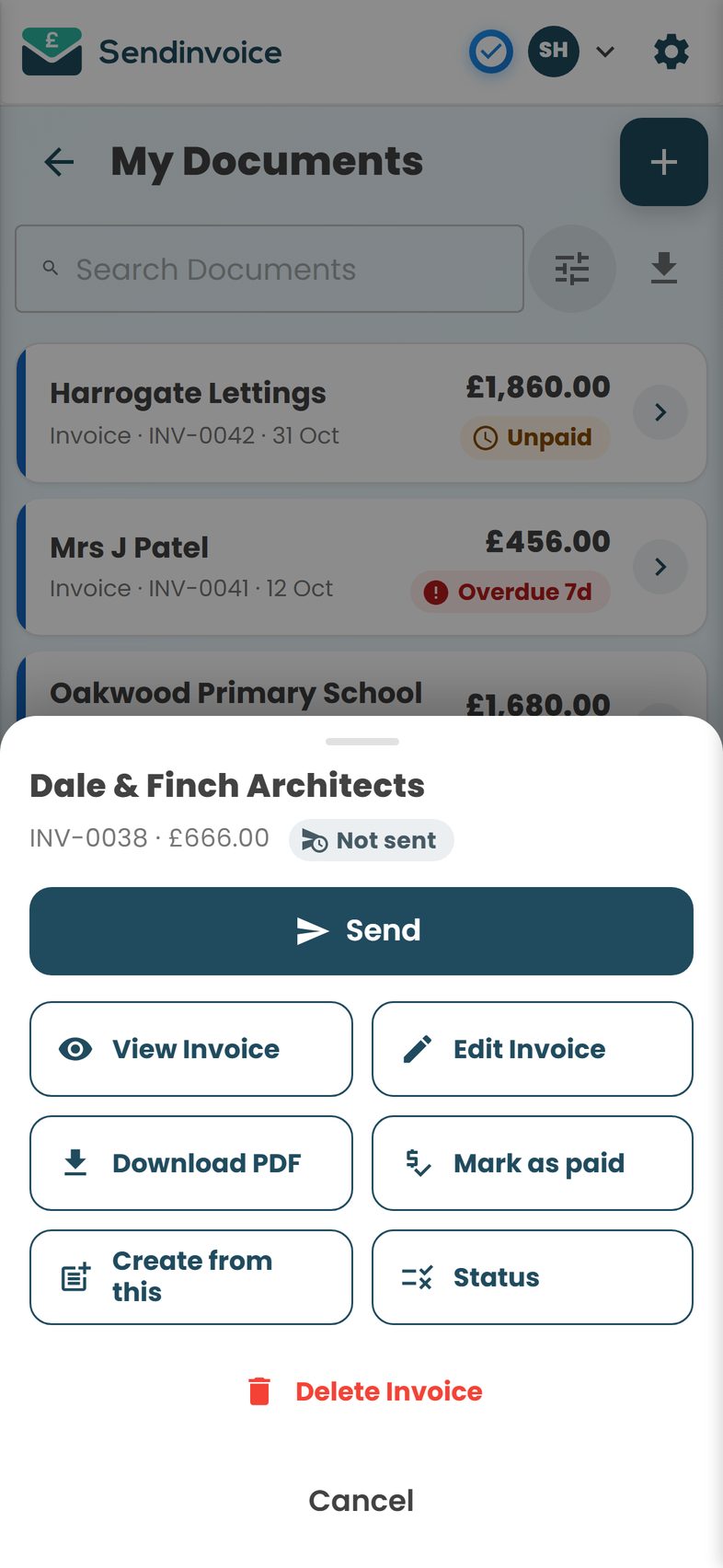
The last one matters more than it sounds. A customer who has just admired their freshly painted house pays on the spot far more often than one who gets a PDF a fortnight later. If the invoice email carries a Pay button, they can do it from their phone before you have packed the dust sheets, and you watch it flip to Paid before you pull away.
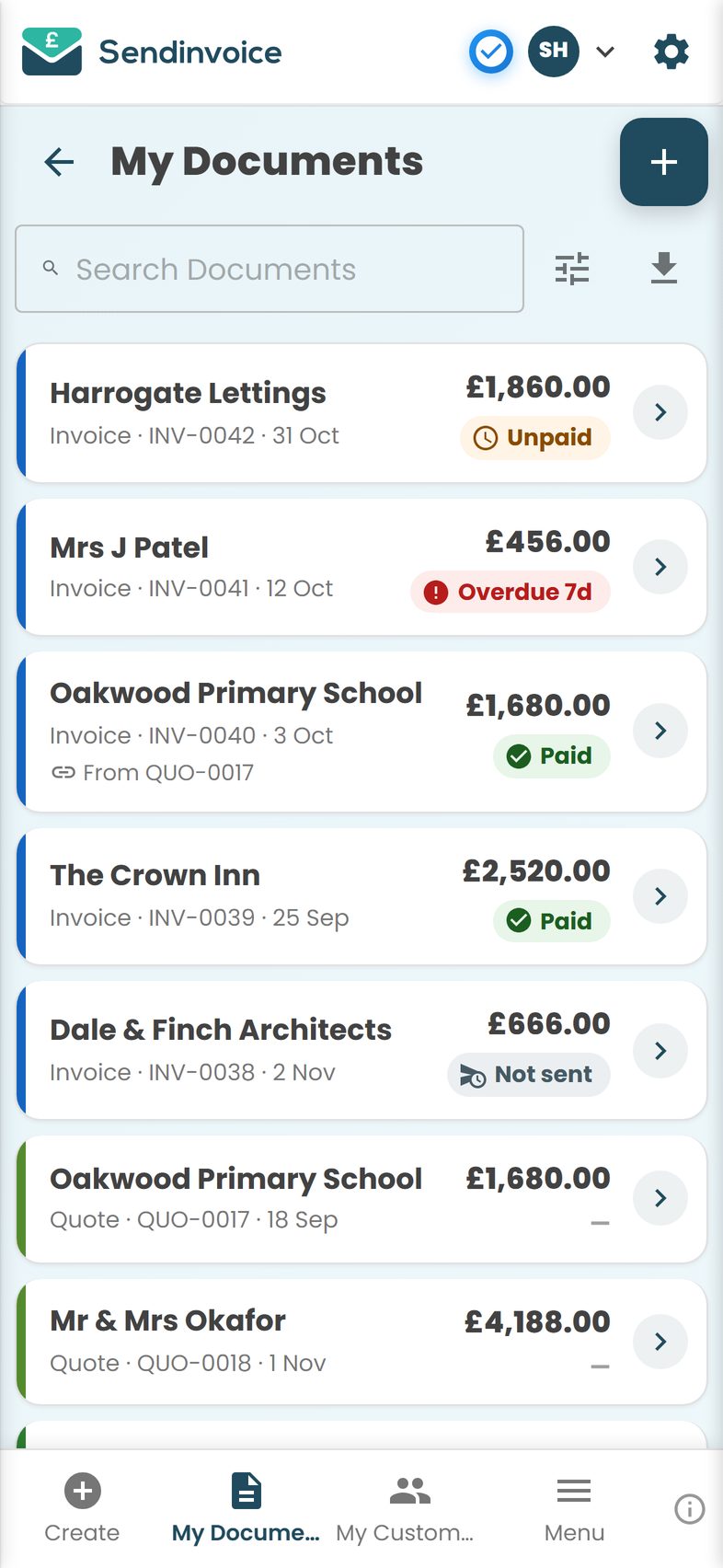
For the invoices that still drift, escalating reminders go out on their own, friendly first and firmer later, each with the Pay button in it, so you are not writing the awkward email at ten o'clock at night. And when you do need to take it further, every send, resend and reminder is dated in the record, which is exactly what a letter before action and a small claim need.
Do this in SendInvoice
Send the final invoice from the customer's hallway with a Pay button in the email, see Overdue in red before you leave the yard, and let escalating reminders do the chasing while you are up a ladder. Free to create and preview; £5 a month to send, remind and get paid by card.
Create a free invoice See the £5/month planFrequently asked questions
How long should I give a homeowner to pay before chasing?
Chase on the due date. If your quote said payment on completion, a reminder the next morning is not rude; it is normal. Most homeowners who have not paid simply forgot, and a short friendly message with the amount and a way to pay sorts it. Leaving it a month makes the conversation harder and the money less likely to arrive.
Can I charge interest when a private customer pays late?
Not under the Late Payment of Commercial Debts (Interest) Act 1998; that only covers business customers, along with the fixed £40, £70 and £100 sums. For a homeowner you can only charge what your written terms set out, if they are reasonable. If it goes to court, the judge can award interest under the County Courts Act, typically 8%, at their discretion.
Can I take back materials or undo the work if they do not pay?
No. Once materials are fixed to the property they belong to the property, and going back to remove them would likely be criminal damage and would wreck any claim you have. Removing a boiler, ripping out a kitchen or taking tiles off a wall are stories that end badly for the tradesperson. Use the ladder and the courts instead.
What is a letter before action?
A formal letter telling the customer exactly what they owe, for what, by when, and that you will start a court claim if they do not pay. If the customer is a private individual, the Pre-Action Protocol for Debt Claims applies, which sets out what the letter must include and gives them 30 days to respond. Check the current protocol before sending.
Is small claims court worth it for a few hundred pounds?
Often yes. The court fee for the smallest claims is around £35 at the time of writing, it is added to what the customer owes, and you can do the whole thing online without a solicitor. Many homeowners pay as soon as the claim form arrives. Weigh it against your time and whether they have the means to pay.
Should I leave a review or post about them online?
No. Naming a customer in a Facebook group or a review site can expose you to a defamation claim and makes you look worse than them to future customers. Keep everything in writing, keep it factual and keep it private. The record of polite, consistent reminders is what wins a small claim.