
Payment terms are the two or three words on an invoice that decide when the money arrives. Most sole traders copy whatever they saw on someone else's invoice, usually "Net 30", and then wonder why they are always a month behind. Here is what the terms mean, what UK law says when you forget to say anything, and the combination that actually gets small jobs paid in days rather than weeks.
What payment terms are (and why they are not a formality)
Your payment terms are the agreement about when and how the customer pays: the due date, any deposit, the accepted methods, and what happens if payment is late. They belong on the quote as well as the invoice, because a term the customer only sees after the work is done is a term they never agreed to.
They matter more to a one-person business than to anyone else. If a big company's customer pays 30 days late, it is a line in a cash-flow report. If yours does, it is the van insurance.
The common terms, compared
You will meet these on invoices from every kind of business. Here is what each one means and who it suits.
| Term | Meaning | Good for | Watch out for |
|---|---|---|---|
| Due on receipt | Pay as soon as you get the invoice | Finished small jobs, one-off services, anything under about £1,000 | Needs an easy way to pay or "on receipt" becomes "when I get round to it" |
| Net 7 / Net 14 | Full amount due 7 or 14 days after the invoice date | Regular clients, freelancers, small business customers | Short enough to feel prompt, long enough to get lost under other emails |
| Net 30 | Full amount due 30 days after the invoice date | Larger companies with a purchase-ledger process | The default for big firms; a month of waiting for everyone else |
| Net 60 / Net 90 | Due 60 or 90 days after the invoice date | Almost nobody you want to work for | You are lending money interest-free; only accept it with a deposit |
| End of month (EOM) | Due at the end of the month the invoice is dated, or the month after | Trade accounts, suppliers | Varies by convention; spell out the actual date |
| 2/10 Net 30 | 2% off if paid within 10 days, otherwise full amount in 30 | Wholesale and distribution | Giving away 2% to get paid; a Pay button does it for less |
| Deposit, balance on completion | Part up front, rest when the job is done | Any job involving materials or more than a few days' work | Issue a proforma for the deposit, then a final invoice for the balance |
| Stage payments | Fixed amounts at agreed milestones | Building work, long design projects | Agree the stages in writing on the quote |
A vocabulary note: "Net" just means the whole balance with no discount, so "Net 30" and "30 days" mean the same thing. Saying "within 30 days of invoice date" avoids any argument about when the clock starts.
The 30-day default: what happens when you say nothing
If your customer is a business and you did not agree a payment term, UK law fills in the gap. Under the Late Payment of Commercial Debts (Interest) Act 1998, payment is due 30 days after the later of the day the customer receives your invoice or the day they receive the goods or services. After that, statutory interest starts running.
Thirty days is also what most people have in their head as "normal", which is why a blank invoice tends to be paid in about five weeks. If you want to be paid faster, you have to say so, before the work starts.
For private customers (a homeowner, a bride, a parent booking tuition) there is no statutory default in the same way. Whatever you agreed is the term, and if you agreed nothing, a court would look at "a reasonable time". All the more reason to write it down.
Why "due on receipt" plus a Pay button beats Net 30 for small jobs
Here is the pattern with small jobs. Dave the electrician replaces a consumer unit on Tuesday, emails a PDF marked "Net 30" on Wednesday, and the customer, who fully intended to pay, files it mentally under "sometime next month". On day 31 Dave sends an awkward reminder. On day 38 a bank transfer arrives.
Now the alternative. Dave builds the invoice on his phone while packing the van, marks it "Due on receipt", and sends it before he has left the drive. The email has a Pay button. The customer, still pleased with the shiny new fuse board, taps it, enters their card, and the invoice is Paid before Dave gets home.
Two things make this work:
- The term matches the moment. "Due on receipt" is reasonable for a finished job the customer has just seen. It would feel pushy on a £12,000 kitchen; it feels normal on a £340 call-out.
- Paying is one tap. The gap between "I should pay that" and "I have paid that" is where late payments live. A bank transfer needs a laptop, a card reader and a sort code typed correctly. A Pay button needs a thumb.
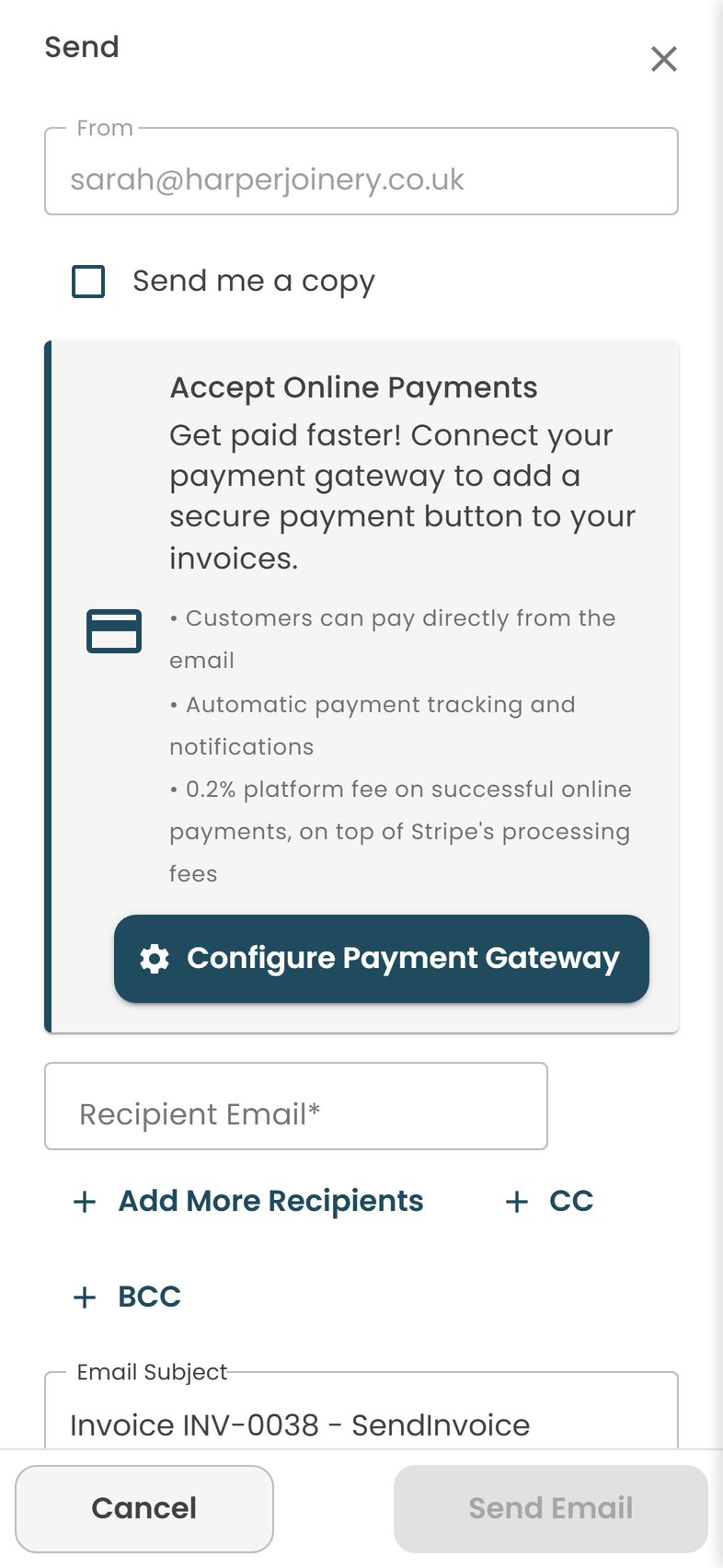
For regular business clients who run a purchase ledger, Net 14 is a fair compromise. Save Net 30 for the customers who insist on it, and keep the Pay button in the email regardless; plenty of accounts departments will pay by card on day 3 if it saves raising a bank payment.
Deposits for bigger jobs: use a proforma
Once a job involves materials you have to buy, or more than a couple of days of your time, a deposit is not rude. It is normal, and good customers expect it. Typical figures are 25% to 50% up front with the balance on completion, or stage payments for anything that runs over several weeks.
The right document for a deposit request is a proforma invoice. It looks like an invoice and states the amount and how to pay, but it is not a tax invoice and is not recorded as a sale until the real invoice is raised. The flow for a £4,800 landscaping job might be:
- Quote QUO-0017 for £4,800, with terms: "40% deposit on acceptance, balance due on completion. Due on receipt."
- Customer accepts. Create a proforma from the quote for the £1,920 deposit, with a Pay button. Deposit lands; you order the sleepers.
- Job finishes. Create the final invoice from the quote for the full £4,800, showing the £1,920 already paid and £2,880 now due. Send it from the garden gate.
Because each document is created from the one before, the details carry over and the documents stay linked. Nobody retypes anything.
Late-fee wording you can paste into your terms
If your customer is a business, the Late Payment Act applies whether or not you mention it. But mentioning it changes behaviour and saves the argument later. At the time of writing, the Act gives you statutory interest at 8% per year above the Bank of England base rate, plus fixed compensation per invoice of £40 (debt under £1,000), £70 (£1,000 to £9,999.99) or £100 (£10,000 or more).
Wording for business customers that quotes the Act correctly:
Payment terms: Payment is due on receipt of this invoice unless otherwise agreed in writing. We reserve the right to charge statutory interest at 8% above the Bank of England base rate and fixed compensation for recovery costs under the Late Payment of Commercial Debts (Interest) Act 1998 on any overdue amount.
For private customers, the Act does not apply, so you need an agreed, reasonable fee in your terms before the job starts. Keep it modest, and put the same wording on the quote:
Payment terms: Payment is due within 7 days of the invoice date. Overdue amounts may incur interest at 4% per year above the Bank of England base rate, calculated daily from the due date until payment is received.
A court can decide a consumer late fee is unfair if it is out of proportion, so do not copy the £40 compensation sum into a homeowner contract. And whatever your terms say, the ladder of polite reminders in our guide to chasing unpaid invoices is what gets most invoices paid. The fee is the backstop, not the plan.
Set your terms once and stop thinking about it
The worst way to manage terms is to retype them on every invoice, because one day you will type "Net 30" out of habit and lose a month. Set them once. In SendInvoice, your business details, bank details and default terms live in Settings and fill in automatically on every new document, and the due date is a single field you can nudge for a particular customer without touching the default.
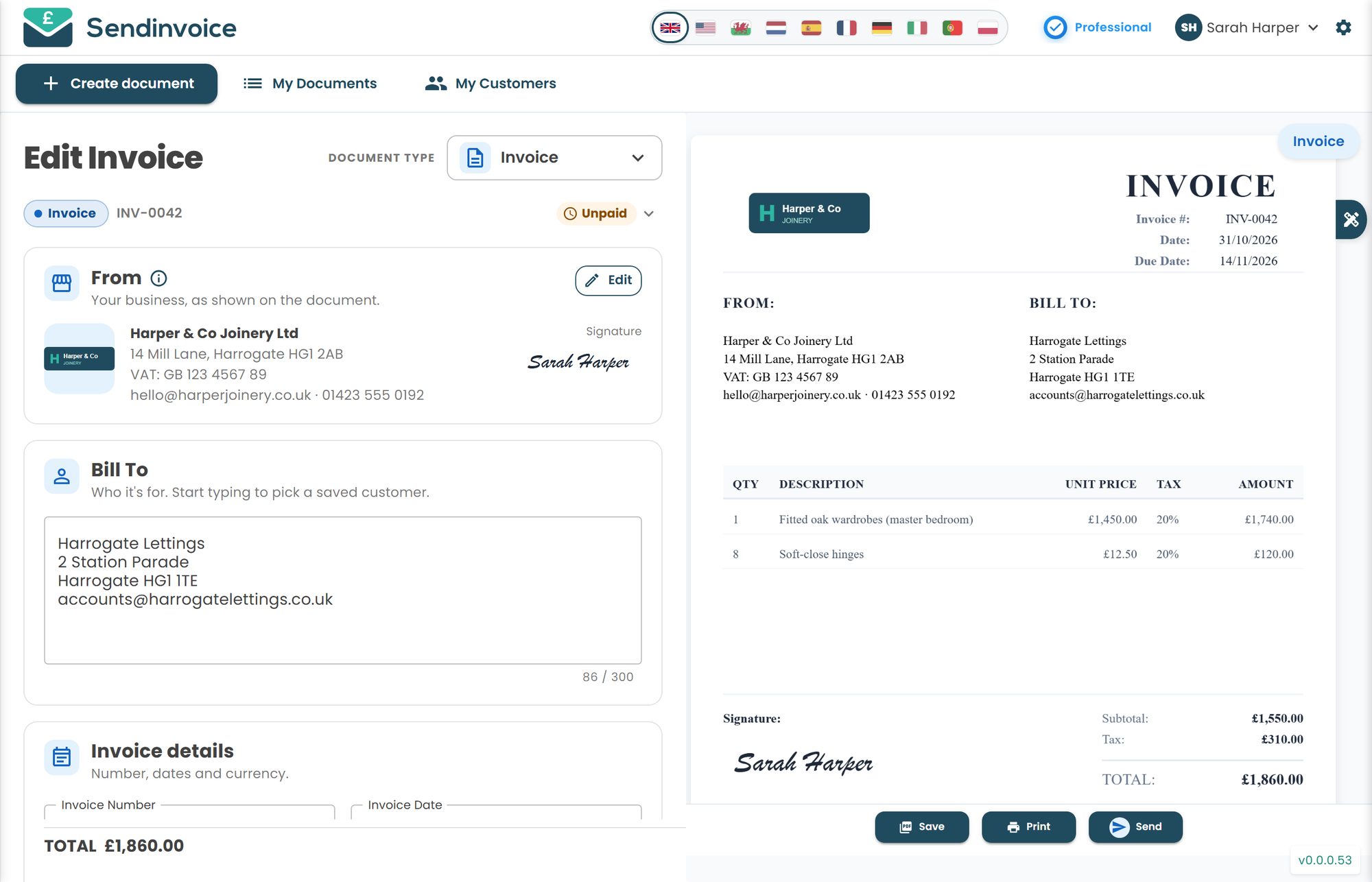
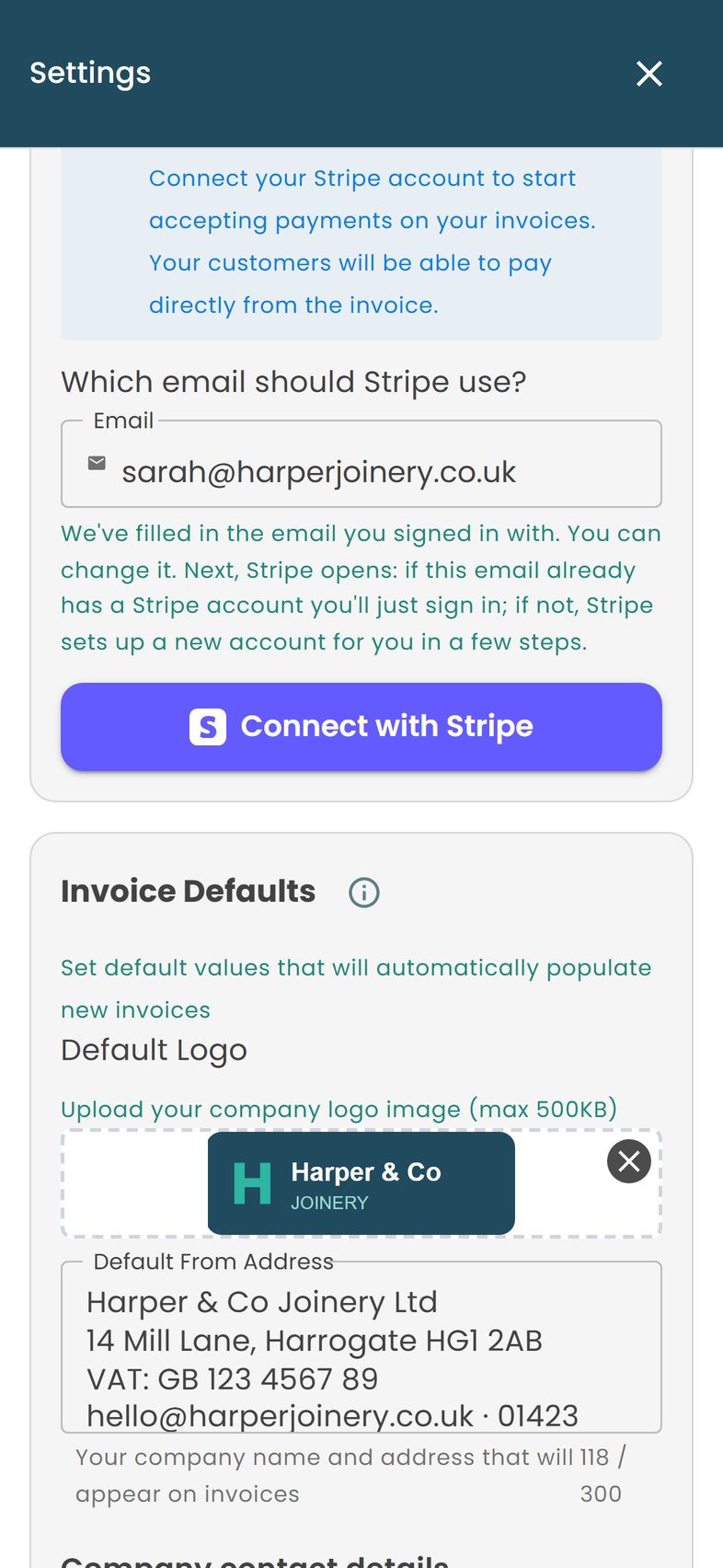
Card payments are a one-off setup too: connect Stripe from Settings and the Pay button appears on every invoice email and PDF from then on. When the customer pays, the invoice flips to Paid automatically with a green tick in My Documents.
An honest note on what getting paid costs
Different tools charge for this in different ways, and the difference matters once you are invoicing real money. SendInvoice's Professional plan is a flat £5 a month, cancel any time, plus 0.2% on online card payments and Stripe's own processing fee. Some well-known alternatives have no monthly fee but take a percentage of every payment instead: Square's invoice card rate is around 2.5%, and PayPal around 2.9% plus a fixed amount per transaction, at the time of writing.
On £3,000 a month of card payments, a flat fee plus 0.2% comes to roughly £11 before Stripe's processing; a 2.5% percentage-only model comes to £75. Percentage fees feel free until you are busy. Do the sum for your own numbers; the pricing page sets ours out plainly.
Do this in SendInvoice
Set your payment terms and due date once in Settings, connect Stripe, and every invoice goes out with a Pay button and the right term already on it. Free to create and preview; £5 a month to send and get paid by card.
Create a free invoice See the £5/month planFrequently asked questions
What does Net 30 mean on an invoice?
Net 30 means the full amount is due 30 days after the invoice date. Net 7, Net 14 and Net 60 work the same way with different day counts. "Net" just means the whole balance, with no discount.
What does due on receipt mean?
Due on receipt means payment is expected as soon as the customer gets the invoice, in practice the same day or within a day or two. It is the most common term for small, finished jobs and works best when the invoice includes an easy way to pay, such as a card Pay button.
What are the default payment terms in the UK if none are agreed?
For business customers, UK law treats payment as due 30 days after the customer receives the invoice or the goods or services, whichever is later. If you want to be paid sooner, state your term on the invoice and in your quote.
Can I charge a late payment fee as a sole trader?
Yes. If the customer is a business, the Late Payment of Commercial Debts (Interest) Act 1998 gives you statutory interest at 8% above the Bank of England base rate plus fixed compensation of £40, £70 or £100 per invoice. For consumers, you can only charge a late fee that was agreed in your terms beforehand and is reasonable.
Should I ask for a deposit?
For anything over a few hundred pounds, or any job where you buy materials up front, yes. A deposit of 25% to 50% on a proforma invoice is normal. It confirms the booking, covers your costs and tells you early whether the customer is a reliable payer.
What is 2/10 Net 30?
It offers the customer a 2% discount if they pay within 10 days, otherwise the full amount is due in 30. It is common in wholesale and rarely worth it for a sole trader; a card Pay button gets you paid faster without giving away 2%.
Where do payment terms go on an invoice?
Show the due date clearly near the top, next to the invoice date, and put the full terms (including any late-fee wording) in a terms section near the bottom. Keep the same terms on your quotes so there are no surprises.