Sunday, ten past seven. Kerry is halfway through a roast when the phone goes: water pouring from under a kitchen sink in Headingley, the stop tap seized, towels not keeping up. Forty minutes later she has the mains off, the split section cut out and a new stop tap on. The customer is grateful and slightly damp. Now comes the part of plumbing that nobody trains you for: turning "you've saved my kitchen" into £185 in your account tonight, not in three weeks after two awkward texts. Here is how to invoice as a plumber so that happens.
What goes on a plumber's invoice
The legal minimum is the same as any UK sole trader: a unique number, your name or trading name and address, the customer's name and address, the date, a description of the work and the amount due. If you are VAT registered, add your VAT number, the rate, the VAT amount and the net total; if you are not, leave VAT off completely. The how to write an invoice guide has the full list, and invoicing when not VAT registered covers the common case for plumbers.
What makes it a plumber's invoice rather than a generic one:
- The call-out, stated as the fee you quoted, with the day and time if it was out of hours.
- Labour beyond the call-out as its own line at the rate you said on the phone.
- Parts, each named: a stop tap, a flexi, a section of pipe. Customers trust a list more than a lump.
- A plain description of what you found and what you did, which doubles as the customer's record for insurance or a landlord.
- The property address when it is not the billing address, which is most of the time for landlords and agents.
Emergency call-outs and out-of-hours rates
The call-out fee is where plumbers get the most grief, and it is almost always a wording problem. A customer who was told "£95 to come out, that covers the first hour, then £65 an hour after, plus parts" has agreed a price. A customer who sees "Emergency call-out £160" on an invoice with no explanation feels mugged, even when it is the same money.
So the rule is: say the structure on the phone, then put it on the invoice in the same words. That means:
- One line for the call-out, saying what it includes: "Emergency call-out, Sunday evening, includes first hour on site".
- One line for additional time at the rate you quoted, with the quantity shown: "Additional labour, out-of-hours rate, 1 hr".
- Parts as their own lines.
Keep two or three call-out lines as saved items (daytime, evening, weekend) so the wording is identical every time and you are not typing it one-handed in a wet kitchen. If you also charge for travel outside your normal area, make it a line, not a surprise in the total. The call-out fees and emergency work post has wording for your website and your voicemail, which is where the price should first be mentioned.
Parts from the van, parts from the merchant
Plumbers carry stock. It is why you can fix a leak at 7pm on a Sunday instead of saying "I'll be back Tuesday with a stop tap". That stock cost you money and shelf space in the van, so charge for it at your normal selling price, as a line with the part named. You do not have to show your cost, and a mark-up on parts is normal and expected.
For bigger items you buy for a specific job (a cylinder, a pump, a shower valve) the same rule applies: a line per item at your price. If the customer bought the part themselves, say so on the invoice ("Fit customer-supplied shower valve") and add a note that you cannot guarantee a part you did not supply. That one sentence protects you when a cheap online valve starts dripping in a month.
If you are VAT registered, VAT applies to the whole supply, labour and parts, at the normal rate. Some work qualifies for reduced or zero rates; check HMRC's notices rather than guessing. The labour and materials post goes into mark-ups and keeping merchant receipts.
Worked example: a Sunday leak repair
This is Kerry's invoice for the Headingley job. Doyle Plumbing is a sole trader and is not VAT registered, so there is no VAT anywhere on it.
Doyle Plumbing
Invoice INV-0344
Date: 8 November 2026
Bill to: Mr J Osei, 27 Cardigan Road, Leeds
Job address: as above
Due: on receipt
| Description | Qty | Unit price | Amount |
|---|---|---|---|
| Emergency call-out, Sunday 8 Nov, 7.45pm, includes first hour on site: isolate supply, locate split in 15mm copper behind base unit, drain down | 1 | £95.00 | £95.00 |
| Additional labour, out-of-hours rate: cut out damaged section, replace seized stop tap, make good pipework, re-pressurise and test | 1 hr | £65.00 | £65.00 |
| 15mm compression stop tap (replacement) | 1 | £14.00 | £14.00 |
| 15mm copper pipe, compression fittings, olives and PTFE | 1 | £11.00 | £11.00 |
| Total due | £185.00 | ||
Payment: by card using the Pay button in this email, or by bank transfer to Doyle Plumbing, sort code 00-00-00, account 00000000, reference INV-0344.
Notes: Cause: split in original 15mm copper pipe at a kinked bend, likely frost damage from a previous winter. Water had reached the floor under the base unit; advised customer to lift the kick-board to dry out and to contact their insurer if the floor lifts. New stop tap operates freely; tested at mains pressure with no leaks.
The notes are not padding. Mr Osei now has, in one document, the time, the cause, what was done and a recommendation. If the floor does lift and he claims on his insurance, that paragraph is most of the evidence. If a landlord or agent is paying, it answers the "what exactly did we pay for?" question before it is asked.
Getting paid by card on the day
Kerry's old routine was the industry standard: say "I'll pop the invoice over", go home, write it up on Tuesday, email it, wait. About a third of her customers paid within a week. The rest needed chasing, and emergency customers are the worst for it, because once the panic has passed the gratitude fades and £185 starts to feel like a lot for an hour and a half.
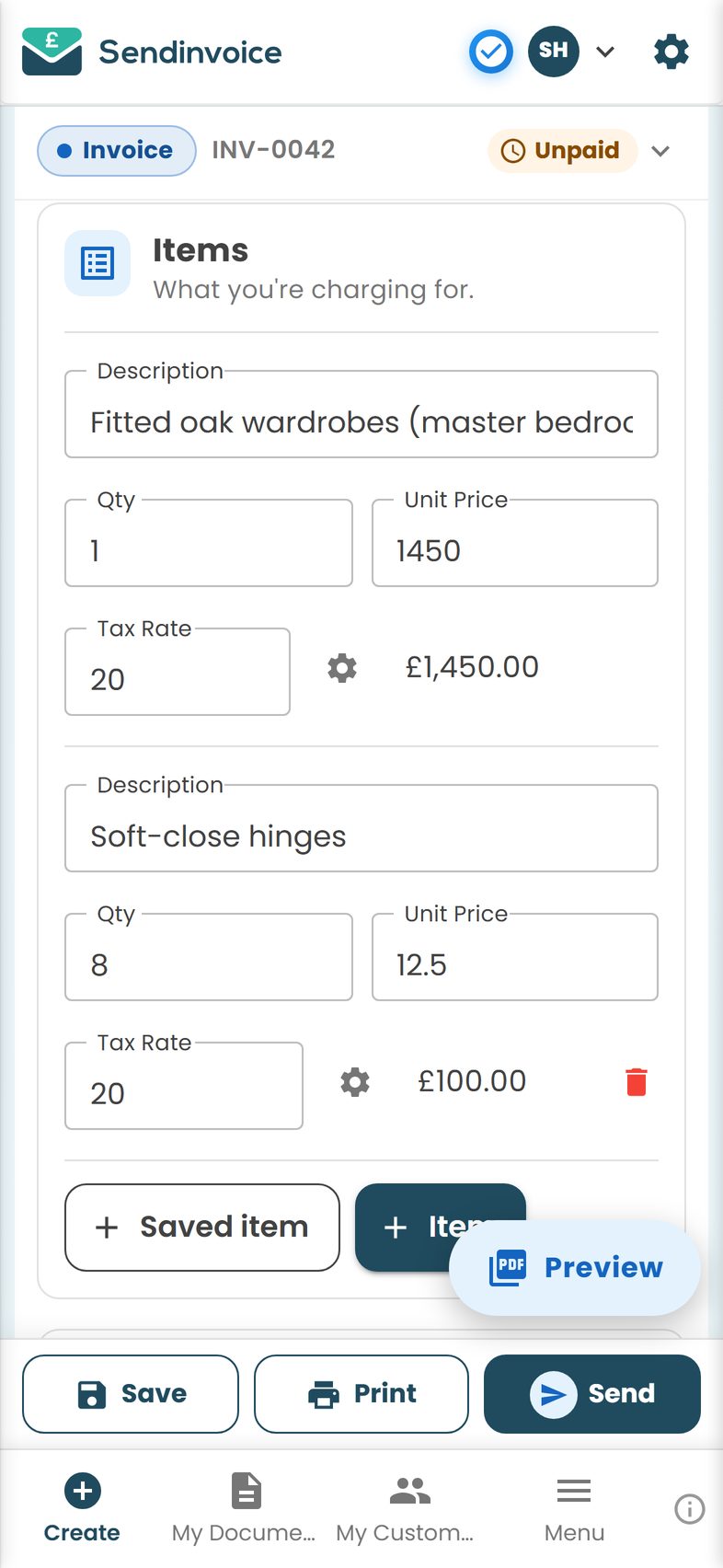
The fix is to invoice before you leave. Standing in the kitchen with the water back on, open the app on your phone, tap Invoice, type the customer's name (if you have billed them before it is suggested as you type), add the four lines, and send. The email lands on Mr Osei's phone with the PDF attached and a Pay button. He taps it, pays by card through Stripe, and the invoice flips to Paid in your My Documents with a green tick. Kerry is back in the van with the money in hand, not a promise.
A few things make this work better:
- Show them the screen. "I'll send it now, it's got a card link, or there are bank details on it if you'd rather." Most people reach for their phone on the spot.
- Set the due date to "on receipt" or 7 days for private customers. Thirty days is a business convention, not a law of nature.
- Bank transfer still counts. Some customers prefer it, especially older ones. Put your sort code and account number on the invoice and mark it paid by hand when it lands.
- No card reader needed. At the time of writing the platform fee on card payments is 0.2% plus Stripe's own fee, which compares well with most readers' percentage, and there is no hardware to lose under the van seat.
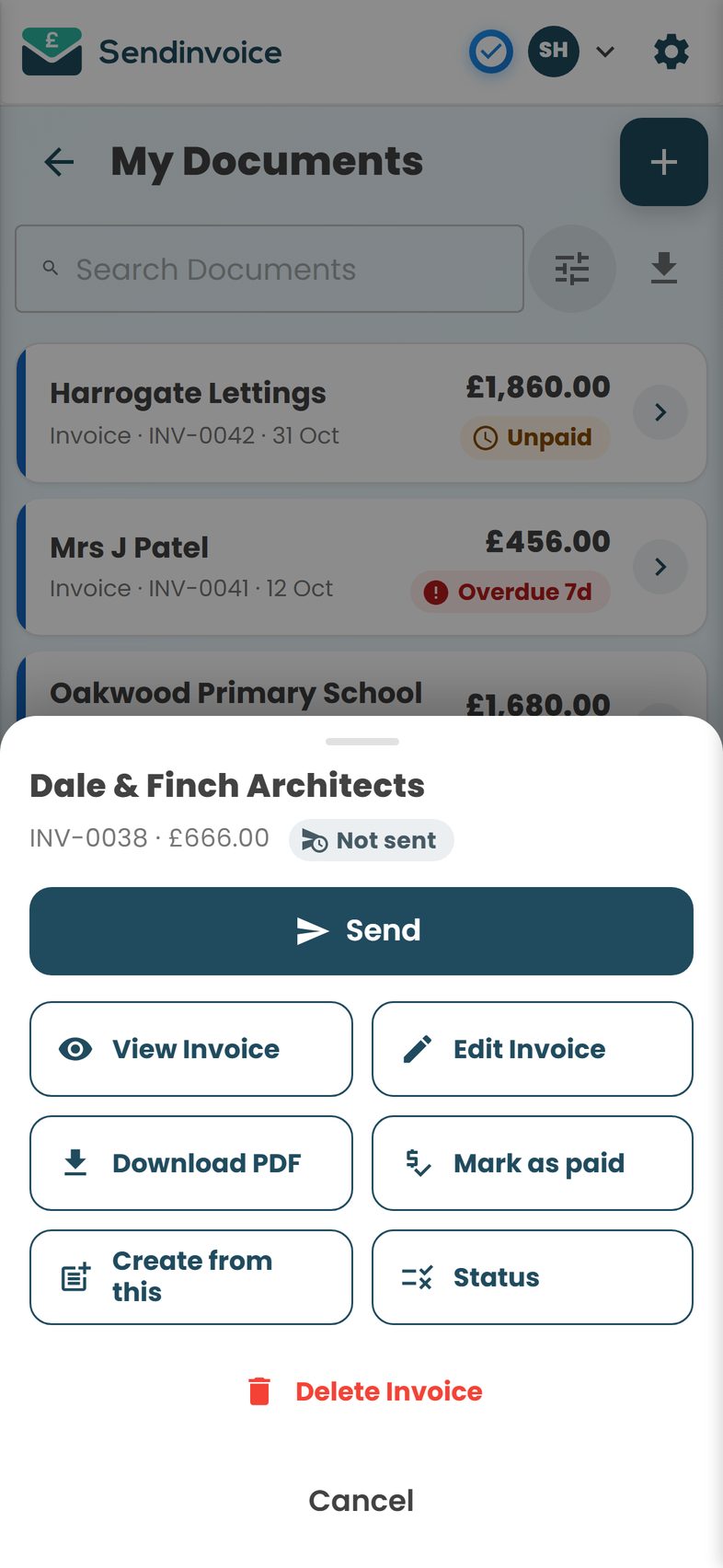
For a cash customer, create a receipt from the invoice in one tap so they have proof and you have a record. The getting paid on the day post compares the card options in more detail.
Planned work: bathrooms, cylinders and quotes
Not every job is an emergency. For a bathroom refit, a new cylinder or re-running pipework, the invoice starts with a quote. Set out the job in the same line structure you will invoice (labour, named parts, sundries), state what is excluded (tiling, electrics, making good decoration), and say whether you want a deposit for materials. For anything with a cylinder or a shower in it, a deposit of around the cost of the main parts, taken against a proforma invoice, is normal and sensible.
When the job is done, create the invoice from the quote. The customer, the address and the lines carry over; you adjust the quantities that changed and add any extras that were agreed on site. The two documents stay linked ("From QUO-0088"), so the customer sees the same figures they said yes to, which is the single best protection against "that's not what we agreed".
If the job was agreed in the customer's home and it is a consumer job over £42, the Consumer Contracts Regulations give them a 14-day cancellation right. If they want you to start inside that window, get the request in writing (a text saying "yes please start Monday" is enough) so that you can charge for work done if they then cancel.
For unvented cylinders you need a G3 qualification; note your registration on the invoice and that the Building Regulations notification has been made, the same way an electrician records Part P. Gas work is a different world, legally and on the invoice; see how to invoice as a heating engineer.
Landlords, agents and other businesses
A lot of plumbing work comes through letting agents, and they pay differently. They want the property address on the invoice, their job reference or purchase order number, and usually 30-day terms. They are businesses, so if they pay late the Late Payment of Commercial Debts (Interest) Act 1998 lets you add statutory interest and a fixed sum; for a private homeowner that Act does not apply, and you cannot add those fixed sums. Save the agent as a customer once, with their billing address, and put the property address on each invoice. The landlords and letting agents post covers chasing them without souring the relationship.
Records, numbers and the tax man
Keep every invoice, every merchant receipt and your bank statements for at least five to six years. Use one running number sequence and never delete or reuse a number; if a job falls through after you invoiced it, issue a credit note. Making Tax Digital for Income Tax applies from April 2026 to sole traders with income over £50,000 (April 2027 for over £30,000, April 2028 for over £20,000, at the time of writing), so an invoice list you can filter by period and export to a spreadsheet is worth having before your accountant asks for it. As always, check with your accountant or HMRC for your own situation.
Do this in SendInvoice
Keep your call-out, hourly and out-of-hours rates as saved items, add the parts in the kitchen, and send the invoice with a Pay button before you have packed the van. Free to create and preview; £5 a month to send, remind and get paid by card.
Create a free invoice See the £5/month planFrequently asked questions
How do I word an emergency call-out fee on a plumbing invoice?
Say exactly what the fee includes and when it applied: "Emergency call-out, Sunday 7pm, includes first hour on site". Then show any extra time as its own line at the rate you quoted on the phone, and parts as separate lines. Customers accept a higher fee when the invoice shows the hour, the day and the parts rather than one round number.
Should I charge for parts I already had on the van?
Yes. A stop tap or a flexi from your van stock is still a part you bought, carried and fitted, and keeping stock is what makes a same-day fix possible. Charge it at your normal selling price as its own line. You do not need to show what you paid for it, and a reasonable mark-up on parts is standard practice.
Can I take a card payment at the customer's house?
Yes, without a card reader. Send the invoice from your phone while you are there; the email includes a Pay button and the customer pays by card on their own phone. The invoice marks itself Paid when the payment goes through. At the time of writing the platform fee is 0.2% plus Stripe's fee, which compares well with most card readers.
Do I need to be VAT registered to invoice as a plumber?
No. Most sole-trader plumbers are below the VAT threshold and simply do not charge or show VAT. If you are not registered, leave VAT off the invoice entirely rather than showing 0%. Once your turnover approaches the threshold, talk to your accountant, because registering changes every invoice you send.
What should I put on the invoice if the customer needs it for an insurance claim?
Write the description as a short factual report: what you found, what caused it, what you did, and the date and time. "Split 15mm copper pipe behind kitchen unit, water damage to floor, isolated and replaced section" is what an insurer wants. Keep your own copy and any photos; the invoice is often the main evidence the customer has.
How soon should a plumber's invoice be paid?
For private customers, on the day or within 7 days. There is no reason a homeowner should have 30 days to pay for a leak you fixed in front of them. For landlords, agents and businesses, 14 to 30 days is normal, and the Late Payment of Commercial Debts (Interest) Act lets you add interest if they pay late. Put the term on the invoice either way.