Jo is a locksmith in Bristol. Her phone goes at 11.40pm: a woman locked out of a flat in Bedminster, keys inside, two-year-old asleep at her mum's and a shift at 6am. Jo quotes the night call-out and the likely cost on the phone, texts it so there is a record, and is there in twenty minutes. Forty minutes later the door is open, the cylinder is replaced with an anti-snap one, and the customer is holding her phone looking at an invoice for £193 with a Pay button on it. She pays before Jo has put the drill back in the van. That is the whole art of emergency work: price it up front, invoice it clearly, get paid before you leave.
What a call-out fee is, and what it is not
A call-out fee is a fixed charge for turning up. It pays for the drive, the fuel, the fact that you answered the phone at midnight, and the diagnosis you do when you get there. It is separate from the labour of actually fixing the thing, and separate again from parts.
There are two common structures, and both are fine as long as you say which you use:
- Call-out plus labour from arrival. "£85 call-out, then £60 an hour on site." Simple and honest for jobs that could be five minutes or three hours.
- Call-out including the first hour (or half hour). "£120 covers attendance and the first hour; £60 an hour after that." Customers like it because most jobs finish inside the hour and the number they were told is the number they pay.
What a call-out fee is not: a penalty, a tip, or something to spring on the customer at the end. If the first time the customer hears the words "call-out fee" is on the invoice, you have already lost the argument, whatever the law says.
Setting out-of-hours rates
Nothing in UK law limits what you charge for evenings, nights, weekends or bank holidays, provided the customer agreed to it before you started. The common patterns:
| Band | Typical approach | Example |
|---|---|---|
| Standard hours (say 8am to 6pm, Mon to Fri) | Base call-out and hourly rate | £55 call-out, £45 an hour |
| Evening (6pm to 10pm) and Saturday | Base plus a fixed uplift, or 1.5 times | £70 call-out, £60 an hour |
| Night (10pm to 6am), Sunday, bank holidays | Roughly double, or a higher flat call-out | £85 call-out, £60 an hour, 1-hour minimum |
Three decisions to make once and write down, so you are not inventing numbers at midnight:
- Your bands and the hours they cover. Put them on your website, on your quote template and in the notes on your phone.
- A minimum charge. A one-hour minimum out of hours is normal. Nobody should drive across a city at 2am for twenty minutes of labour at the standard rate.
- Whether the fee is payable if you cannot fix it. Usually yes: the call-out is for attending. If you offer "no fix, no fee", define it precisely, because a customer will remember the slogan and forget the small print.
Parts are always on top, at your usual price. For a locksmith that is the cylinder; for a plumber, the valve; for an electrician, the RCD. The labour and materials post covers how to show them.
Stating them up front, and proving you did
This is the part that decides whether you get paid. Emergency customers are stressed, tired and not listening carefully. Whatever you say on the phone, half of it will not land. So:
- Say it on the phone, slowly: "It's £85 for the night call-out, then £60 an hour with a one-hour minimum, plus any parts. A new cylinder is usually £40 to £60. So you're probably looking at £150 to £200 all in. Is that OK?"
- Then text it before you set off. "Hi, Jo from Keys Bristol. As discussed: night call-out £85, labour £60/hr (1 hr min), parts extra. Likely £150-£200. On my way, with you in about 20 mins. Please reply OK." That text is your contract.
- Get the "please come now". When you agree a job at a customer's home, consumers generally have a 14-day cancellation right. If they ask you to start immediately, you can charge for work done, but you want that request on record. "Please reply OK and I'll come straight away" does it in one line. Keep claims about this cautious; it is an area where the detail matters.
- Put the bands on your invoice template too, in the terms, so the invoice confirms what the text said.
Invoicing it clearly
An emergency invoice should be readable by someone who was not there: the customer's partner, a landlord, an insurer. That means:
- The call-out as its own line, labelled with the band: "Emergency call-out, out of hours (22:00 to 06:00)".
- Labour as its own line with the time on site and the minimum applied if it was: "Labour, 40 minutes on site, charged at 1-hour minimum".
- Each part as its own line with enough description to identify it.
- Date, time called, time arrived, time left in the description or the notes. This is what justifies the rate, and it is the first thing an insurer or a letting agent asks for.
- The address attended, which may not be the billing address, in the notes.
- What was done, in plain words: "Non-destructive entry via lock manipulation; existing cylinder replaced with anti-snap euro cylinder, 3 keys supplied."
Everything else is the ordinary stuff every invoice needs: a unique number, your details, the customer's name and address, the date, the amount, and no VAT shown if you are not registered. How to invoice as a locksmith walks through the full layout for that trade; the same lines work for an emergency plumber or electrician.
Worked example: Jo's midnight lockout
Jo is a sole trader and not VAT registered, so there is no VAT on this invoice. The customer, Ms Okafor, is a private tenant paying personally.
Invoice INV-0412 from Keys Bristol (J. Bennett) to Ms D. Okafor, Flat 3, 41 North Street, Bedminster, Bristol. Date 18 October 2026. Payment due on receipt.
| Description | Qty | Unit | Amount |
|---|---|---|---|
| Emergency call-out, out of hours (22:00 to 06:00). Called 23:40, arrived 00:02, left 00:45, 18 Oct 2026. Rate agreed by text 23:44. | 1 | £85.00 | £85.00 |
| Labour: non-destructive entry to front door by lock manipulation; remove and replace cylinder. 40 minutes on site, charged at 1-hour minimum. | 1 hr | £60.00 | £60.00 |
| Euro cylinder, 35/45, anti-snap, anti-pick, 3 keys supplied | 1 | £48.00 | £48.00 |
| Total due | £193.00 | ||
Notes: Not VAT registered. Attended at the above address at the customer's request to start immediately. Entry gained without damage to door or frame. Cylinder guaranteed 12 months. Paid by card on site.
Within the £150 to £200 Jo texted. Times on the invoice. What was done, in words the customer can repeat to her landlord. Nothing to argue about, which at 1am is worth more than the £48 on the cylinder.
Getting paid before you leave
Emergency work has the best moment for getting paid of any trade: the problem is fixed, the relief is enormous, and you are standing right there. Leave with the invoice "to be paid later" and you have turned a grateful customer into a debtor who will reconsider the price in the cold light of day. The habit:
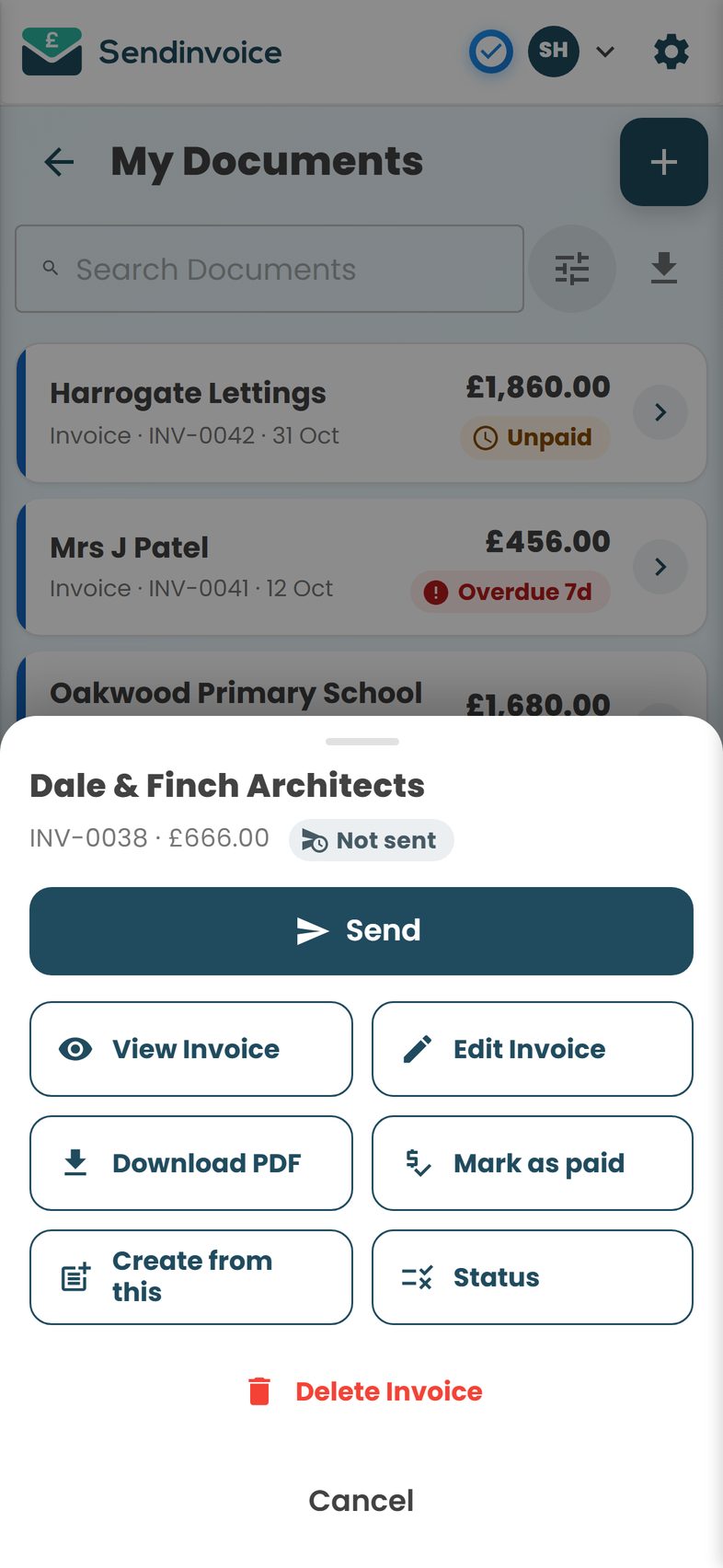
- Create the invoice on your phone while you pack up. Thirty seconds if your call-out and labour rates are saved items.
- Send it to the customer's email, with the PDF attached and a Pay button in the email.
- Show them the Pay screen on your own phone if they are standing next to you, so they are not hunting for an email at 1am. They tap, pay by card, done.
- If they want to pay cash, take it, mark the invoice paid, and create a receipt from it in one tap. If they want to do a bank transfer, ask them to do it now, on their phone, and mark it paid when it shows.
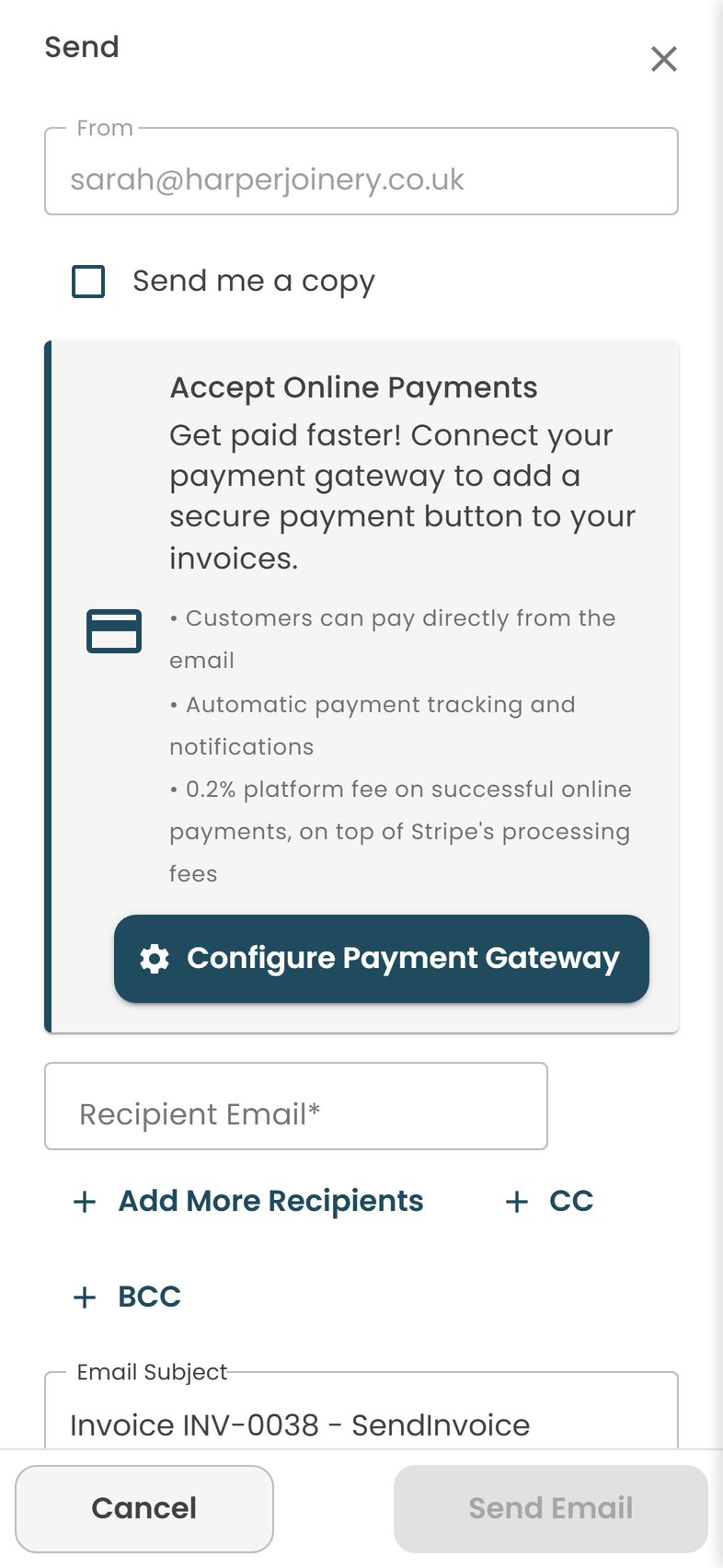
Card payments through SendInvoice go via Stripe, and the invoice flips to Paid on its own when the payment goes through, so there is nothing to reconcile at the end of a long night. At the time of writing the platform fee is 0.2% on successful online payments plus Stripe's own fee, which on a £193 invoice is a few pence more than most card readers and does not involve carrying a reader. Getting paid on the day compares the options properly.
When the bill goes to a landlord, an agent or an insurer
A lot of emergency work is for tenants but paid for by someone else. Two rules:
- Find out who is paying before you start, and get the letting agent's email or the landlord's name on the phone. If the agent is paying, ask for a purchase order number or job reference and put it on the invoice; some agents will not pay without one.
- Put the property address on the invoice as well as the billing address, because the agent has forty properties and yours is just "the Bedminster one".
Agents and landlords' companies are businesses, so 30-day terms are normal and, if they pay late, the Late Payment of Commercial Debts (Interest) Act applies: statutory interest and a fixed sum of £40 or more per invoice. That does not apply to a private tenant paying personally; for them you are limited to what your terms say and, if it ever went to court, interest at the court's discretion. Invoicing landlords and letting agents covers the whole relationship.
For insurance claims, the customer usually pays you and claims it back, and the insurer wants the times, the cause, what was done and a note that entry was non-destructive (or why it was not). Write the invoice as if an assessor will read it, because one might.
The habit in one line
Text the price before you leave, invoice from the doorstep with the times on it, and show them the Pay button before you show them the van. Emergency customers are the easiest customers in the world to get paid by, for about fifteen minutes. Use the fifteen minutes.
Do this in SendInvoice
Save your call-out and out-of-hours rates as items, build the invoice on your phone in the time it takes to pack the tools, and send it with a Pay button so the customer can pay by card before you leave. Free to create and preview; £5 a month to send, take card payments and track what is paid.
Create a free invoice See the £5/month planFrequently asked questions
What is a call-out fee and what does it cover?
A call-out fee is a fixed charge for attending, separate from the work itself. It covers the time to get to the job, the fuel and the fact that you are available at short notice. Some trades include the first half hour or hour of labour in it; others charge labour from arrival on top. Either is fine as long as you say which before you set off.
Is it legal to charge more out of hours?
Yes. There is no law limiting what you charge for evening, night, weekend or bank holiday work, provided the customer agreed the rate before you started. The risk is not the law but the dispute: a customer who did not know the night rate was double will argue, and may win. State it clearly in writing, a text is enough, before you leave the house.
Can a customer refuse to pay a call-out fee if I could not fix the problem?
Not if the fee was agreed in advance as a charge for attending. You turned up, diagnosed the problem and spent your time; the fee is for that. Make it clear on the phone and in your text whether the call-out is payable regardless of outcome, and if you offer no-fix-no-fee, say precisely what that means.
Does the 14-day cooling-off period apply to emergency work?
Contracts agreed at the customer's home generally give a consumer a 14-day cancellation right, but if they ask you to start straight away, which in an emergency they always do, you can charge for the work done. Keep a record of that request: a text saying please come now, or a line in your reply confirming they have asked you to start immediately.
How do I get paid before I leave an emergency job?
Create the invoice on your phone while you pack the tools, send it to the customer's email with a Pay button, and show them the Pay screen on your own phone if they are standing beside you. A card payment marks the invoice paid on the spot. If they pay cash, mark it paid and issue a receipt; if bank transfer, ask them to do it while you are there.
Should the invoice show the time of the call-out?
Yes. Put the date, the time you were called and the time you arrived and left in the description. It justifies the out-of-hours rate, and if the invoice is ever queried by the customer, a landlord or an insurer, the times are the first thing they want.