Marcus gets the call in the first cold week of November. The Pattersons' twenty-year-old boiler has finally locked out for good, there is a baby in the house, and they want a new combi fitted this week. The quote is £2,850, the boiler alone is £1,480 at the merchant, and Marcus would rather not fund that out of his own account for a family he met on Tuesday. This post is about invoicing a heating business properly: a deposit for the boiler, a clean final invoice with VAT, the Gas Safe and Benchmark notes that belong on it, and the small, regular services that keep the diary full in summer.
What a heating engineer's invoice needs
The legal basics first: a unique invoice number, your name or trading name and address, the customer's name and address, the date, a description, and the amount. Bell Heating is VAT registered, so Marcus's invoices also carry his VAT number, the VAT rate and amount, the tax point and the net total. If you are not VAT registered, leave VAT off entirely; our how to write an invoice guide covers both cases.
On top of that, a heating engineer's invoice should carry:
- Your Gas Safe registration number. Gas Safe registration is a legal requirement for gas work and customers are told to check it. Put it in your business details so it prints on every invoice, quote and receipt.
- The appliance. Make, model and, for installs, the serial number. In ten years when the house is sold, this is the line the solicitor's form asks about.
- Benchmark and building control. A note that the Benchmark checklist has been completed and the installation notified to building control via the Gas Safe Register, with the date. The invoice is not the certificate and an invoicing app does not issue one; it is the record that one exists.
- Labour, boiler, parts and consumables as separate lines. A £2,850 figure is easier to accept when a third of it is visibly a boiler.
- The deposit deducted, with the proforma number and the date it was paid.
Taking the deposit on a proforma invoice
A boiler install is the classic case for a deposit: a big part you have to pay for before the job starts, and a customer you may not know. Common practice is the cost of the boiler and major parts, or 10-30% of the job; nothing in law sets a maximum for consumer work, but "roughly what I have to buy" is the figure that nobody argues with.
Take it against a proforma invoice, not a normal invoice. A proforma says "this is what the job will cost and here is the deposit I need to order the boiler"; it is not a demand for the whole amount, it does not sit in your Unpaid list as a £2,850 debt, and if you are VAT registered it is not a tax invoice. Send it the same evening as the quote is accepted, with the Pay button in the email, and most customers pay the deposit before bed. The boiler is ordered first thing.
Two things to keep in mind. The deposit is still the customer's money until you have done the work, so keep it accessible; if the boiler turns out to be unavailable or you cannot do the job, it goes back. And if the contract was agreed in their home, the Consumer Contracts Regulations give them a 14-day cancellation right on jobs over £42. If they want the boiler fitted inside that window, which with a baby in the house they will, get the request in writing (a text saying "yes, please go ahead for Thursday" is enough) so that you can charge for work done and parts ordered if they then cancel.
The deposits and staged payments post covers the full pattern, including splitting bigger jobs into stages.
The final invoice, with the deposit taken off
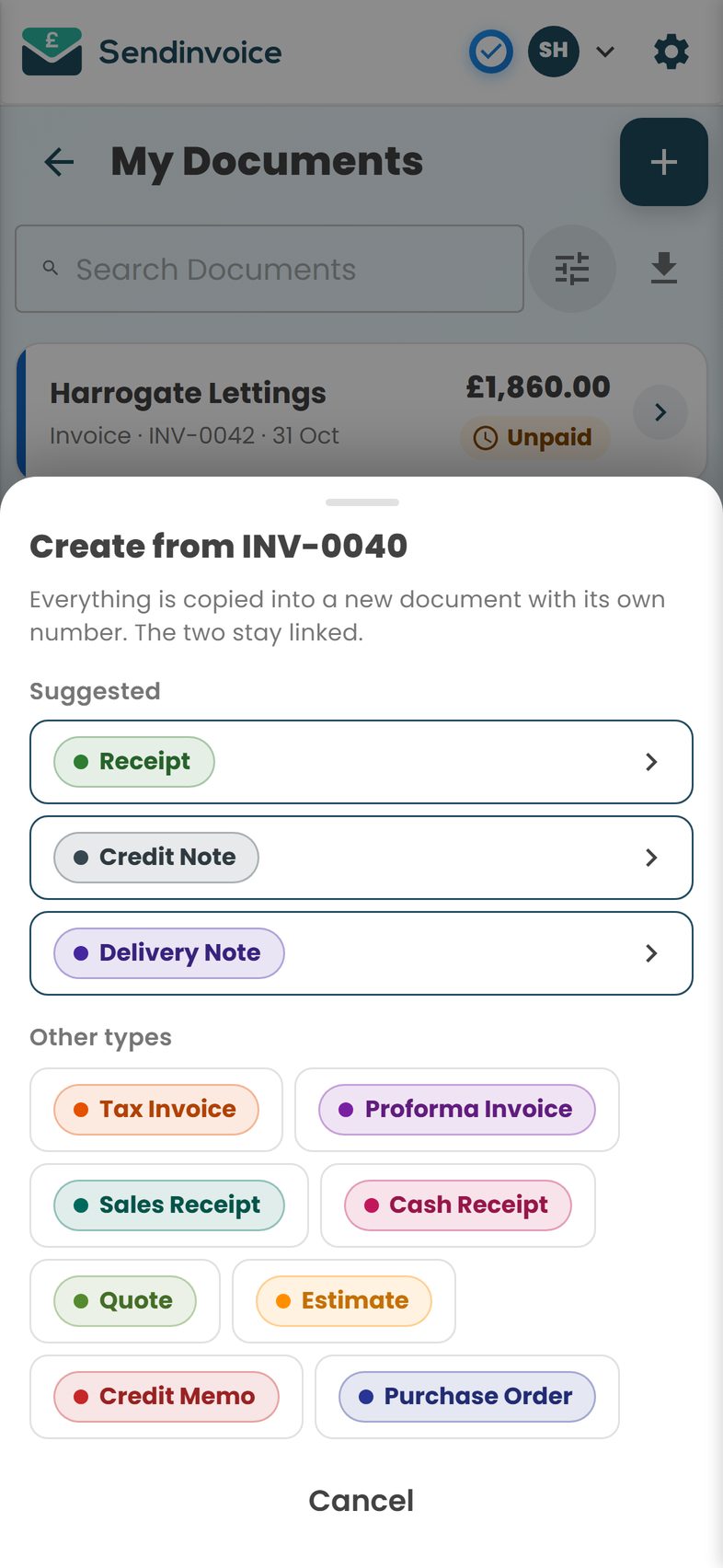
When the boiler is fired up, the system is balanced and the Benchmark checklist is filled in, Marcus creates the final invoice from the original quote. The customer, the address and the lines come across; he adjusts anything that changed (the flush took longer, an extra radiator valve), adds the deposit as a deduction, and sends it from the kitchen.
The structure matters. Show the whole job first, so the customer sees the full price they agreed, VAT included. Then deduct the deposit as its own line with the proforma number and the date it was paid. Then the balance due. Customers who are invoiced only for the balance, with no sign of the deposit, go looking for the "missing" £1,000 and ring you about it; customers who are invoiced for the full amount with no deduction assume they are being charged twice. Showing both prevents both calls.
Worked example: a combi boiler replacement
Here is the final invoice for the Pattersons. Bell Heating is VAT registered, so VAT is charged on the whole supply, labour and materials, at the standard rate. (Some heating work can qualify for the reduced rate; check HMRC's notices rather than assuming.)
Bell Heating Ltd (Gas Safe registered, no. 123456; VAT no. GB 000 0000 00)
Invoice INV-0512
Date and tax point: 13 November 2026
Bill to: Mr and Mrs D Patterson, 8 Elm Close, Warrington
Job address: as above
Due: 7 days
| Description | Qty | Unit price | Amount |
|---|---|---|---|
| Combi boiler, 30kW, with horizontal flue kit, condensate pump and fittings (serial no. recorded on Benchmark) | 1 | £1,480.00 | £1,480.00 |
| Magnetic system filter | 1 | £95.00 | £95.00 |
| Labour: remove and dispose of existing boiler, install new combi, extend gas supply in 22mm, new flue and condensate, wire to existing controls, commission and demonstrate | 2 days | £310.00 | £620.00 |
| Chemical flush of existing system and inhibitor dose | 1 | £140.00 | £140.00 |
| Sundries: 22mm copper, fittings, flue sealant, brackets | 1 | £40.00 | £40.00 |
| Commissioning, Benchmark checklist and building control notification via Gas Safe Register | 1 | £0.00 | Included |
| Net total | £2,375.00 | ||
| VAT at 20% | £475.00 | ||
| Total | £2,850.00 | ||
| Less deposit paid 10 Nov 2026 against proforma PRO-0031 | -£1,000.00 | ||
| Balance due | £1,850.00 | ||
Payment: by card using the Pay button in this email, or by bank transfer to Bell Heating Ltd, sort code 00-00-00, account 00000000, reference INV-0512.
Notes: Benchmark checklist completed and left in the boiler's log book; installation notified to building control via Gas Safe Register on 13 Nov 2026 (compliance certificate to follow by post). Manufacturer's guarantee registered; first annual service due November 2027 to keep it valid. Old boiler removed and disposed of.
Note the last line. The service reminder is not a sales pitch, it is a condition of most manufacturers' guarantees, and it is the first step in turning a one-off install into a customer for the next ten years.
Annual services and the small invoices that keep you going
Boiler installs make the headlines, but services, landlord gas safety checks and repairs keep the diary full in May. The money is small per job and the admin can swallow the margin if you let it: a £85 service that takes forty minutes and then twenty minutes of paperwork at night is not an £85 job.
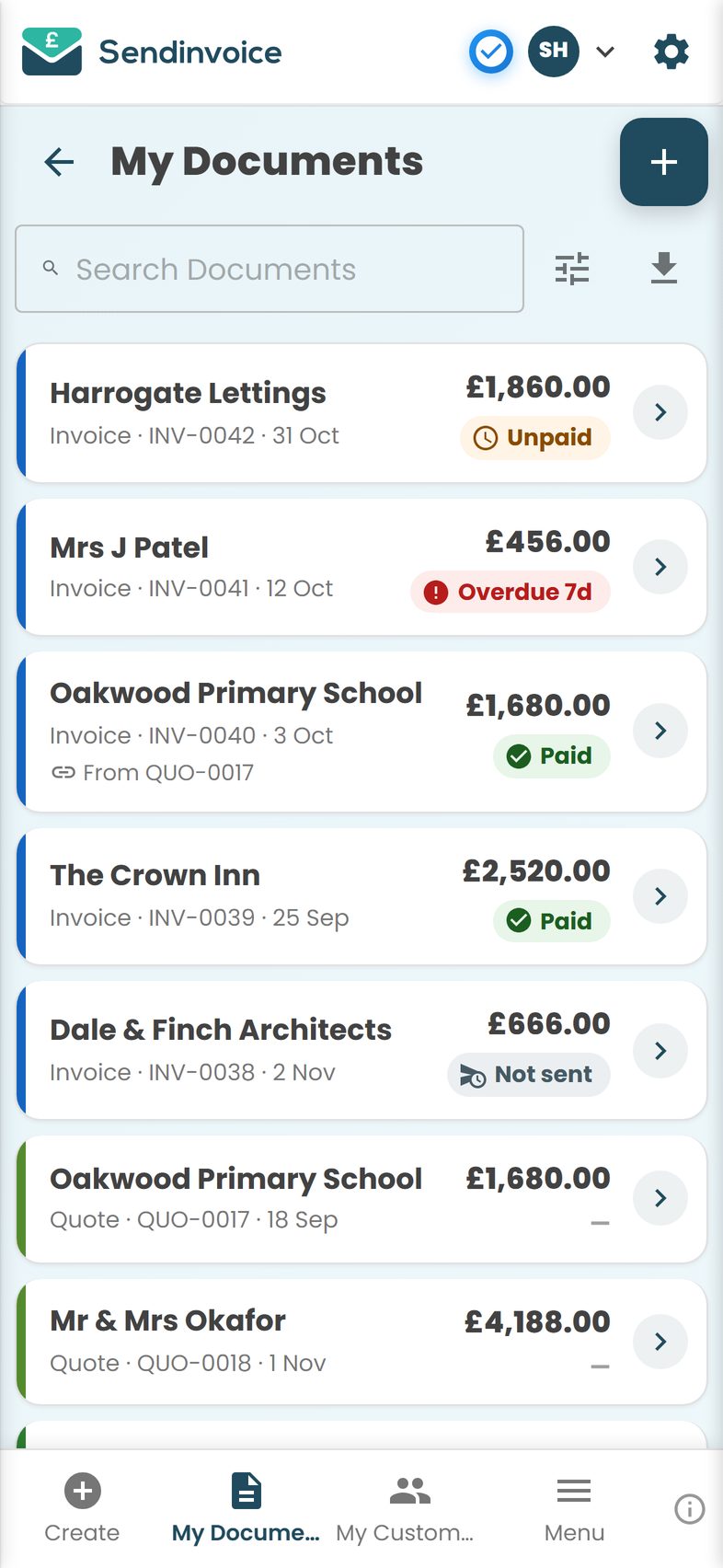
The fix is a routine. Keep a saved item for your service at your fixed price, with the description already written ("Annual boiler service: combustion analysis, gas rate and pressure check, clean condensate trap, check flue and seals, safety devices tested"). At the property, create the invoice on your phone from the saved item, add the customer (suggested as you type if you have been before), send it with the Pay button, and let the card payment mark it Paid. If they pay cash, create a receipt from the invoice in a tap so they have proof and you have a record; the cash jobs and HMRC records post explains why that matters.
For landlord gas safety checks, the invoice goes to the landlord or the agent, the property address goes on the invoice, and the record number of the CP12 goes in the notes. Agents are businesses: 30-day terms are normal and, if they are late, the Late Payment of Commercial Debts (Interest) Act applies. For private homeowners it does not, and you cannot add the fixed sums; see invoicing landlords and letting agents.
Repairs, call-outs and parts
For breakdowns, use the plumber's pattern: a call-out line that says what it includes ("Call-out and diagnosis, includes first hour"), additional labour as its own line, parts named (a fan, a PCB, a diverter valve) at your selling price. If you have to order a part and come back, say so on the invoice and either invoice the diagnosis visit now and the repair later, or wait and invoice both together with the two dates in the notes. Invoicing the first visit on the day is better for cash flow and makes the second visit feel like a fresh, agreed job rather than an extension of the first one. How to invoice as a plumber covers call-out wording in more detail.
Working for builders and developers
If some of your work is for builders, new-build developers or main contractors rather than homeowners, two things change. First, the Construction Industry Scheme: if you are a subcontractor on construction work, the contractor deducts tax (20% if you are registered, 30% if not) from the labour element and pays it to HMRC for you, so your invoice needs labour and materials shown separately, your UTR, and the deduction as a line. Second, if both of you are VAT registered, the domestic reverse charge may mean you do not charge VAT and instead state that the customer accounts for it. Neither applies to work for private homeowners. Our CIS invoice example and reverse charge post walk through the wording; check with your accountant or HMRC before you change how you invoice.
Records
Keep invoices, proformas, merchant receipts and bank statements for at least five to six years, and keep the Benchmark and notification records with them. One running number sequence per document type (PRO-0031, INV-0512, REC-0077) means nothing is lost. If you are VAT registered you are already on Making Tax Digital for VAT; Making Tax Digital for Income Tax reaches sole traders with income over £50,000 from April 2026 (over £30,000 from April 2027, over £20,000 from April 2028, at the time of writing). An exportable list of invoices with Paid and Unpaid against each is the minimum you want before then. Check with your accountant or HMRC for your own position.
Do this in SendInvoice
Quote the boiler, create the proforma for the deposit from the quote, then the final invoice with the deposit deducted and your Gas Safe number already on it, and send each one from the customer's kitchen with a Pay button. Free to create and preview; £5 a month to send, remind and get paid by card.
Create a free invoice See the £5/month planFrequently asked questions
How much deposit should I take for a boiler installation?
Common practice is the cost of the boiler and major parts, or somewhere between 10% and 30% of the job. Nothing in law sets a maximum for consumer work, but a deposit that roughly matches what you have to buy up front is easy to justify. Take it against a proforma invoice, and remember it is still the customer's money until the job is done.
Do I need to show the deposit on the final invoice?
Yes, clearly. Show the full job (labour, boiler, parts and VAT if registered) so the customer sees the whole price they agreed, then a line deducting the deposit with the proforma number and the date it was paid, and the balance due. If you invoice the full amount without the deduction, expect a confused phone call and a late payment.
Should my Gas Safe registration number be on the invoice?
Put it in your business details so it prints on every document, alongside your name and address. For a boiler install, add a note that the Benchmark checklist has been completed and the installation notified to building control through the Gas Safe Register. The invoice is not the certificate, but it is the record the customer will find when they sell the house.
What is the simplest way to invoice annual boiler services?
Keep a saved item for the service at your fixed price, create the invoice from your phone at the property, send it with a Pay button, and mark it paid or let the card payment do it. If the customer pays cash, create a receipt from the invoice in one tap. Note the date of the service and anything you found so the next visit starts with the history.
Can I charge VAT at 5% on heating work?
Only in specific cases. Most boiler installations and repairs for homeowners are standard rated. Some energy-saving installations and some work for people on certain benefits or over 60 can qualify for a reduced rate, and the rules change. Check HMRC's notices or ask your accountant before putting anything other than the standard rate on an invoice.
What if the customer cancels after paying the deposit?
If the contract was agreed in their home, they have a 14-day cancellation right under the Consumer Contracts Regulations. If they cancel inside that window and you have not started, refund the deposit. If they asked you in writing to start early, you can charge for work done and materials ordered. Keep deposits accessible; they may have to go back.