Marek finishes the ceiling in a Bradford living room at twenty past four, washes his tools in the back garden and looks at the walls going pink in the fading light. It is a £715 skim, walls and ceiling, over old but sound plaster. The customer is delighted and asks what she owes. Marek has two ways to answer that question, and tomorrow, on a site where he is skimming for a builder, he has a third. Plastering invoicing is simple on the face of it, and then the square metres, the day rates and the Construction Industry Scheme all turn up at once.
Per square metre or per day
Plastering is one of the few trades where a customer can genuinely compare prices, because the unit is the wall. That is a gift if you use it well. Two pricing models, and most plasterers use both:
| Model | Use it for | How it looks on the invoice |
|---|---|---|
| Per m² | Skim over sound plaster or new board; float and set; boarding and skimming; whole rooms where you can measure | "Skim walls, 34 m² at £12.00", a separate rate for ceilings (they are slower and higher) |
| Day rate | Patching, Artex removal, chases after the electrician, making good after a window, anything where the background is unknown | "Labour, 1.5 days at £220.00", with a line describing what the day covered |
| Fixed price for the job | Small, clear jobs where the customer wants one number | "Skim hallway walls and ceiling, as quoted QUO-0088", with the m² in the description so the price makes sense |
Whichever you choose, write the measurements on the quote and carry them to the invoice. "Skim living room" invites "that seems a lot". "Skim walls 34 m² and ceiling 16 m²" does not. Charge ceilings at a higher rate than walls and say so; everyone who has ever tried to skim one upside down understands.
What the per m² rate includes and excludes is the thing to nail on the quote. Included: a sound, dry background, PVA, beads and scrim, clean-down. Not included: removing wallpaper, bonding over blown render, dubbing out, Artex, moving furniture, and any defect you only find once you start. Say that up front and the extras conversation on day one is a formality rather than a fight. Our post on day rate versus fixed price goes deeper on when each model protects you.
What goes on a plasterer's invoice
Every UK invoice needs your name and address, the customer's, a unique number, the date, a description and the amount (the full list is in how to write an invoice). On top of that, a plastering invoice reads best with:
- A line per surface. Walls, ceilings and any patching, each with the area or the time.
- Materials. Bags of multi-finish, bonding or hardwall, boards, beads, scrim, PVA. The sums are small on a skim and large on a boarding job; either way, show them. Builders need it for CIS; homeowners like to see it. There is more on markup and receipts in labour and materials on an invoice.
- Extras. Each on its own line with the date you agreed it and how (usually "by text").
- Drying and decorating advice. A note at the bottom: "Allow the plaster to dry fully (typically 5 to 7 days, longer in winter) before applying a mist coat of watered-down emulsion." It is not a legal requirement; it is the note that stops the phone call in a fortnight asking why the paint is peeling.
- Payment terms and how to pay. For homeowners, "payment on completion" with bank details and a card link. For builders, whatever is agreed, with their order or job reference.
Worked example: a skim for a homeowner
Marek is a sole trader and is not VAT registered, so there is no VAT anywhere on his invoice: no VAT number, no rate, no VAT line. Here is the living room.
Marek Nowak Plastering, 8 Thornton Street, Bradford BD7 1XY
Invoice INV-0142, dated 3 November 2026. Payment due on completion.
Bill to: Ms R. Patel, 41 Oak Avenue, Bradford BD9 4LP
Job: Skim living room walls and ceiling over existing plaster, as quoted QUO-0137.
| Description | Qty | Rate | Amount |
|---|---|---|---|
| Skim walls, two coats multi-finish over PVA'd existing plaster | 34 m² | £12.00 | £408.00 |
| Skim ceiling, two coats multi-finish | 16 m² | £14.00 | £224.00 |
| Multi-finish plaster | 6 bags | £9.50 | £57.00 |
| PVA, scrim tape and angle beads to chimney breast | 1 | £26.00 | £26.00 |
| Protection of floor and furniture, clean down on completion | 1 | £0.00 | Included |
| Total due | £715.00 | ||
Notes: Not VAT registered. Allow 5 to 7 days for the plaster to dry before a mist coat. Pay by card using the Pay button or by bank transfer to the details below.
The "Included" line costs nothing and earns a lot. Customers remember that you covered the sofa.
The same job for a builder, with CIS
Now the room is in a refurb being run by Hartley Build Ltd, and Marek is the plastering subcontractor. Hartley is a contractor under the Construction Industry Scheme, so the invoice changes in four ways, and the number at the bottom goes down.
- Labour and materials are totalled separately. Labour £632.00 (the two skim lines); materials £83.00.
- A deduction line appears. "Less CIS deduction, 20% of £632.00 labour: -£126.40." If Marek were not registered as a subcontractor the builder would have to deduct 30%; with gross payment status, nothing. Materials are never deducted from, and if Marek were VAT registered, neither would the VAT be.
- His UTR goes on the invoice, along with the builder's job or order reference, because the builder's CIS return needs to match it.
- The amount payable is £588.60, not £715.00. The £126.40 is not lost: Hartley pays it to HMRC against Marek's tax, gives him a deduction statement, and it comes off his bill at Self Assessment. Keep every statement.
Payment terms also change. A builder is a business, so if Hartley pays late the Late Payment of Commercial Debts (Interest) Act applies and Marek can charge statutory interest and the fixed compensation sums; with Ms Patel he cannot. And if the job runs over 45 days, the Construction Act gives him the right to staged payments; worth knowing, rarely worth citing. The full example with the deduction worked through is in our CIS invoice guide, and invoicing a main contractor covers applications for payment and retention if you move up to bigger sites.
Pricing traps in plastering
A few things that go wrong on plasterers' invoices, and the line that fixes each:
- The blown wall. You tap the chimney breast, it sounds hollow, and the skim is now a hack-off and float. Stop, photograph, text a price, wait for the "yes". The invoice line reads: "Hack off and re-float chimney breast, 6 m², agreed by text 2 Nov." See invoicing variations and extras.
- Artex. Pre-1999 Artex may contain asbestos. Do not price it as a skim until you know. Put "textured ceilings excluded pending a sample test" on the quote and invoice the test and the treatment as their own lines.
- Waiting time. The electrician has not finished the chases, so you lose a morning. On a builder's job, agree a waiting-time rate in advance; on a homeowner's job, you usually swallow it. If charged, it is a labour line with the date.
- Boards. On a boarding job the materials can outweigh the labour. Count, and invoice by the board, not the guess.
Getting paid while the walls are still pink
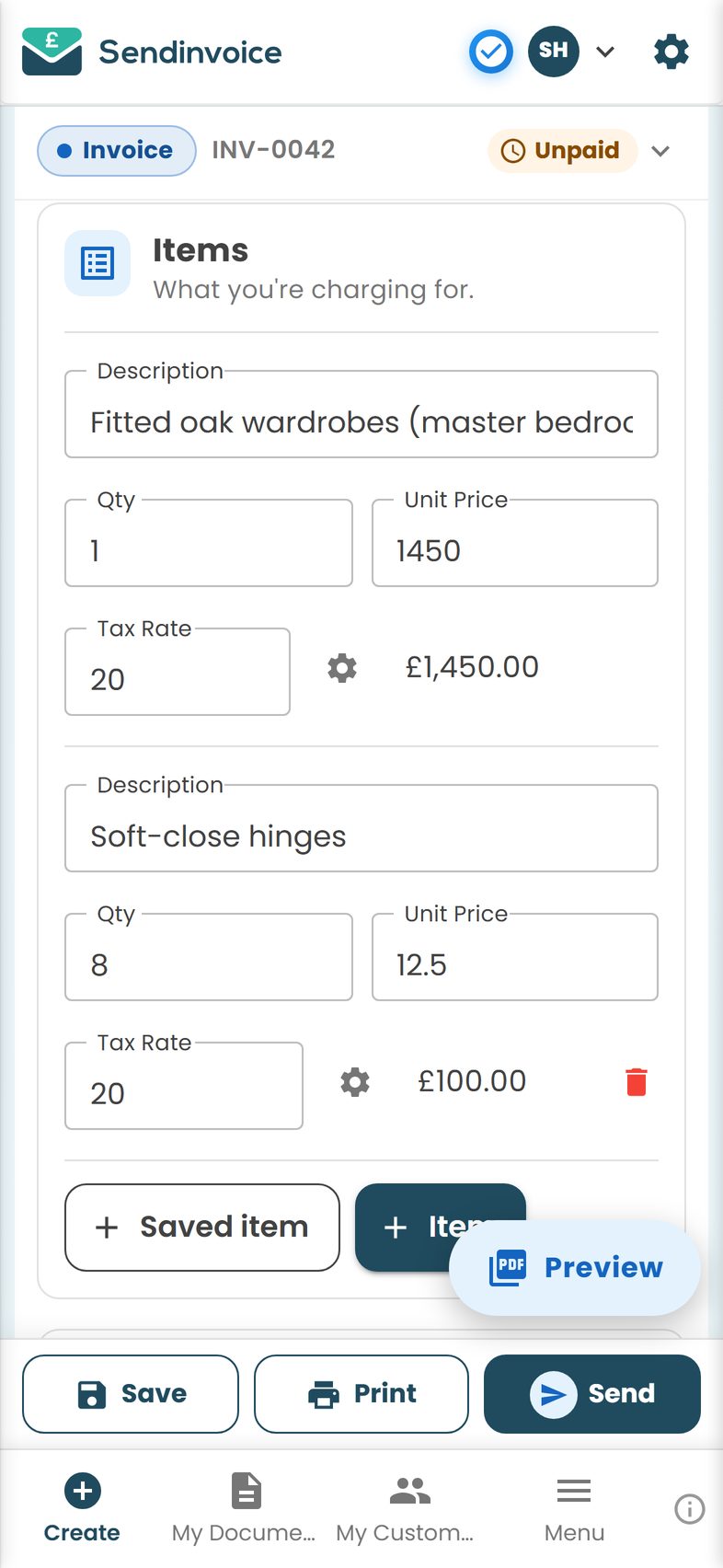
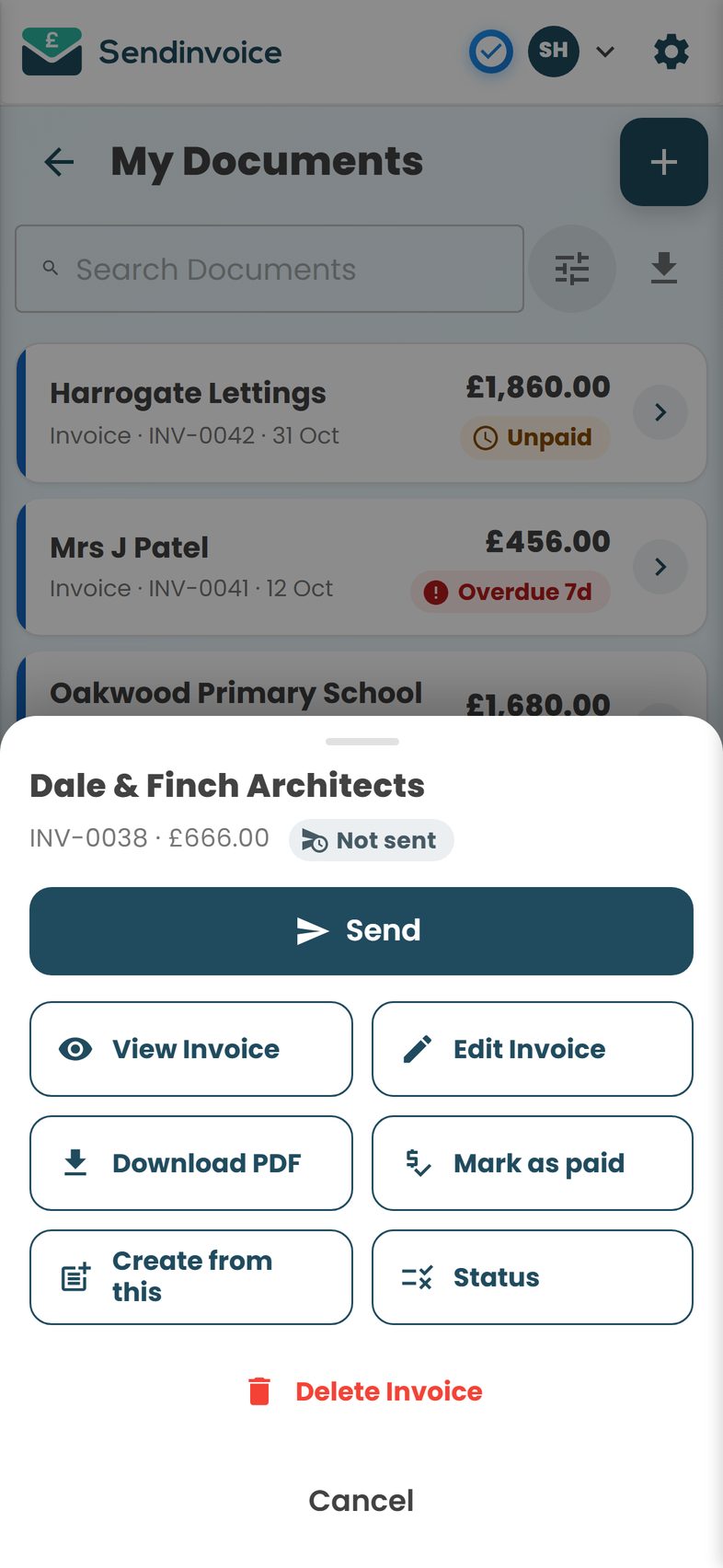
For a homeowner, the invoice should leave your phone before your van leaves the drive. The moment of maximum goodwill is the moment they see the finished ceiling; a PDF that arrives a week later competes with the gas bill. In SendInvoice the quote becomes the invoice with its lines intact in one tap, and the email carries the PDF and a Pay button so Ms Patel can pay by card on the doorstep; the invoice flips to Paid on its own. There is more on the habit in getting paid on the day.
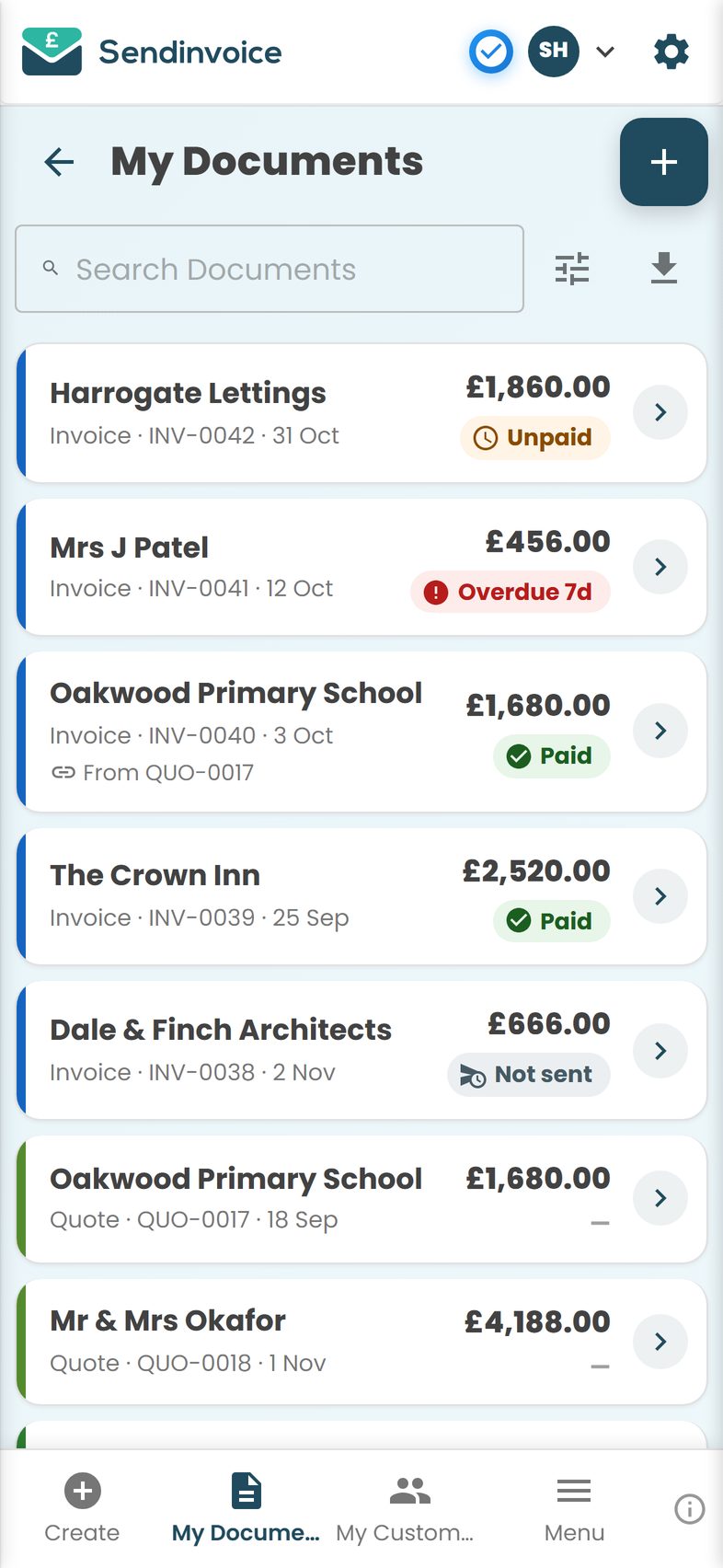
For builders, the rhythm is different: invoice on completion or at the agreed stage, with their reference on it, and let reminders chase on the due date. My Documents shows Hartley's invoice as Unpaid, then Overdue in red, without you having to remember which site you have not been paid for.
Plastering invoices are short, and that is their strength: area, rate, materials, extras with a date, a drying note, and a way to pay. Do it the same way every time and the invoice stops being a job in itself, which is what you want at twenty past four with the light going.
Do this in SendInvoice
Price walls and ceilings per square metre from saved items, turn the quote into the invoice in one tap, and send it with a Pay button before you leave the job. Free to create and preview; £5 a month to send, remind and get paid by card.
Create a free invoice See the £5/month planFrequently asked questions
Should a plasterer charge per square metre or per day?
Use per square metre for skimming, boarding and float-and-set where you can measure the area and the background is sound: customers can compare it and you get paid for speed. Use a day rate for patching, Artex removal, making good after other trades and anything where you cannot see the problem until you start. Many plasterers use both on the same quote.
Do I put materials on a plastering invoice separately?
Yes, even when the sums are small. A line for multi-finish, bonding, beads, scrim and PVA shows the customer what was bought and makes the labour figure honest. For a CIS job it is essential, because the builder only deducts from your labour, not from your materials.
What is a CIS deduction on a plasterer's invoice?
When you plaster for a builder or other contractor, the Construction Industry Scheme makes them deduct 20% (30% if you are not registered) from the labour part of your invoice and pay it to HMRC against your tax. You show labour and materials separately, add a deduction line and your UTR, and claim the deductions back through Self Assessment. It never applies to work for a homeowner.
Do I charge VAT on plastering?
Only if you are VAT registered. Most one-person plastering businesses are not, and in that case you must not show or charge VAT at all. If you are registered, VAT applies to the whole supply, labour and materials, at the standard rate, and your invoice needs your VAT number and the VAT amount.
How do I deal with extra work I find once the old plaster comes off?
Stop, photograph it, and agree the extra by text before you carry on: a dubbing-out coat, a bonding coat over blown render, new boards where the lath has gone. Add it to the invoice as a separate line with the date it was agreed. The quote should already say that hidden defects are not included.
When should I ask for payment on a plastering job?
For a homeowner, on the day you finish, while the walls are still pink and they are pleased. Send the invoice from your phone before you leave with a card payment link. For a builder, invoice on completion or at the stage they have agreed, with their payment terms on it, and chase on the due date.