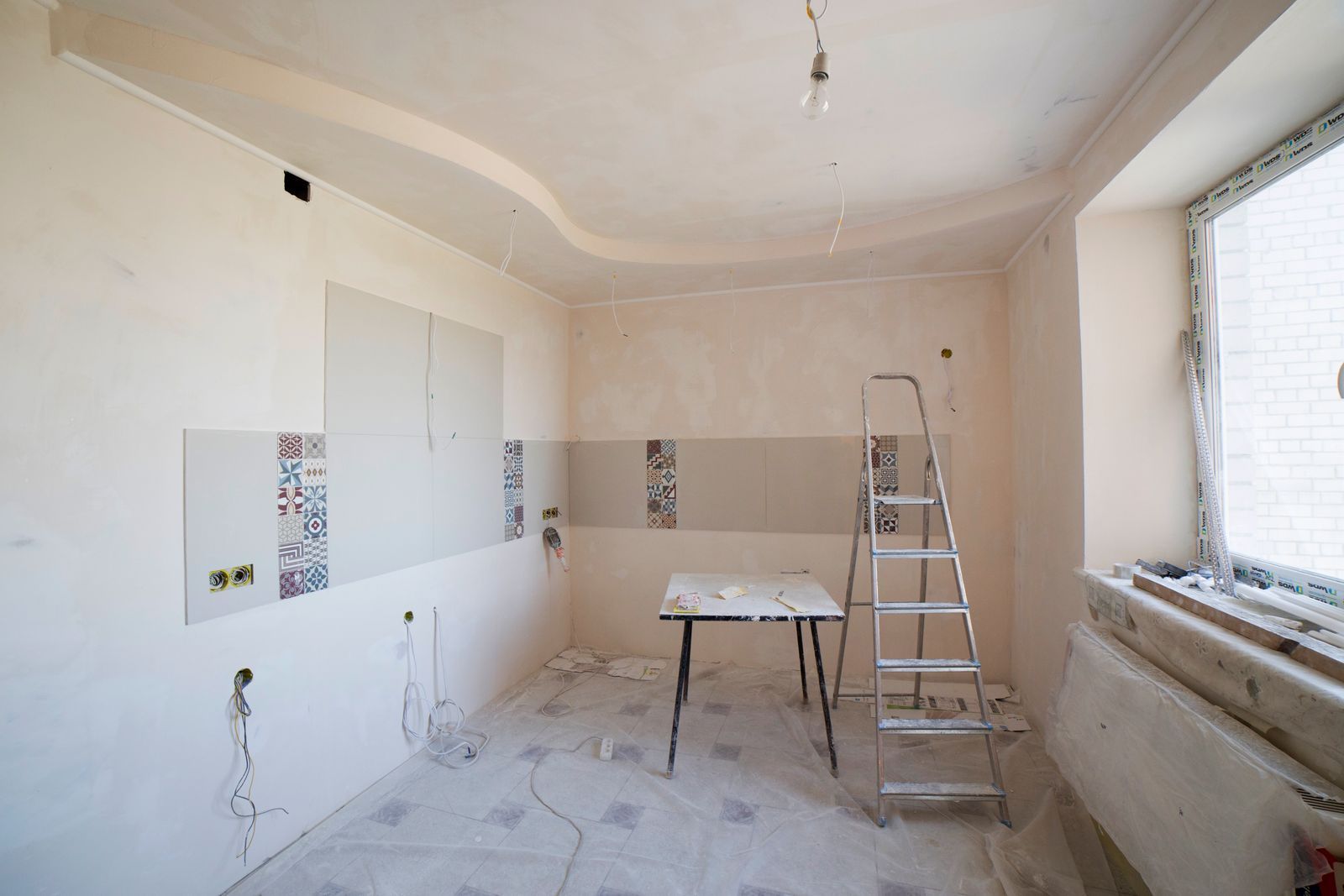
Ben fits kitchens in Norwich, him and an apprentice, VAT registered since last year. He is three days into a £9,600 fit when the customer, Sarah, appears with a coffee and a "while you're here". Could he box in the boiler pipes with a matching end panel? And move the double socket because the fridge is going there now? Then on day four he lifts the old sink unit and finds the floorboards underneath have been quietly rotting for a decade. Three variations, three different conversations, and by the end of the job £415 plus VAT that was not on the quote. Whether Ben gets paid for it, without a row, depends entirely on what he did in the moment each one came up.
What counts as a variation
A variation is anything that changes the scope, the price or the time of the job you quoted. The obvious kind is the customer asking for more. The less obvious kinds catch people out:
- Customer additions. "While you're here" in all its forms.
- Customer changes. A different worktop, the sink moved to the window, the colour of the doors changed after they were ordered.
- Unforeseen conditions. Rotten floor, pipes where the plan said there were none, a wall that is not square enough to hang a run of units on without packing.
- Supplier substitutions. The ordered tap is discontinued and the replacement costs more, or needs a different hole.
- Customer-caused delay. The worktop template is booked but the customer has not chosen the sink, so you lose a day.
- Omissions. The customer decides not to have the pelmet after all. A variation can cut the price as well as add to it.
If it was not in the quote and it costs you time or money, it is a variation, and it needs its own agreement and its own line.
Agree it in writing before you do it
The whole method is one habit: stop, price it, get a yes in writing, then do it. In that order. The yes does not need a form or a signature. A text message does the job, and it is a far better record than a conversation on the stairs that both of you will remember differently in a fortnight.
Here is Ben's text for the boiler pipes, sent from the kitchen while Sarah was in the next room:
"Hi Sarah, boxing in the boiler pipes with a matching end panel: £140 + VAT (£168), adds about half a day so we'd finish Thursday rather than Wednesday afternoon. OK to go ahead?"
"Yes please, that'd be great."
That is a contract. It has the scope (box in pipes, matching end panel), the price (with VAT, because she is a consumer and the number she pays is the one that matters to her), the effect on the programme, and a clear yes. Ben screenshots it and files it with the job.
A few rules that keep this working:
- Put a number on it, every time. "I'll sort that for you" is how £140 becomes free. Even "about £140, I'll confirm tonight" is better than nothing.
- Say what it does to the finish date. Customers are often more upset about the extra day than the extra money, if they did not expect it.
- Do not start until you have the yes. Half an hour of waiting beats a week of arguing.
- For anything bigger than a few hundred pounds, send a short revised quote or a separate quote headed "Variation 1 to QUO-0058", so it sits in the same paper trail as the main job. How to write a trade quote covers what goes on it.
- Keep every message with the job. When you invoice, you will reference the date of each one.
Unforeseen problems are not your risk, but they are your conversation
The rotten floor is the hardest kind of variation, because the customer did not ask for it and does not want to pay for it. But it is not in your quote and it is not your fault, and a fixed price for fitting a kitchen is not a promise to repair whatever the last kitchen was hiding. The day rate vs fixed price post explains where that line sits.
What you cannot do is fix it quietly and add it to the bill. That is where "I never agreed to that" comes from, and the customer is right. Instead:
- Stop and photograph it. Two or three pictures with something for scale.
- Show the customer, in person if they are there, by message with the photos if not.
- Explain the options and price them. "Replace the three boards under the sink run with new treated timber, £180 + VAT, half a day. Or I can leave it, but I wouldn't put a sink unit on it."
- Get the yes, in writing, before you cut a board.
Ben's message, with the photos attached: "Found this under the old sink unit. Boards are soft for about a metre. Replacing them with new treated timber is £180 + VAT (£216) and about half a day. I'd strongly recommend doing it before the new units go in. OK?" Sarah replied "Oh no. Yes, do it, thanks for spotting it." That reply is the difference between £216 paid with gratitude and £216 argued over at the end.
How to invoice variations
There are three ways to put variations on paper, and the right one depends on the length of the job and how you are being paid.
Extra lines on the final invoice
Simplest, and right for most domestic jobs of a week or two. The main work is one line referencing the quote; each variation is its own line below it, with the date it was agreed in the description. The customer can match every line to a message on their phone.
A separate invoice per variation
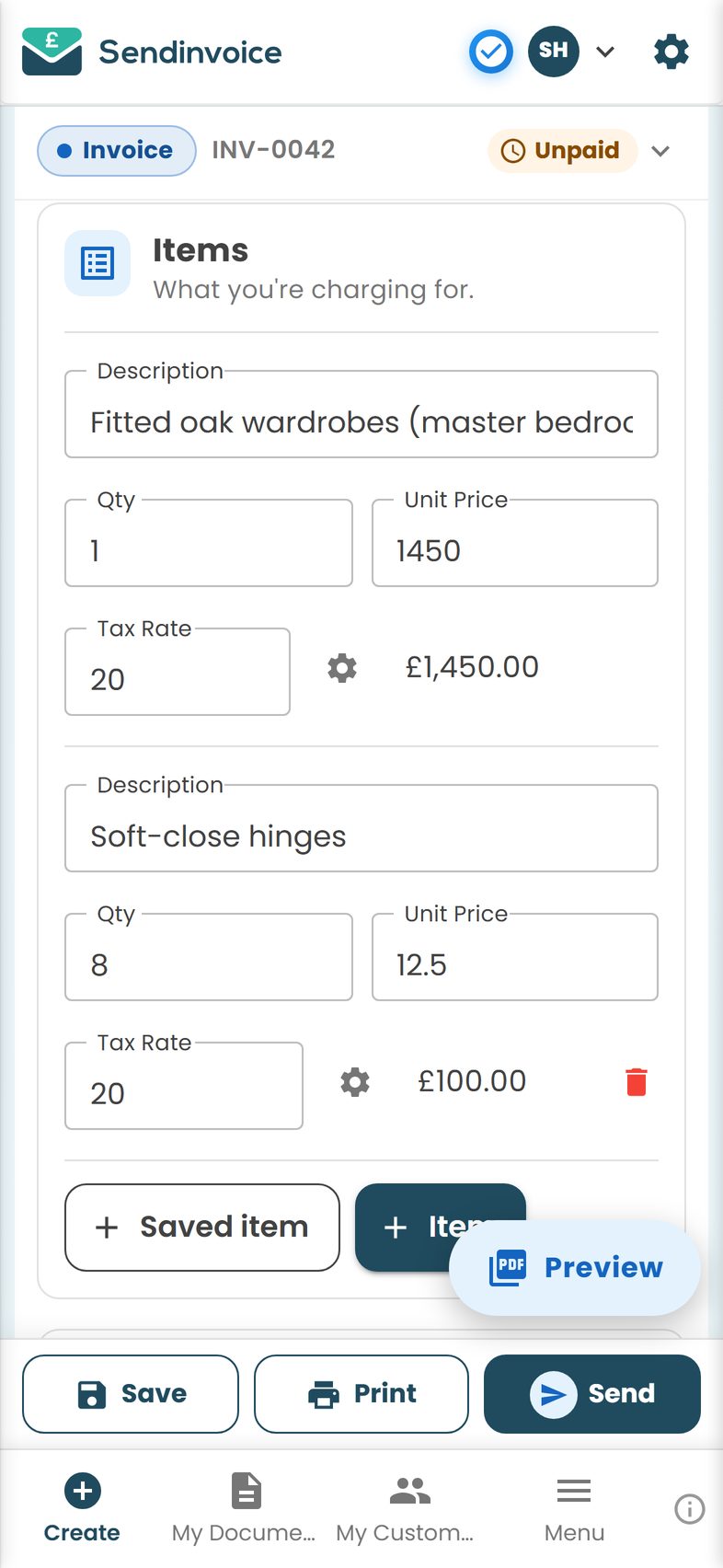
Better for longer jobs, for anything with stage payments, and for variations big enough that you want to be paid for them before the main job finishes. It also keeps the final invoice clean: the final shows the quote price less the deposit and stages, and the extras have already been dealt with. In SendInvoice you can create each variation invoice from the original quote so the customer and job details carry over and it shows "From QUO-0058".
Added to the next stage invoice
If you are on staged payments, add agreed variations as lines on the next stage invoice, under a "Variations" heading in the description. They get paid with the stage, and the final invoice is unchanged.
Whichever you choose, each variation needs four things on its line: what it was, when it was agreed and how ("agreed by text 14 Oct"), the price, and VAT if you are registered. Never fold variations into the main line, and never write "extras" with one number and no breakdown.
Worked example: Ben's final invoice
Ben's firm is VAT registered, so VAT at 20% is shown. Sarah paid a 30% deposit (£2,880 including VAT) on acceptance and a stage payment (£3,520 including VAT) after first fix, so the final invoice shows the balance of the quoted price, with those payments deducted at their net amounts, plus the three variations.
Invoice INV-0289 from B. Carter Kitchens Ltd, VAT no. shown, to Ms S. Whitmore, 17 Unthank Road, Norwich. Date 23 October 2026. From QUO-0058. Payment due within 7 days.
| Description | Amount (net) |
|---|---|
| Supply and fit of kitchen as per QUO-0058: strip out, first fix, units, worktops, sink and tap, appliances, plinths, cornice and pelmet, make good. Completed 23 Oct 2026. | £8,000.00 |
| Less deposit received 22 Sep (PRO-0044) | -£2,400.00 |
| Less stage payment received 10 Oct (INV-0281) | -£2,933.33 |
| Variation 1: box in boiler pipes with matching end panel. Agreed by text 14 Oct. | £140.00 |
| Variation 2: relocate double socket to fridge position and add one further double socket, including electrician's certificate for the alteration. Agreed by text 16 Oct. | £95.00 |
| Variation 3: replace rotten floorboards under sink run with new treated timber (photos sent 17 Oct). Agreed by text 17 Oct. | £180.00 |
| Subtotal (net) | £3,081.67 |
| VAT at 20% | £616.33 |
| Total due | £3,698.00 |
Notes: VAT registered; VAT shown at 20% on the whole supply. Deposit and stage payment shown net; VAT on those was invoiced at the time. Workmanship guaranteed 24 months. Pay by card using the link in this email or by bank transfer to the details below.
Every line Sarah is paying for beyond the quote has a date next to it, and each date matches a message on her phone that ends with her saying yes. The invoice is not asking her to remember anything; it is reminding her.
One point on the VAT: when a VAT-registered business takes deposits and stage payments, each payment normally has its own tax point and its own VAT invoice, which is why the deductions above are shown net and the note says so. It is a detail your accountant will want right, so check it with them rather than copying this blindly.
When the variation makes the job smaller
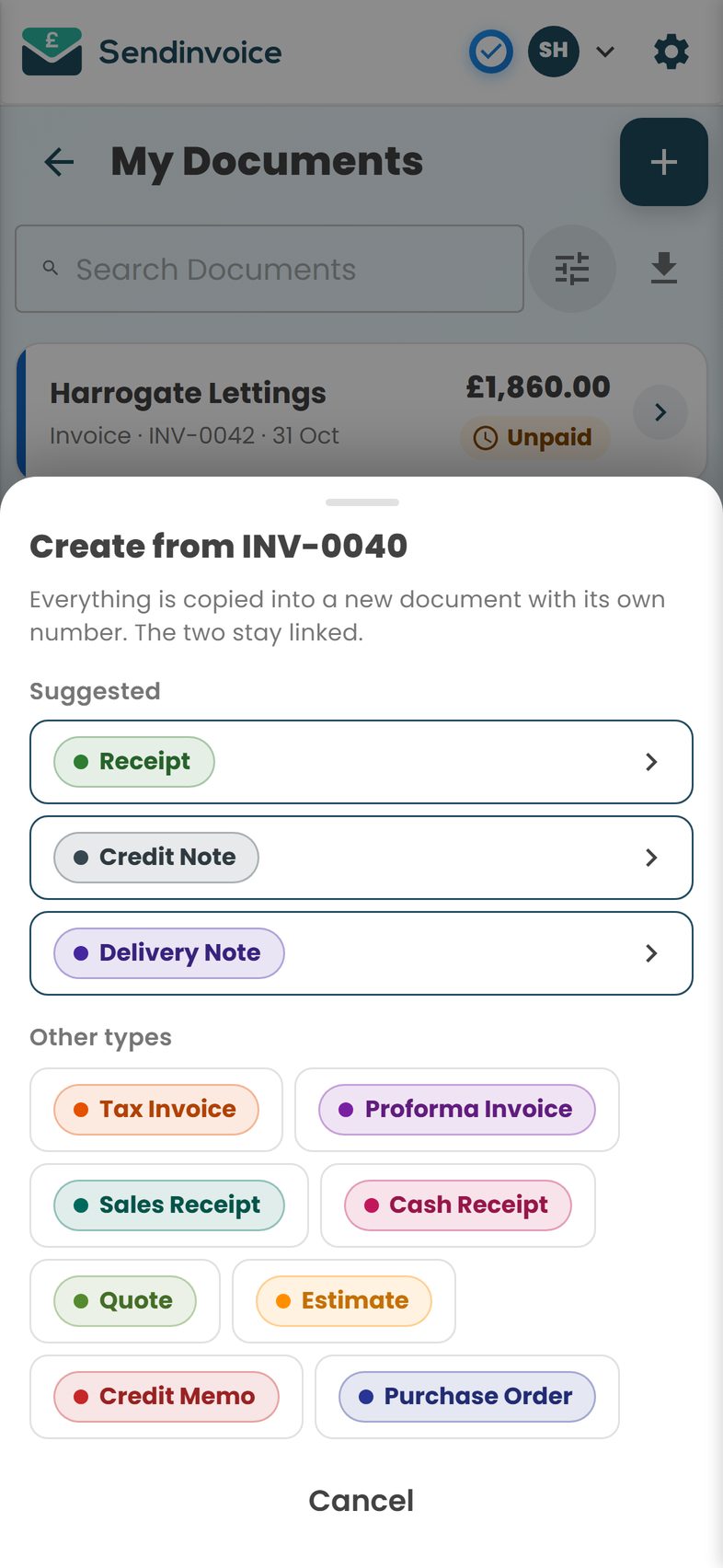
Customers remove things too: the pelmet they decide looks fussy, the second oven they can no longer afford. Treat an omission exactly like an extra. Confirm it in writing with the reduction: "No pelmet: takes £120 + VAT off the price. The cornice stays. OK?" Then show it as a negative line on the final invoice. If you have already invoiced for it, issue a credit note rather than editing the original invoice. And if the material is already bought and cannot be returned, say so in the same message, so the customer knows the omission saves the labour but not the part.
Avoiding the "I never agreed to that" argument
Almost every dispute over extras has the same shape: the tradesperson remembers a conversation, the customer remembers a different conversation, and there is nothing in writing. You cannot win that one, and you should not try to. You can only stop it happening next time.
- Price before you do, every time, by message. It is a 30-second habit that removes the whole category of argument.
- Reference the message on the invoice line. "Agreed by text 14 Oct" turns the invoice into an index of the agreements.
- Send a short progress message on jobs over a week: "End of day 3: units in, worktop template Thursday. Extras so far: boiler boxing and socket, £235 + VAT." The running total means there is no surprise at the end.
- Never bury an extra in the main line. A bigger number on "kitchen fit" with no explanation is the single most common trigger for the argument.
- If you did forget to get it in writing, say so, and offer a fair compromise. A customer who sees you being straight about your own slip will usually meet you halfway. A customer who sees you insisting will dig in.
If you work for a main contractor rather than a homeowner, the same discipline applies with more paperwork: variations are usually instructed in writing by the contractor and claimed on your next application for payment. Invoicing a main contractor as a subcontractor covers that world.
The rest of what goes on a kitchen fitter's invoices, from the deposit proforma to the snag list, is in how to invoice as a kitchen fitter.
Do this in SendInvoice
Quote the job, then create each variation invoice or the final invoice from that quote in one tap, with every extra on its own line and the date it was agreed, and a Pay button in the email. Free to create and preview; £5 a month to send and get paid by card.
Create a free invoice See the £5/month planFrequently asked questions
What counts as a variation on a trade job?
Anything that changes the scope, the price or the time of the job you quoted. The customer asking for something extra is the obvious one, but so is something hidden coming to light once you open up, the customer changing their mind on a material, a supplier substituting a product, or the customer causing a delay. If it was not in the quote and it costs you time or money, it is a variation.
Does a text message count as agreeing a variation?
Yes. A text or WhatsApp message in which you describe the extra work and the price, and the customer replies yes, is a written agreement and is far better evidence than a conversation on the stairs. Keep it specific: what, how much, and whether it adds time. Screenshot it and keep it with the job's documents.
Should I invoice extras separately or add them to the final invoice?
Either works, as long as each extra is its own line with its own price and a reference to when it was agreed. Separate lines on the final invoice are simplest for a short domestic job. A separate invoice per variation suits longer jobs, staged payments, or anything where you want to be paid for the extra before the main job finishes.
What if the customer says they never agreed to the extra work?
Show them the message. If there is no message, you are in a weak position, and the honest answer is that you will probably have to negotiate. The lesson for next time is to stop and get the yes in writing before you pick up a tool. If you cannot prove the agreement, a court is unlikely to make the customer pay for work they did not ask for in writing.
Can I charge for a problem I found that was not my fault?
Yes, if you stop, show the customer, price the fix and get their agreement before doing it. Rotten joists, a leaking pipe behind the old units or an unsafe consumer unit are not in your quote and are not your risk. What you cannot do is fix it quietly and add it to the bill; that is the quickest route to the never-agreed argument.
How do I handle a variation that reduces the job?
If the customer removes something from the scope, say what the reduction is in writing just as you would for an extra, and show it as a negative line on the final invoice, or issue a credit note if you have already invoiced for it. Say whether any materials already bought can be returned, and if not, that they will still be charged.