
Marcus has been an electrician for nine years, mostly rewires and consumer units for homeowners. This autumn he takes his first proper subcontract: first fix on a twelve-flat conversion in Bedminster for a main contractor, £6,150 for the first stage. He finishes the floor, sends an invoice the way he always has, and gets an email back from the quantity surveyor: "Thanks Marcus. We need this as an application by the 25th, labour and materials split, UTR on it, retention shown. Can you resend?" Nobody told him. Nobody ever does. This is the guide he needed that week.
How a main contractor actually pays you
When you work for a homeowner, you do the job, you send the invoice, they pay. When you work for a main contractor, the money goes through a process, and the process is not personal. It is the same for the groundworker, the plasterer and you. Understanding it is the difference between being paid on the dot each month and being the subbie who is always "in the next run".
The moving parts, in order:
- The subcontract order. A document or email setting out the scope, the price (fixed, measured or day rate), the payment dates, retention and any conditions. Read it before you start, not when the first payment is short.
- Valuation dates. Most contractors value work once a month on a fixed date, say the 25th. You submit an application for payment by that date for everything you have done so far.
- The payment notice. The contractor (usually the QS) checks your application and tells you what it will pay and how it worked that out. If it disagrees with your figure, this is where you find out.
- The pay less notice. If the contractor intends to pay less than the notified sum, for example for defective work or a contra charge, it has to tell you in writing before the final date for payment, with its reasons.
- Deductions. CIS tax on your labour and, on many contracts, a retention percentage held back. Both come off before the money reaches you.
- Payment. Typically 30 days after the valuation date, sometimes longer. Terms of 45 or 60 days are not unusual on bigger sites.
The Housing Grants, Construction and Regeneration Act 1996, which everyone calls the Construction Act, is what sits behind the notices. In short: construction contracts between businesses that last more than 45 days must allow staged payments, must follow a payment notice and pay less notice process, and give either side the right to adjudication, a fast dispute procedure. It does not apply to contracts with homeowners. You do not need to be an expert, but you should know it exists, because it is why a contractor cannot simply pay you less without telling you in writing.
Applications for payment versus invoices
An application for payment is you saying: "Up to the 25th, I have done this much work, worth this much, and you have already paid me this much, so I am owed this." It is cumulative: application 3 shows the total value to date, less applications 1 and 2. The QS checks it against what is actually on site and issues a payment notice for the certified amount.
Then one of two things happens, depending on the contract. Either you raise an invoice for the certified figure, or the contractor treats your application as the invoice. Ask on day one: "Do you want an application then an invoice, or does the application stand as the invoice?" Then do it that way every month, in the same format, on the same date.
CIS on your invoice
If you do construction work for a contractor, the Construction Industry Scheme almost certainly applies. The contractor deducts tax from the labour part of what it pays you and sends it to HMRC on your behalf. At the time of writing the rate is 20% if you are registered as a subcontractor, 30% if you are not, and 0% if you have gross payment status. Deductions apply to labour only, never to materials and never to VAT.
So your invoice needs:
- Labour and materials as separate lines, with materials at what they cost you (keep the receipts; contractors can ask to see them).
- Your UTR (Unique Taxpayer Reference) printed on the invoice, so the contractor can verify you with HMRC and apply the right rate.
- A deduction line: "Less CIS deduction 20% of £4,800 labour: £960.00".
- The amount actually payable after the deduction.
The deductions are not lost. They count towards your tax bill, and as a sole trader you reclaim them through Self Assessment at the end of the year. The contractor must give you a deduction statement for each payment; file every one. There is a full walk-through in our CIS invoice example for subcontractors. If you are VAT registered and the contractor is too, the VAT domestic reverse charge will usually apply as well, which changes how VAT appears; see the VAT reverse charge explained. Marcus is under the VAT threshold, so for him it is simply not on the invoice. Check with your accountant or HMRC on your own position.
Retention, briefly
Many subcontracts let the main contractor hold back a percentage of each payment, usually 3% to 5%, as security against defects. Half is normally released at practical completion of the whole project and the other half after the defects period, often 12 months later. It is shown on the application as a separate deduction line, and you need to keep a running total of what is being held, because nobody will remind you to ask for it back. Retention on construction invoices covers tracking and chasing it in detail.
A worked example: Marcus's first application
Marcus is a sole trader, registered for CIS, not VAT registered. His subcontract order says: measured work, applications by the 25th, payment 30 days from valuation, 5% retention, CIS at the verified rate. Here is application number 1 for the first-fix stage.
Application for payment no. 1 (INV-0341) from Marcus Bell trading as Bell Electrical, 27 Ashton Drive, Bristol BS3 2NN. UTR 12345 67890
To: Northgate Construction Ltd, Unit 4, Avonside Business Park, Bristol BS2 0XY. For the attention of J. Okafor, Quantity Surveyor
Contract: Electrical first fix, 12 flats, 40-44 North Street, Bedminster. Order no. NC-2026-0817
Valuation date: 25 November 2026. Final date for payment: 25 December 2026
| Description | Qty | Rate | Amount |
|---|---|---|---|
| Labour: first fix wiring, flats 1 to 6, containment, back boxes, cabling to DB positions | 12 days | £400.00 | £4,800.00 |
| Materials: twin and earth, singles, back boxes, containment, clips and fixings (supplier receipts available) | 1 | £1,350.00 | £1,350.00 |
| Gross value of work this application | £6,150.00 | ||
| Less previously certified | £0.00 | ||
| Less retention 5% of £6,150.00 | -£307.50 | ||
| Less CIS deduction 20% of £4,800.00 labour | -£960.00 | ||
| Amount payable | £4,882.50 | ||
Not VAT registered; no VAT charged. Retention held to date: £307.50. Payment by bank transfer to the account shown. Day sheets signed by the site manager attached.
Keeping your own paper trail
The main contractor has a QS, a commercial manager and a filing system. You have a van. That is fine, as long as you keep the handful of documents that decide every argument about money on a site. From day one of the contract, keep:
- The subcontract order and any emails that change it.
- Signed day sheets or progress records, countersigned by the site manager, especially for day-rate work.
- Written instructions for every variation. An email or a text from the site manager saying "yes, add the extra sockets in flat 4" is enough; a conversation by the mixer is not. Price each variation and add it to the next application as its own line. Variations and extras goes into this.
- Delivery notes and receipts for every material you supply, so the materials line can be backed up.
- Dated photos of work complete and, especially, of work that is about to be covered up by plasterboard.
- Every application, payment notice, pay less notice and CIS deduction statement, filed by month.
- A retention running total for each contract, with the expected release dates.
Keep all of it for at least five to six years. The CIS statements go to your accountant for Self Assessment; the rest is your evidence if a dispute ever reaches adjudication.
Getting paid on time, and what to do when you are not
Three habits keep subcontract money flowing. Submit on the valuation date, every month, without fail. Address the application to the person named in the order and copy accounts. And agree the figure early: a two-minute call with the QS on the 26th to confirm they accept your valuation saves a surprise pay less notice on the 20th of the following month.
If the final date for payment passes and nothing arrives, chase in writing, politely, the next day. A main contractor is a business, so the Late Payment of Commercial Debts (Interest) Act 1998 applies: statutory interest at 8% above the Bank of England base rate, plus fixed compensation of £40, £70 or £100 per invoice depending on its size, at the time of writing. A formal reminder that mentions this is usually enough to move your application from "next run" to "this run". The escalation ladder in how to chase an unpaid invoice works for contractors too, with the interest paragraph left in.
Two cautions. If the contractor has issued a valid pay less notice, the dispute is about the notice, not about late payment; argue the figure, with your day sheets and photos. And do not walk off site over a late payment without advice: the Construction Act gives you a right to suspend work for non-payment, but only after proper written notice, and getting it wrong can put you in breach. A trade body, your accountant or a construction solicitor can tell you where you stand in an hour, which is cheaper than guessing.
Do this in SendInvoice
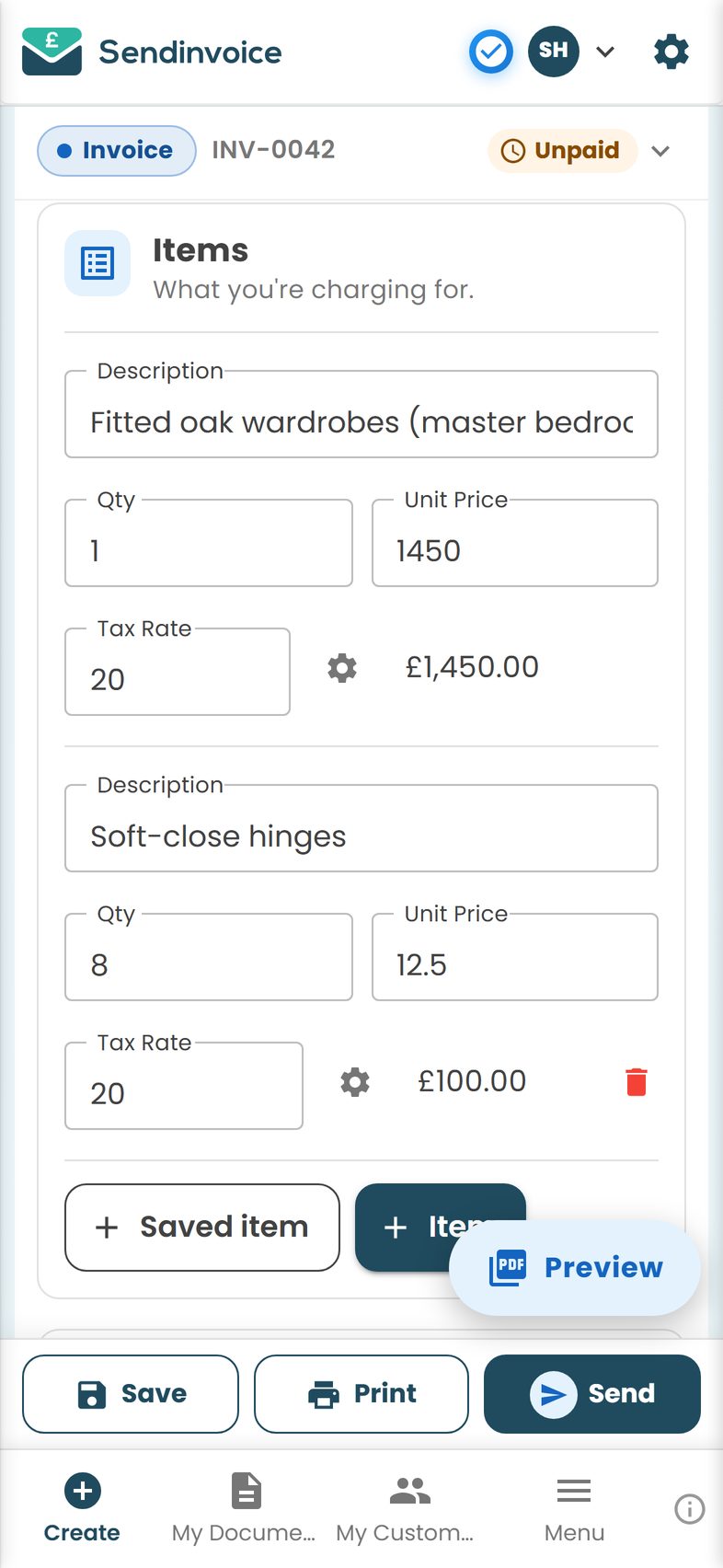
Build your monthly application with labour, materials, retention and CIS as clear lines, send it to the QS with accounts in copy, and create the invoice for the certified sum from it in one tap. Free to create and preview; £5 a month to send, remind and get paid.
Create a free invoice See the £5/month planFrequently asked questions
What is the difference between an application for payment and an invoice?
An application is your statement of what you believe you are owed up to a valuation date, usually cumulative. The contractor checks it and tells you what it will pay in a payment notice. The invoice is then raised for that certified amount, or the application itself is treated as the invoice, depending on the contract. Ask which your contractor wants and follow it to the letter.
Does the main contractor deduct CIS from my whole invoice?
No. Under the Construction Industry Scheme the deduction applies to the labour element only, not to materials you supplied or to VAT. That is why a subcontractor invoice always shows labour and materials as separate lines. At the time of writing the rate is 20% if you are registered, 30% if you are not, and 0% with gross payment status.
Why has the contractor paid me less than I invoiced?
Usually one of three things: the CIS deduction, retention held back, or a pay less notice reducing the amount. Each should be explained in writing: a CIS deduction statement, a retention line on the payment notice, or a pay less notice sent before the final date for payment. If you have had none of those, ask for them before you accept the shortfall.
Does the Construction Act apply to my subcontract?
If it is a construction contract between two businesses and the work lasts more than 45 days, the Housing Grants, Construction and Regeneration Act 1996 generally applies. It requires staged payments, a payment notice and pay less notice process, and gives you the right to adjudication. It does not apply to contracts with homeowners. Get advice before relying on it.
Can I charge a main contractor late payment interest?
Yes. A main contractor is a business, so the Late Payment of Commercial Debts (Interest) Act 1998 applies: statutory interest at 8% above the Bank of England base rate plus fixed compensation of £40, £70 or £100 per invoice depending on its size, at the time of writing. Mention it in a formal reminder; it is often enough to move an application up the pile.
What records should I keep as a subcontractor?
The subcontract order, every application and invoice, each payment and pay less notice, every CIS deduction statement, delivery notes for materials, signed day sheets, written variation instructions, dated photos, and a running retention total per contract. Keep them at least five to six years. They are your evidence if a dispute goes to adjudication and your proof of CIS deductions for Self Assessment.