Lauren has spent four days on a hall, stairs and landing in Bishopston: a Victorian terrace, lining paper that came off in strips, spindles that took most of a day on their own. The quote was £1,150. On the last afternoon the customer, Priya, walks round with her in the good light, spots two misses above the door frame, Lauren touches them in, and the invoice is sent before the dust sheets are back in the van. Here is how a painter and decorator invoices so that it goes like that, rather than "I'll send it over" followed by three weeks of silence.
What a decorator's invoice needs
The legal basics are the usual: a unique number, your name or trading name and address, the customer's name and address, the date, a description, and the amount due. Petty Decorating is a sole trader and not VAT registered, so there is no VAT on Lauren's invoices at all, and no VAT number. (If you are registered, add the VAT number, rate, VAT amount, tax point and net total; the how to write an invoice guide covers it.)
What makes it a decorator's invoice:
- The rooms, named, with what was done to each surface. "Hall, stairs and landing: walls two coats, ceilings two coats, woodwork prepared, undercoated and satin finished." The description is the thing the customer compares with the quote.
- Labour as days or as a room price, whichever you quoted, in the same words.
- Materials as separate lines, main products named, sundries as one line.
- Extras agreed mid-job as their own lines, with the date you agreed them.
- The colours. Brand, range and name. In two years when they want the landing touched up, the invoice is where they will look.
Quoting rooms: per room, per square metre or per day
Decorating has three honest ways to price, and the invoice should mirror whichever one the quote used.
Fixed price per room or per job is what most homeowners want: a number they can say yes to. It rewards you for being quick and tidy, and it means the invoice is already written when you quote. The risk is the prep. A room that looks like "two coats and done" can hide blown plaster and three layers of woodchip. Protect yourself with a line on the quote saying what is included ("prepare, fill and sand minor defects") and what is not ("stripping existing wallpaper, re-plastering, or more than light filling will be quoted separately").
Per square metre works for big plain areas (new-build, commercial, whole-house rentals) where the surfaces are consistent and the sums are easy to check. Say the rate, the area and whether ceilings and woodwork are included.
Day rate is the honest choice when nobody can see the scope: stripping, repairs, working round other trades, or a customer who wants to decide colours as they go. Quote the day rate, estimate the days, and say that the estimate is an estimate. Invoice the actual days with the dates listed, so the customer can match them to the days you were there.
For the Bishopston job Lauren quoted a fixed price with four days of labour shown, because the customer asked how long it would take and the figure made sense of the price. The day rate vs fixed price post goes through when each one wins, and how to write a trade quote covers exclusions, which matter more in decorating than in almost any other trade.
Materials versus labour
Keep them apart on the invoice, always. A customer who sees "Hall, stairs and landing: £1,150" wonders where the number came from. A customer who sees four days' labour, two tubs of trade matt, a tin of satinwood and a line of sundries can see that most of the money is skill and time, and that the paint was not marked up to the moon.
You can mark up materials. You chose the right product, drove to the trade counter, carried it up the stairs and will stand behind the finish; a margin on that is normal. Show the price you are charging, not your trade-account cost. For sundries (filler, caulk, sandpaper, masking tape, dust sheets you wore out) one line is fine.
When the customer supplies the paint, which happens more in decorating than in any other trade, put "customer-supplied" on the labour line and add a note that you cannot guarantee coverage or finish with a product you did not choose. Designer emulsion that needs four coats instead of two is a day of your life, and the note is what lets you charge for it.
If you are VAT registered, VAT applies to the whole supply, labour and materials, at the standard rate; decorating almost never qualifies for the reduced rates. The labour and materials post goes into receipts and mark-ups in more detail.
Extras and the "while you're here"
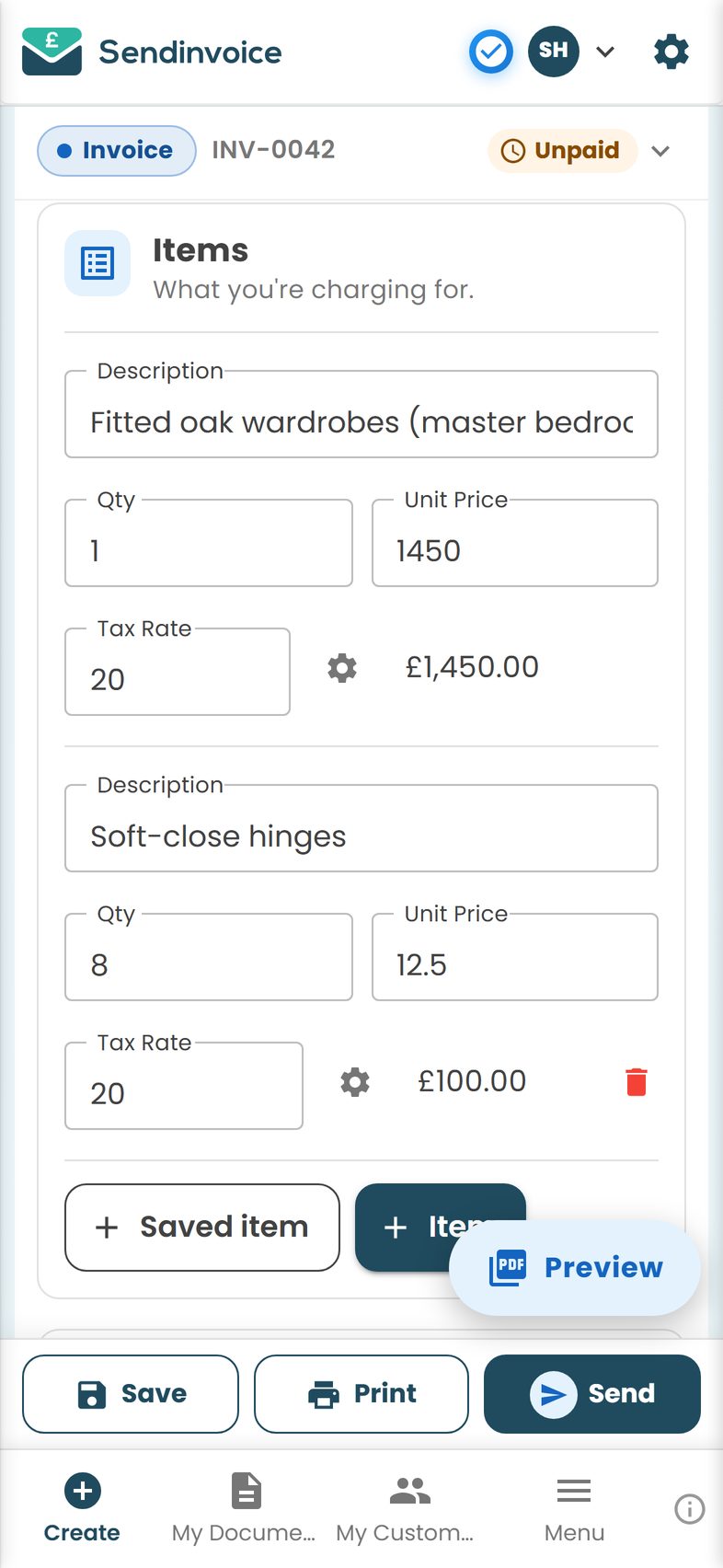
Every decorator knows the sentence. "While you're here, could you just do the cupboard doors?" The answer is yes, and the price is agreed before you open the tin. A text saying "Happy to, that'll be £95 on top, OK?" and a reply saying "Yes please" is all the contract you need. On the invoice the extra gets its own line, under the original job, with the date it was agreed. Do not fold it into the labour total; the customer will remember the original quote and not the conversation on the landing.
The same goes for changes you find rather than changes they ask for. If the lining paper comes off with the old paint and a wall needs re-lining, stop, show them, agree the cost, carry on. The variations and extras post has wording that keeps it friendly.
The snagging walk-round before the final invoice
Decorating is judged by eye, in daylight, by someone who has been living in the mess for a week and wants it to be perfect. So before you invoice, walk every room with the customer when the light is good. Look at the cutting-in, the edges of the ceilings, the backs of doors, the tops of skirting. Let them point. Fix what they find, there and then, while the paint and the brushes are still out. Most lists are two or three touch-ups and a drip on a radiator.
Then, standing in the finished hall, send the invoice from your phone. The customer has just approved the work out loud; the invoice email arrives with the PDF and a Pay button while they are still pleased. That is the moment people pay. The decorator who leaves, writes up the invoice on Sunday and emails it on Monday has given the customer a weekend to find a miss behind the sofa and a reason to hold the money.
If something genuinely cannot be fixed on the day (a colour the customer now dislikes, a door that needs another coat when it has cured), agree the return visit, note it on the invoice, and invoice the job anyway. "Return visit to recoat landing door agreed for Tue 18 Nov" in the notes is a promise in writing, and a reason for them to pay now rather than later.
Worked example: hall, stairs and landing
This is Lauren's invoice for the Bishopston job. Petty Decorating is not VAT registered, so there is no VAT line.
Petty Decorating
Invoice INV-0163
Date: 14 November 2026
Bill to: Ms P Nair, 19 Berkeley Road, Bristol
Job address: as above
Quote: QUO-0140, accepted 30 October 2026
Due: on receipt
| Description | Qty | Unit price | Amount |
|---|---|---|---|
| Labour: hall, stairs and landing. Prepare, fill and sand walls and ceilings; walls two coats matt emulsion; ceilings two coats; woodwork (skirting, dado rail, handrail, 34 spindles and newels, four doors and frames) sanded, undercoated and two coats satinwood. Mon 10 to Thu 13 Nov | 4 days | £220.00 | £880.00 |
| Trade vinyl matt emulsion, 10L, tinted "Pale Oat" (walls, hall and landing) | 2 | £54.00 | £108.00 |
| Trade satinwood, 2.5L, white (woodwork) | 1 | £38.00 | £38.00 |
| Sundries: filler, caulk, sandpaper, masking tape, white ceiling emulsion, undercoat | 1 | £29.00 | £29.00 |
| Extra agreed by text 11 Nov: strip failed lining paper on stair wall, re-line and prepare before painting | 1 | £95.00 | £95.00 |
| Total due | £1,150.00 | ||
Payment: by card using the Pay button in this email, or by bank transfer to Petty Decorating, sort code 00-00-00, account 00000000, reference INV-0163.
Notes: Colours for touch-ups: walls trade vinyl matt "Pale Oat"; ceilings white matt; woodwork trade satinwood brilliant white. Snagging walk-round completed 14 Nov with Ms Nair, two touch-ups above the front door completed on the day. Allow 7 days before washing walls.
The invoice and the quote match, line for line, except for the extra. That is the whole trick. Ms Nair said yes to £1,055 on the 30th of October, said yes to £95 more by text on the 11th, and is now looking at a bill for £1,150 that she has already agreed to twice.
Wallpaper, deposits and bigger jobs
Paint is cheap relative to labour, so most paint-only jobs do not need a deposit. Wallpaper is different. A feature wall in a designer paper can be £400 of material before you have hung a drop, and some papers are made to order and cannot be returned. Take a deposit that covers the paper on a proforma invoice before you order, and say on the quote that it is non-refundable once the paper is ordered. If the contract was agreed in the customer's home, they have a 14-day cancellation right under the Consumer Contracts Regulations on jobs over £42; if they want you to order the paper inside that window, get the request in writing (a text will do) so the deposit covers it.
For whole-house jobs running two or three weeks, a deposit and a mid-point stage invoice are reasonable and nobody minds if they were on the quote. The deposits and staged payments post covers how to word the schedule.
Landlords, lettings and end-of-tenancy work
A good share of decorating is for landlords and letting agents between tenants. They are businesses: they want the property address on the invoice, their job or purchase order reference, and usually 30-day terms, and if they pay late the Late Payment of Commercial Debts (Interest) Act 1998 lets you add statutory interest and a fixed sum. For a private homeowner that Act does not apply and you cannot add those fixed sums. Quote per flat as a fixed price with the colours specified, and see invoicing landlords and letting agents for chasing them.
Invoicing from the van
Lauren does not go home to invoice. The quote was written on her phone at the customer's kitchen table after the first visit. When the job finished, she created the invoice from that quote in one tap, so the customer, the address and the lines were already there; she adjusted the paint quantities, added the extra, and sent it from the hall. Priya paid by card from the Pay button in the email before Lauren had reached the end of the road, and the invoice flipped to Paid on its own. For customers who prefer bank transfer, the details are on the invoice and it is marked paid by hand when the money lands.
Keep every invoice, quote, trade-counter receipt and bank statement for at least five to six years. One running number sequence per document type; if a job is cancelled after invoicing, issue a credit note rather than deleting anything. Making Tax Digital for Income Tax applies from April 2026 to sole traders with income over £50,000 (over £30,000 from April 2027, over £20,000 from April 2028, at the time of writing), and a list of invoices you can filter by quarter and export is most of what you need. Check with your accountant or HMRC for your own position.
Do this in SendInvoice
Quote the rooms with labour and paint on separate lines, turn the quote into the invoice after the walk-round, add the extra the customer agreed by text, and send it from the finished hallway with a Pay button. Free to create and preview; £5 a month to send, remind and get paid by card.
Create a free invoice See the £5/month planFrequently asked questions
Should a decorator charge a day rate or a fixed price per room?
Fixed price for most domestic work, because customers want to know the total before they say yes and you want to be paid for speed, not punished for it. Day rate when the scope is unclear, such as stripping an unknown number of layers or working alongside other trades. Either way, state it on the quote and invoice in the same words.
Do I put paint on the invoice as a separate line?
Yes. Show materials as their own lines, with the main products named (the brand, the finish, the litres), and sundries like filler, caulk and tape as one line. You can mark materials up; you are choosing, collecting and carrying them. If the customer supplied the paint, say so, and note that you cannot guarantee a finish with a product you did not choose.
How do I handle extra work the customer asks for mid-job?
Agree the price before you do it, in writing. A text saying "Yes please, do the cupboard doors for £120" is enough. Then put it on the invoice as its own line, with the date it was agreed, under the original job. Customers who see the agreed work and the extras separately pay without argument; customers who see one bigger number do not.
What is a snagging walk-round and why do it before invoicing?
It is a five-minute tour of the finished rooms with the customer, in daylight, looking for misses, drips and touch-ups. Do it, fix what they find there and then, and send the final invoice while they are looking at a job they have just approved. Invoicing before the walk-round invites a late payment with a list of complaints attached.
Does a decorator need to be VAT registered?
Only once your taxable turnover passes the threshold, which most one-person decorating businesses do not reach. If you are not registered, do not charge or show VAT on the invoice at all. If you are, VAT applies to the whole supply, labour and materials, at the standard rate. Ask your accountant when you get close to the threshold.
Should I take a deposit for decorating work?
For paint-only jobs, usually not; the materials are cheap relative to labour and most customers pay promptly. For wallpaper, especially expensive or made-to-order paper, take a deposit that covers the paper on a proforma invoice before you order it. For a whole-house job over several weeks, a deposit and a mid-point stage payment are reasonable.