Lena runs LK Plastering, a VAT-registered two-person firm in Manchester. She has just finished skimming six flats for Ashcombe Developments, a VAT-registered main contractor: £3,500 of labour and £700 of plaster, beads and scrim. For a homeowner the invoice would say £4,200 plus £840 VAT. For Ashcombe it says £4,200, no VAT charged, and a sentence that makes it legal. That sentence is the domestic reverse charge, and if you are a VAT-registered subcontractor it is on most of the invoices you send. Here is what it is, when it applies and exactly what to write.
What the reverse charge is
Since 1 March 2021, for most construction work supplied by one VAT-registered business to another, the customer accounts for the VAT to HMRC instead of the supplier. You, the subcontractor, do not add VAT to your invoice and do not receive it. The contractor declares the VAT on their own return and, usually, reclaims it on the same return. HMRC introduced it to stop "missing trader" fraud, where a subcontractor collected VAT from a contractor and vanished before paying it over.
For a small firm like Lena's the practical effects are:
- Invoices to contractors show no VAT charged, with specific wording.
- Invoices to homeowners and other non-VAT-registered customers are unchanged: VAT as normal.
- The VAT you used to collect from contractors and hold until the return no longer comes in, which changes your cash flow.
If you are not VAT registered, none of this applies to you at all. You do not charge VAT, show VAT or use any reverse charge wording. See invoicing when you are not VAT registered, and keep an eye on the threshold (£90,000 turnover at the time of writing), because crossing it brings this post into play immediately.
Does it apply to this invoice? Four questions
Run every construction invoice through this list. The reverse charge applies only when the answer to all four is yes.
| Question | If no |
|---|---|
| 1. Am I VAT registered? | Stop. No VAT, no reverse charge, nothing to do. |
| 2. Is the customer VAT registered? | Charge VAT normally. This covers every homeowner and every small business below the threshold. |
| 3. Is the work a CIS-reportable construction service? (Building, alteration, repair, demolition, groundworks, plastering, decorating, electrical and plumbing installation and similar; the CIS definition is the test.) | Charge VAT normally. Some services are excluded, for example architects' fees and the manufacture of components off site; check HMRC's list. |
| 4. Is the customer going to sell the work on, rather than being the "end user" (or an intermediary connected to one)? | Charge VAT normally. An end user is a VAT-registered business that will not supply the construction work onward, such as a shop having its own premises refitted. End users should tell you in writing that they are one. |
Lena's job passes all four: LK Plastering is registered, Ashcombe is registered, plastering is a CIS-reportable construction operation, and Ashcombe is a contractor selling the finished flats, not an end user. Reverse charge applies.
Her next job, skimming a hallway for Mr and Mrs Doyle, fails at question 2. She charges them 20% VAT on an ordinary VAT invoice and the reverse charge never comes into it.
What to put on the invoice
A reverse charge invoice is a full VAT invoice with the VAT removed from the total and a statement added. It must still carry everything a VAT invoice needs: a unique number, your name, address and VAT number, the customer's name and address, the date and tax point, a description of the work, and the net amount. Then:
- State that the reverse charge applies. HMRC accepts several wordings; the one most subcontractors use is "Reverse charge: customer to pay the VAT to HMRC." Others include "VAT Act 1994 Section 55A applies" and "Reverse charge: VAT Act 1994 Section 55A applies". Pick one and use it every time.
- Show the VAT rate that applies (20% for most work) and the amount of VAT the customer must account for. You can show it as a note ("VAT at 20%: £840.00 to be accounted for by the customer") rather than as a line that adds to the total.
- Do not add VAT to the total. The amount payable is the net figure.
- Show the customer's VAT number. Not strictly compulsory, but it is the evidence that question 2 was answered yes.
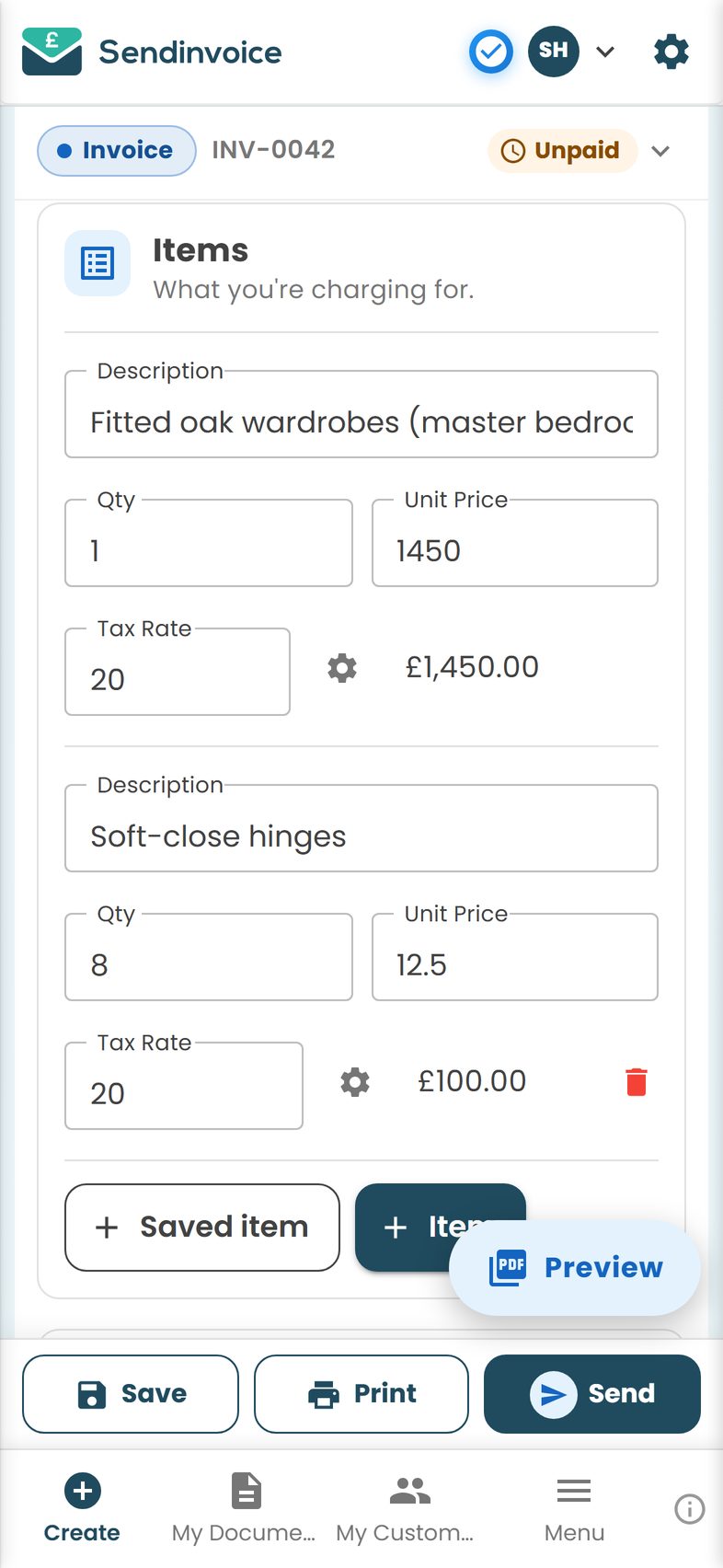
In SendInvoice, the practical way is to set the VAT on each line to 0% so nothing is added to the total, then put the reverse charge statement, the rate and the VAT amount the customer must account for in the notes or terms. Your own VAT number sits in your saved business details and the customer's VAT number goes in their address block. The app does not work out whether the reverse charge applies; that is your four questions above.
The worked example: six flats for Ashcombe
Lena's firm is VAT registered and registered under CIS at 20%. Ashcombe is a VAT-registered contractor and not an end user.
LK Plastering Ltd · VAT No. GB 123 4567 89 · UTR 98765 43210 · Invoice INV-0412 · Date 6 November 2026 · Tax point 6 November 2026 · Due 30 days
Bill to: Ashcombe Developments Ltd, 2 Canal Street, Manchester · Customer VAT No. GB 987 6543 21 · Site: Flats 1-6, Weir Mill, Stockport · Order no.: AD-0875
| Description | Qty | Unit price | VAT | Amount |
|---|---|---|---|---|
| Labour: two-coat skim to walls and ceilings, flats 1-6, including beads and preparation | 1 | £3,500.00 | Reverse charge | £3,500.00 |
| Materials: multi-finish plaster, bonding, angle beads, scrim and PVA | 1 | £700.00 | Reverse charge | £700.00 |
| Net total | £4,200.00 | |||
| VAT charged | £0.00 | |||
| Total | £4,200.00 | |||
| Less CIS deduction, 20% of £3,500.00 labour | -£700.00 | |||
| Amount payable | £3,500.00 | |||
Reverse charge: customer to pay the VAT to HMRC. VAT at 20% on £4,200.00, being £840.00, to be accounted for by the customer. CIS deduction applies to labour only. Please issue a payment and deduction statement. Bank details below.
Walk through it once. The net is £4,200. No VAT is added, but the invoice says what the rate is and what Ashcombe must account for: £840. Then CIS: 20% of the labour (£3,500), which is £700. Because there is no VAT in the total, there is no way for the contractor to accidentally deduct CIS from VAT, which was a real problem on old-style invoices. The amount that should land in Lena's account is £3,500.
For comparison, the same job for a homeowner would show £4,200 net, £840 VAT, £5,040 total, no reverse charge statement and no CIS line. Same work, two very different pieces of paper. The CIS side on its own is covered in our CIS invoice example.
The cash-flow change nobody mentions
Under normal VAT, Lena would have invoiced Ashcombe £5,040, received it (eventually), and held the £840 until her quarterly return. For a firm doing £15,000 of contractor work a month, that was several thousand pounds sitting in the account between returns. Under the reverse charge, it never arrives.
Meanwhile she still pays VAT on her van, fuel, tools and plaster, and reclaims it. Many subcontractors find that, with little or no output VAT on their sales, they are now regularly owed money by HMRC rather than owing it. Two things to raise with your accountant, at the time of writing:
- Monthly VAT returns. If you are usually in a repayment position, monthly returns bring the refunds in faster than quarterly ones.
- The Flat Rate Scheme. Reverse charge sales are treated differently under the flat rate scheme, and for many subcontractors it stops being worthwhile. Do not assume it still works for you.
And budget for it. The VAT you used to hold was never yours, but it was useful. The reverse charge removes the float, so the deposit and staged payment habits in invoicing a main contractor as a subcontractor matter more, not less.
Mixed invoices and the edge cases
A few situations that catch people out. Keep these cautious and check HMRC's guidance or your accountant for your own case.
- Reverse charge and standard-rated work on one invoice. If any of the services on an invoice fall under the reverse charge, HMRC's guidance is that the whole supply is treated as reverse charge (there is a small "5% disregard" for minor reverse charge elements). The easy route is to invoice reverse charge work separately.
- Materials only. If you only supply materials with no construction service, the reverse charge does not apply. If you supply and fit, it applies to the whole supply, materials included, as in Lena's example.
- Reduced-rate work. Some construction work is at 5% (for example certain conversions and some energy-saving installations). The reverse charge still applies between registered businesses; you state the 5% rate instead. Check HMRC's notices for what qualifies.
- Labour agencies and employment businesses. Supplying staff rather than construction services is outside the reverse charge. If you sometimes "lend" a plasterer to a contractor, ask how the contract is framed.
- Customer not CIS registered but VAT registered. The test is whether the supply is CIS-reportable and the customer is VAT registered and not an end user. If in doubt, ask the customer in writing and keep the reply.
Getting paid, and the records to keep
Contractors pay by BACS on a run, not by card button, so the job on your side is making the invoice easy to approve: their order number, the site, labour and materials separate, the reverse charge statement, the CIS line and the amount payable. Thirty-day terms are normal; "end of month following" is common and worth negotiating. You are a business invoicing a business, so the Late Payment of Commercial Debts (Interest) Act 1998 applies if they pay late, and construction contracts between businesses sit under the Construction Act's payment notice rules too. When the BACS arrives, mark the invoice paid and check the amount against the "amount payable" line; a shortfall of exactly 10% of labour means they have applied 30% CIS and you need re-verifying.
Keep each invoice with any end-user statement you received, the contractor's payment and deduction statement, and the bank entry, for at least five to six years. Your accountant will need the reverse charge sales shown separately on the VAT return (they go in the net sales box but not the output VAT box, at the time of writing), so keeping contractor and homeowner invoices clearly distinguishable, with the statement on every reverse charge one, saves a lot of sorting at quarter end.
Lena's invoice to Ashcombe took five minutes in the van: two lines, VAT at zero, one sentence in the notes, the CIS deduction, and £3,500 as the number to expect. The sentence is what makes it right. Get it on every contractor invoice and the reverse charge becomes the least interesting thing about your paperwork, which is exactly what it should be.
Do this in SendInvoice
Keep your VAT number and UTR in your saved business details, set VAT per line, put the reverse charge statement in your notes once, and send contractor invoices from the site with labour, materials and the CIS line laid out clearly. Free to create and preview; £5 a month to send, track payment and export for your VAT return.
Create a free invoice See the £5/month planFrequently asked questions
I am not VAT registered. Does the reverse charge affect me?
No. The domestic reverse charge only applies to supplies between VAT-registered businesses. If you are not VAT registered you do not charge VAT, do not show VAT and do not need any reverse charge wording, whoever your customer is. The only thing to watch is your turnover against the registration threshold; if you cross it, this post becomes relevant overnight.
Does the reverse charge apply when I work for a homeowner?
Never. A private homeowner is not VAT registered and is not a CIS contractor, so you charge VAT in the normal way on an ordinary VAT invoice. The reverse charge is only for construction services supplied to a VAT-registered business that is itself going to sell the work on, such as a main contractor or developer.
What exactly do I write on a reverse charge invoice?
Everything a normal VAT invoice needs, plus a clear statement that the reverse charge applies, such as 'Reverse charge: customer to pay the VAT to HMRC', the VAT rate that applies (usually 20%) and the amount of VAT the customer must account for, with no VAT added to the total. Showing the customer's VAT number is good practice. Check HMRC's current guidance for the accepted wordings.
How does the reverse charge interact with CIS?
The reverse charge decides who accounts for the VAT; CIS decides what tax the contractor deducts from your labour. On one invoice you show labour and materials, no VAT charged with the reverse charge statement, then the CIS deduction on the labour element only. Because no VAT was charged, there is no risk of the contractor deducting CIS from VAT.
What is an end user and why does it matter?
An end user is a VAT-registered business that will not sell the construction work on, such as a retailer having its own shop refitted. End users are excluded from the reverse charge, so you charge them VAT normally, but they are supposed to tell you in writing that they are an end user. If a VAT-registered business customer has not said so, and the work is CIS-reportable, the reverse charge applies.
Will the reverse charge hurt my cash flow?
It can, in a quiet way. Before, you collected 20% VAT with each invoice and held it until the return was due, which was useful working capital. Under the reverse charge that money never arrives. Many subcontractors find they regularly reclaim more VAT than they pay and move to monthly returns to get repayments faster; ask your accountant whether that suits you.