
Dean has been plastering for eleven years and has never had a page of terms. He quoted £1,150 to skim a living room and hallway, collected no deposit, and turned up on Monday with the boards and bags already paid for. On Tuesday morning the customer's husband said they were dropping the hallway because his brother-in-law would do it. By Friday there was a row about who was taking the old artex to the tip. None of it needed to happen. A few plain sentences on the quote would have settled all three.
Why a page of terms beats a handshake
You already have a contract with every customer. The moment they say "go ahead" to a price, the deal exists. The only question is whether the details are written down or left to memory, and memory is on the customer's side the moment money is involved.
Terms are not about being heavy. They are a quiet list of what you both expect, written once and attached to every quote and invoice. They do the arguing for you, before the argument starts. Most of the disputes that cost sole traders money are not about the quality of the work; they are about payment dates, deposits, cancellations, extras and waste. Every one of those can be covered in a sentence.
Nothing here is legal advice. Trading Standards publishes free guidance for small businesses through its Business Companion site, and a solicitor can check a set of terms for a modest fee if you want belt and braces. What follows is the practical shape of terms that work for a one-van trade.
The eight terms that matter on a trade job
Keep the list short. A customer will read eight lines; they will not read eight pages, and a term nobody read is a term you will struggle to rely on.
1. When and how you get paid
Say exactly when payment is due and how. "Payment due on completion, by card or bank transfer" is clearer than "payment on receipt of invoice", which means different things to different people. For jobs that run more than a few days, say that you invoice in stages. Our guide to invoice payment terms covers the options; for trades, short is best. If the job is for a homeowner, the law gives you no automatic late fee, so if you want one you must state it here, keep it reasonable, and accept that a court may still decide what is fair. For business customers the Late Payment of Commercial Debts (Interest) Act 1998 applies whether or not you mention it.
2. The deposit and what it covers
State the amount or percentage, when it is due, and what it buys: usually materials and a booked slot. Nothing in law sets a maximum for consumer jobs; 10 to 30%, or the cost of materials, is normal. Say whether it is refundable, and in what circumstances, remembering that a deposit held inside the cooling-off period (below) will usually have to go back. Invoice it on a proforma invoice rather than a full invoice. See deposits and staged payments for the mechanics.
3. Cancellation and the 14-day cooling-off right
This is the term tradespeople most often get wrong, and the one that caught Dean. It gets its own section below.
4. Changes and extras
"Any work not described in this quote will be priced separately and agreed in writing before it is carried out. A text message counts." One line, and the "I never asked for that" conversation becomes "you did, on the 14th, here is the message". There is a whole post on invoicing variations and extras.
5. Access, parking and the state of the site
You need to get in, park, use water and electricity, and work in a room that has been cleared. Say so. "The customer will provide clear access to the work area, with furniture removed or covered, and reasonable use of water and power. Time lost because the area is not ready may be charged at my day rate." Parking permits and congestion charges go here too if you work in a city.
6. Materials and waste
Who buys materials, whether you mark them up (you may), what happens to leftovers, and who removes waste. Taking rubble and old plaster away costs you tip fees and a van load; either include it as a line or say the customer is responsible. If you carry waste for a customer you need a waste carrier registration; mention the disposal in the terms so nobody is surprised.
7. Your guarantee
A workmanship guarantee of 12 months is common and reassuring. Spell out what it covers (your labour and workmanship), what it does not (manufacturer faults, movement or damp in the building, damage by others, normal wear), and that it is in addition to the customer's statutory rights. The Consumer Rights Act 2015 already requires services to be carried out with reasonable care and skill, and you cannot write that away; your guarantee sits on top of it.
8. What is not included
Decorating after plastering. Making good after an electrician. Moving a boiler flue. Scaffolding. Skip hire. Removing asbestos. Whatever your trade's classic "I assumed that was included" is, name it. A short exclusions list on the quote is the cheapest insurance you will ever buy.
The 14-day cooling-off period, explained carefully
When you agree a job with a private customer somewhere other than your own premises, which for a tradesperson is almost always their home, the Consumer Contracts Regulations 2013 treat it as an "off-premises" contract. For contracts worth more than £42, the customer usually has 14 days from the day the contract is made to cancel without giving a reason. The rules do not apply to business customers, and there are some exemptions for urgent repairs the customer specifically asked for, but do not rely on an exemption without checking.
Two things follow for a busy trade:
- Tell the customer about the right. You are expected to give the customer information about the cancellation right, including a cancellation form or equivalent, in a durable form (an email or a PDF is fine). If you do not, the cancellation period can be extended by up to a year, which is a long time to be unsure whether a job is cancellable.
- If they want you to start inside the 14 days, get that in writing. You can start sooner if the customer expressly asks you to. If they then cancel, you can charge a reasonable amount for the work done up to that point, but only if you had that request. A sentence in your acceptance email ("I confirm I have asked you to start work on 10 November, within my 14-day cancellation period") does the job.
In Dean's case, the customer accepted the quote on a Wednesday in their kitchen and he started the following Monday, inside the 14 days, with nothing in writing. When they dropped the hallway he had no clear basis to charge for the extra boards or the lost day. Had his acceptance email carried the start-early sentence, he could have charged fairly for materials bought and work done.
Worked example: Dean's quote with terms attached
Here is the quote Dean sends now. He is a sole trader and not VAT registered, so no VAT appears. The terms sit under the figures in the terms box of the document, short enough to read on a phone.
Quote QUO-0038 from Dean Walsh Plastering to Mr and Mrs Okafor, 14 Lime Grove. Valid for 30 days.
| Description | Qty | Unit price | Amount |
|---|---|---|---|
| Living room: overboard ceiling, skim walls and ceiling | 1 | £720.00 | £720.00 |
| Hallway: skim walls and ceiling | 1 | £310.00 | £310.00 |
| Materials: plasterboard, multi-finish, beads, scrim, PVA | 1 | £120.00 | £120.00 |
| Total (no VAT; not VAT registered) | £1,150.00 |
Terms
Payment: deposit of £250 on acceptance to cover materials and secure the dates (proforma invoice to follow). Balance due on completion, by card link or bank transfer, same day.
Cancellation: you have 14 days from accepting this quote to cancel. If you ask me to start inside that period and later cancel, I will charge for work done and materials bought to that point.
Changes: work not listed above will be priced and agreed in writing (a text is fine) before I do it.
Access: rooms cleared or furniture moved to the centre and covered, with water and power available. Lost time charged at £220 per day.
Waste: removal of old artex, dust sheets and offcuts included and taken away under my waste carrier registration. Skip hire not included.
Not included: decorating, electrical work, making good to woodwork.
Guarantee: 12 months on my workmanship, excluding cracking from building movement, damp or damage by others. This does not affect your legal rights.
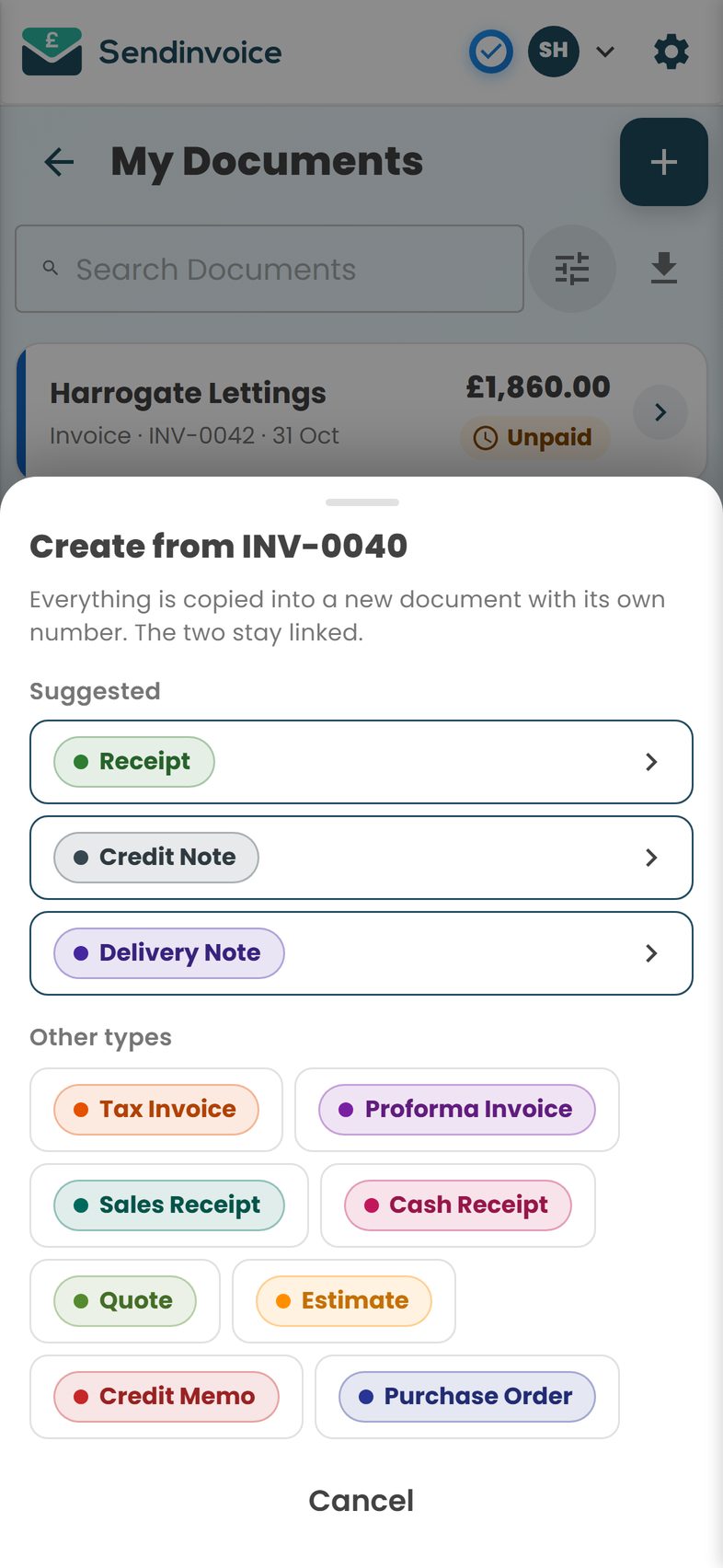
When the Okafors accept, Dean creates the proforma for the deposit from the quote, then the final invoice from the same quote when the work is done. The details carry over each time, the numbers follow on, and the documents stay linked, so the terms the customer agreed to are the ones on the invoice. The post on writing a trade quote goes deeper on the quote itself.
Writing terms people will actually read
A few rules of thumb that keep terms useful rather than ornamental:
- Plain English, first person. "I will" and "you will" read as fair; "the Contractor shall" reads as borrowed. The Consumer Rights Act expects consumer terms to be transparent and prominent, and plain wording is the easiest way to pass that test.
- Short lines, bold labels. One line per topic, as in Dean's example. The terms box on every SendInvoice document supports formatting, so the labels stay bold on the PDF and in the email.
- Same terms every time. Consistency is what makes them credible. If a customer wants something different, agree it in writing on that quote, and leave the standard terms alone.
- Nothing unfair. A term that lets you keep a large deposit no matter what, or that excludes all liability, is likely to be unenforceable against a consumer and makes you look bad. Fair terms that are clearly stated protect you better than fierce ones.
- Keep a fuller version somewhere. If your trade needs more (insurance work, specific scheme requirements, long jobs), keep a one-page PDF and send it with the quote. The short version on the document points to it.
When the terms get tested
Good terms earn their keep on the bad days. A homeowner who will not pay the balance is a different conversation when the quote they accepted says "balance due on completion, same day": the post on what to do when a homeowner won't pay walks through the ladder from a reminder to a letter before action. A customer who cancels on day three, having asked you to start early in writing, owes you for the work done. A customer who adds "just the porch ceiling while you're here" has agreed, by text, to pay for it.
And on the good days, which are most of them, the terms simply sit there, read once, making you look like someone who has done this before. Which you have.
Do this in SendInvoice
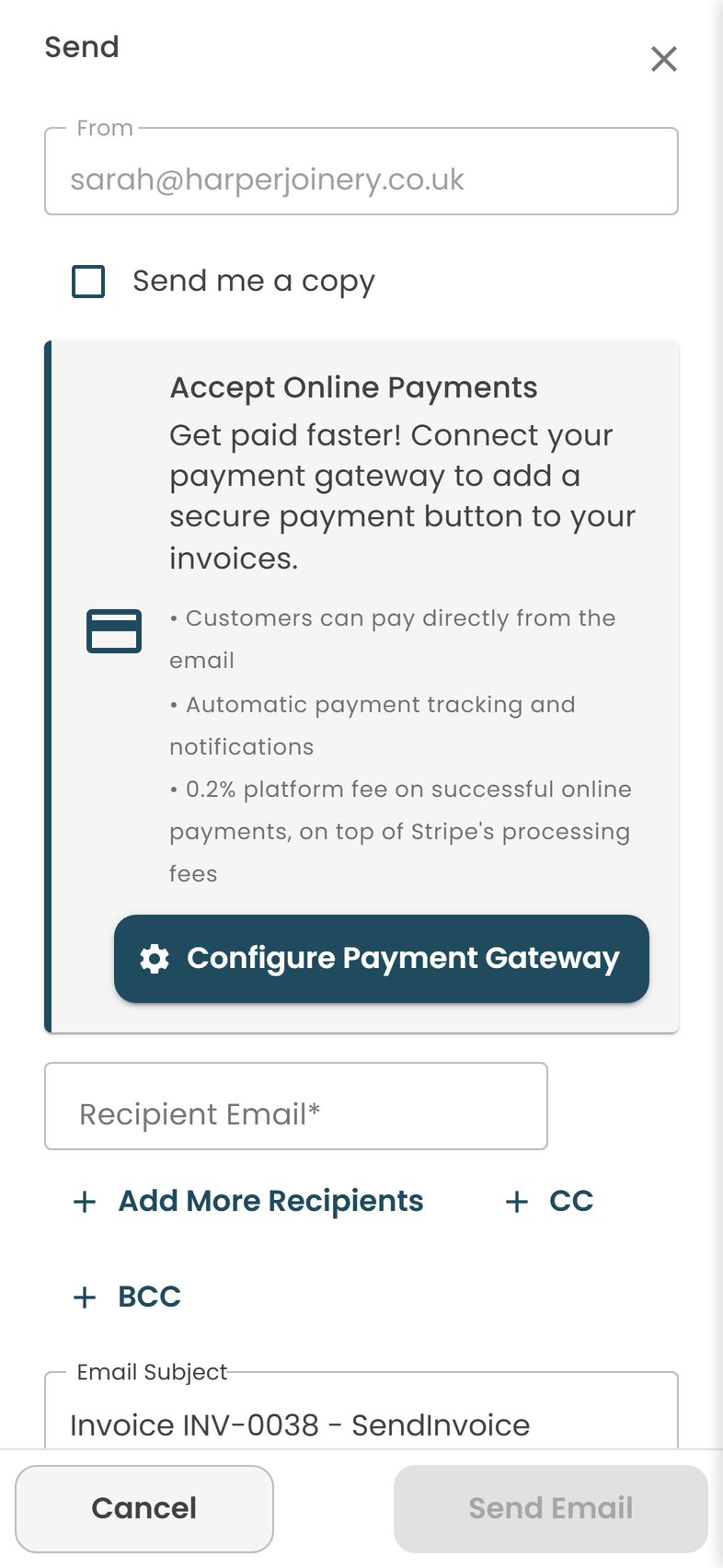
Put your terms in the terms box with bold labels, send the quote from the customer's kitchen, and create the proforma and final invoice from it so the terms they agreed are the terms on the invoice. Free to create and preview; £5 a month to send, remind and take card payments.
Create a free invoice See the £5/month planFrequently asked questions
Do I really need terms and conditions as a sole trader?
You already have a contract with every customer; the question is whether it is written down. A short page of terms on your quote and invoice settles the arguments that cost tradespeople money: when payment is due, what the deposit covers, what happens if the job is cancelled, and who clears the waste. It does not need a solicitor to be useful.
What is the 14-day cooling-off period for tradespeople?
Under the Consumer Contracts Regulations 2013, when you agree a job with a consumer away from your own premises, typically in their home, and it is worth more than £42, they usually have 14 days to cancel. If they want you to start inside those 14 days, get that request in writing so you can charge for work done if they then cancel. Check current guidance if unsure.
Can I keep a deposit if the customer cancels?
It depends on when they cancel and what your terms say. Inside the 14-day cooling-off period a consumer can normally cancel and get the deposit back, less a fair charge for any work done at their written request. Outside it, a reasonable deposit that covers materials you have bought or time you have lost is far easier to keep if your terms said so up front.
Can I add late payment interest to a homeowner's invoice?
Only if your terms set out a reasonable charge and the customer agreed to them before the work. The statutory 8% plus base rate and the fixed £40, £70 and £100 sums under the Late Payment Act apply to business customers only. If a consumer debt ends up in court, the judge may award interest, usually around 8%, at their discretion.
Should I offer a guarantee on my work?
A short workmanship guarantee, say 12 months on your labour, reassures customers and costs little if you do good work. Keep it specific: what it covers, what it does not (manufacturer faults, wear, damage by others), and that it is on top of the customer's legal rights, which you cannot take away. Materials are usually covered by the manufacturer instead.
Where should my terms appear?
On the quote, because that is the document the customer accepts, and again on the invoice. Put the short version in the terms box of each document and keep a fuller version on your website or as a PDF you can send with the quote. In SendInvoice the terms box takes formatting, so a few bold headings and short lines stay readable on a phone.