Dean has just finished a consumer unit change in a 1970s semi in Stockport. The old rewireable board is in the van, the new RCBO board is labelled, the testing is done and the figures are in his notebook. The customer, Mrs Khan, asks the question every electrician hears at ten to five: "So what do I owe you?" This guide is about answering it properly, with an invoice that covers call-outs, materials, testing time and certificates, and gets paid before the van is warm.
What an electrician's invoice needs
The basics are the same for every UK sole trader: a unique invoice number, your name or trading name and address, the customer's name and address, the date, a description of the work, and the amount. If you are VAT registered you also need your VAT number, the VAT rate and amount, and the net total. If you are not VAT registered, do not show VAT at all. (Our general guide to writing an invoice covers the legal list.)
On top of that, an electrician's invoice does a few jobs the law does not ask of it but customers and inspectors do:
- The job address, if it differs from the billing address. Landlords, agents and builders all want to see which property the work was at.
- Your scheme and registration number (NICEIC, NAPIT, ELECSA and so on). Put it in your business details so it prints on everything.
- What was tested and certified. The certificate type and number, and whether building control has been notified.
- Labour, materials and testing as separate lines, so a £630 bill reads as a day of skilled work plus a board, not a mysterious lump.
Set your business details once in Settings and they fill in on every document. The job-specific lines are the part you type on the day, and they are what the rest of this post is about.
Call-outs and the first hour
Most of Dean's week is not consumer units. It is "the sockets in the back bedroom have gone dead" and "the shower pulls the main switch". For that work the price structure that causes the least argument is a fixed call-out fee that includes the first hour (or first half hour), then a stated hourly rate after that, with materials on top.
Say the structure out loud on the phone before you go, then put it on the invoice in the same words. A line reading "Call-out including first hour: diagnose dead sockets on ring final, bedroom 2" tells the customer exactly what the £85 bought. A second line, "Additional labour, 30 minutes: trace and repair broken neutral in junction box under floor", explains the rest. If you charge more for evenings and weekends, make that its own rate and name it on the line ("out-of-hours rate").
The call-out fees and emergency work post goes deeper, including how to get paid before you leave.
Labour, materials and testing time
Labour
For a planned job like a board change, labour as a day rate or a fixed sum is easier for the customer to read than hours. Describe what the day covered: "Remove existing fuse board, install 18th Edition consumer unit, 10-way RCBO, with surge protection, reconnect and label all circuits." The description is doing two things: justifying the price, and recording what you did in case anyone asks in three years.
Materials
List the significant items by name: the board, the SPD, the earth cable. Small bits (glands, tails, labels, cable clips) can be one "sundries" line. You can mark materials up; you are collecting them, carrying them and standing behind them. Show the price you are charging, not your wholesaler cost. If you are VAT registered, VAT goes on the whole supply, labour and materials, at the normal rate (some work qualifies for reduced or zero rates; check HMRC's notices). The labour and materials post covers mark-ups and receipts in more detail.
Testing and certification
This is the line electricians most often leave off, and it is a mistake. Dead testing, live testing, filling in the schedule of test results, writing the EIC and sending the notification to building control is an hour or more of skilled work per board change. Put it on as its own line: "Test, inspect and certify: Electrical Installation Certificate, Part P notification via NAPIT". When it is on the invoice, customers understand that the certificate is a product they paid for, not a bit of paper that turned up later.
Certificates and Part P on the invoice
Part P of the Building Regulations (England and Wales) means that notifiable electrical work in dwellings, including a consumer unit replacement, must be notified to building control, and if you are registered with a competent person scheme you self-certify through the scheme. The certificate itself comes from your scheme paperwork or software; an invoicing app does not issue it, and it should not pretend to.
What the invoice should do is record it. In the notes:
Notes: Electrical Installation Certificate EIC-2026-0417 issued for the consumer unit replacement. Work notified to building control via NAPIT on 12 November 2026; the Building Regulations compliance certificate will be posted to the property by the scheme. Keep both with the house documents.
For minor works (an extra socket, a replaced light fitting) note the Minor Electrical Installation Works Certificate number instead. For an EICR on a rental property, say which report number, the date and the next inspection date; letting agents live for that detail.
Worked example: a consumer unit replacement
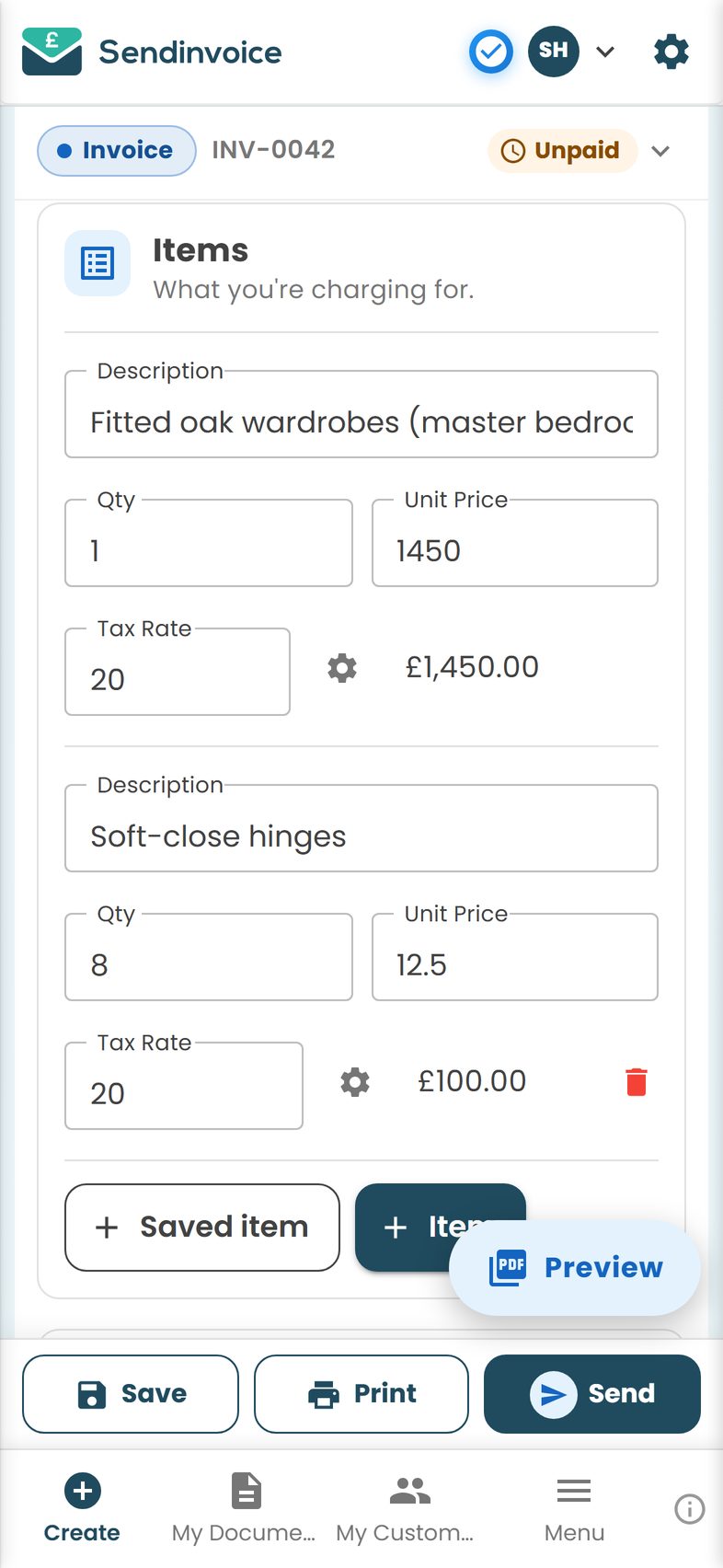
Here is Dean's invoice for the Stockport job. Whitlock Electrical is a sole trader and is not VAT registered, so there is no VAT line and no VAT number; the totals are the totals.
Whitlock Electrical (NAPIT registered, no. 12345)
Invoice INV-0218
Date: 12 November 2026
Bill to: Mrs S Khan, 14 Birch Avenue, Stockport
Job address: as above
Due: on receipt
| Description | Qty | Unit price | Amount |
|---|---|---|---|
| Labour: remove existing rewireable fuse board, install 18th Edition consumer unit (10-way, RCBO, surge protection), reconnect and label all circuits | 1 day | £280.00 | £280.00 |
| Consumer unit, 10-way RCBO with SPD, including RCBOs | 1 | £185.00 | £185.00 |
| Labour: upgrade main protective bonding to gas and water | 1.5 hrs | £40.00 | £60.00 |
| 10mm earth cable, bonding clamps and labels | 1 | £22.00 | £22.00 |
| Test, inspect and certify: Electrical Installation Certificate, Part P notification via NAPIT | 1 | £65.00 | £65.00 |
| Sundries: meter tails, glands, circuit labels | 1 | £18.00 | £18.00 |
| Total due | £630.00 | ||
Payment: by card using the Pay button in this email, or by bank transfer to Whitlock Electrical, sort code 00-00-00, account 00000000, reference INV-0218.
Notes: EIC-2026-0417 issued; notified to building control via NAPIT 12 Nov 2026. Old board removed from site. 12-month guarantee on workmanship.
Notice what the invoice does not do. It does not show Dean's wholesaler prices, it does not list every screw, and it does not try to calculate anything the law does not ask of a non-VAT business. It says what was done, what it cost, and how to pay.
Homeowners, builders and landlords
Who you are invoicing changes the invoice more than what you did.
Private homeowners are the simplest. No CIS, no reverse charge, no purchase order numbers. If the job was agreed in their home, the Consumer Contracts Regulations give them a 14-day cancellation right on contracts over £42; if they wanted you to start within those 14 days, get that request in writing (a text is fine) so you can charge for work done.
Builders and main contractors are different. If you subcontract on construction work and the contractor is registered under the Construction Industry Scheme, they will deduct tax (20% if you are CIS registered, 30% if not) from the labour element of your invoice and pay it to HMRC on your behalf. Your invoice needs labour and materials shown separately, your UTR, and the deduction as a line, so the amount payable is clear. If you are both VAT registered, the domestic reverse charge may apply too. The CIS invoice example walks through it line by line.
Landlords and letting agents want the property address on every invoice, a purchase order or job reference if they gave one, and (for EICRs) the report number. They are businesses, so the Late Payment of Commercial Debts (Interest) Act applies if they pay late. See invoicing landlords and letting agents.
Getting paid before you leave the drive
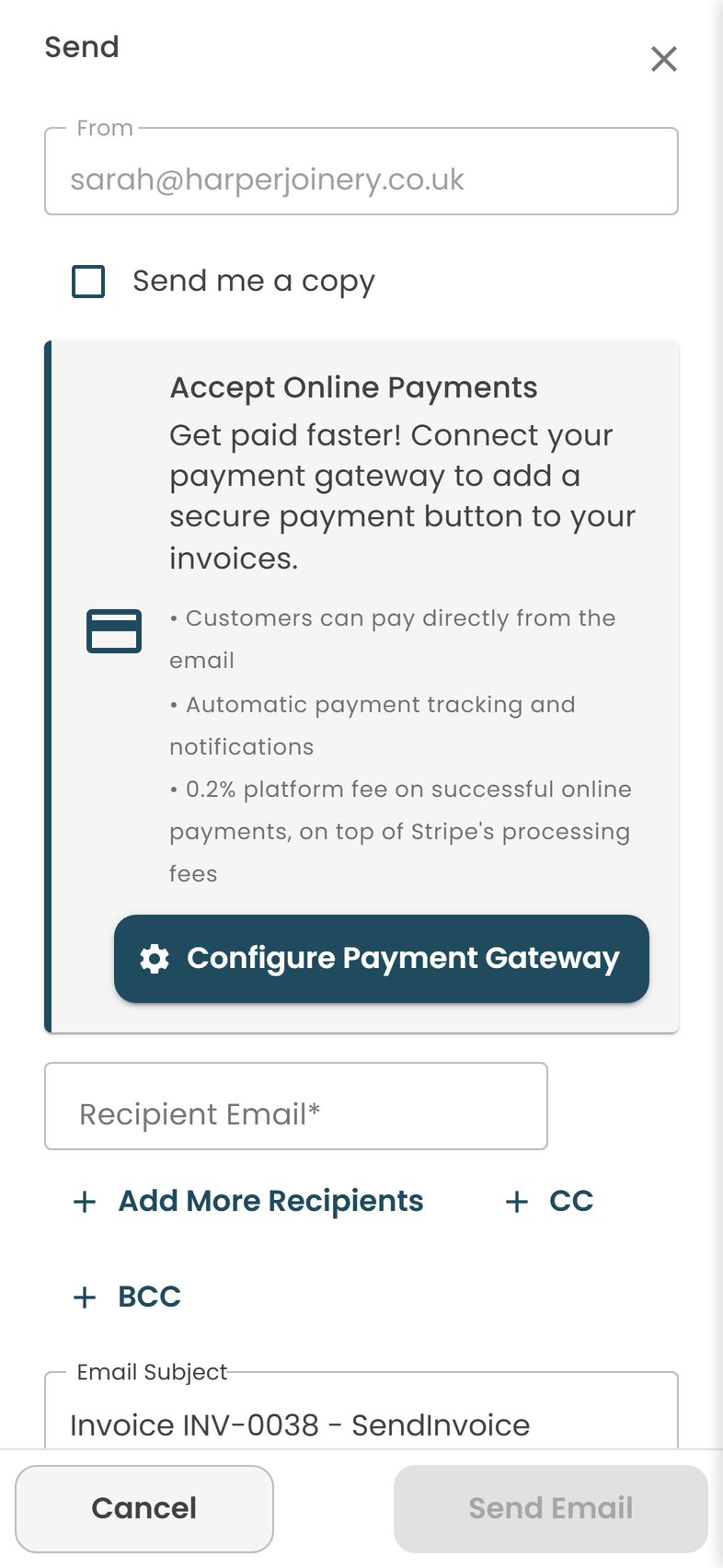
Back to Mrs Khan's kitchen. Dean has two options. He can say "I'll send it over tonight", drive home, forget until Thursday, email a PDF, and chase it in a fortnight. Or he can open the app on his phone, pick Invoice, tap Mrs Khan's name (it suggests her from the quote), add the lines, and send it while she is standing there. The email arrives with the PDF attached and a Pay button. She pays by card on her own phone, the invoice flips to Paid, and Dean gets a green tick in My Documents before he has reversed off the drive.
It sounds trivial. Over a year it is the difference between a healthy bank balance and a list of people who "will do it at the weekend". Showing the customer the invoice on your screen also prompts the "oh, I'll do that now" reaction far more reliably than an email that lands among the supermarket offers.
Three habits make it stick:
- Quote first, then convert. Send a quote for anything over a call-out. When the job is done, create the invoice from the quote in one tap; the lines carry over and you only adjust what changed.
- Short terms for domestic work. "Due on receipt" or 7 days. There is no reason a homeowner needs 30 days to pay for a board change they have just watched you fit.
- Check Paid, Unpaid and Overdue daily. Red means a nudge. If you are on the Professional plan, the reminders go out on their own and each one carries the Pay button.
For the full method, including how card fees compare with a card reader at the time of writing, read getting paid on the day. If the customer prefers bank transfer, put your bank details on the invoice and mark it paid by hand when the money lands.
Keeping your records straight
Your invoices, your materials receipts and your bank statements are your accounts. Keep them for at least five to six years. Number invoices in one running sequence (INV-0217, INV-0218) and never reuse or delete a number; if a job is cancelled, issue a credit note against the invoice instead. Making Tax Digital for Income Tax applies from April 2026 to sole traders with income over £50,000 (April 2027 for over £30,000, April 2028 for over £20,000, at the time of writing), so a clean, exportable list of invoices with Paid and Unpaid against each will save you a weekend. Check with your accountant or HMRC for your own position.
Do this in SendInvoice
Quote the board change, convert the quote to an invoice on the day, put testing and certification on as its own line and send it from the customer's kitchen with a Pay button. Free to create and preview; £5 a month to send, remind and get paid by card.
Create a free invoice See the £5/month planFrequently asked questions
Should I charge for testing and certification as a separate line?
Yes. Testing, inspecting and writing up the certificate is skilled work that takes real time, and customers rarely know that. A separate line, such as "Test, inspect and certify, including Part P notification", makes the price easier to understand and stops the labour line looking inflated. It also makes it obvious that a certificate is part of what they are paying for.
Do I need to put my Part P or NICEIC registration on an electrician invoice?
There is no law that says the invoice must carry it, but it is good practice and customers look for it. Put your scheme (NICEIC, NAPIT, ELECSA and so on) and registration number in your business details so it prints on every document. Add the certificate number and the date you notified building control in the notes for notifiable work.
How do I invoice a call-out that turned into a bigger job?
Invoice the call-out exactly as you quoted it on the phone (for example, a fixed fee covering the first hour), then add the extra labour and materials as their own lines. If the extra work was agreed on site, say so in the notes: "Additional work agreed with Mrs Khan on site, 12 Nov". That one sentence prevents most disputes.
Can I mark up the materials I buy from the wholesaler?
Yes. You are supplying, collecting, carrying and guaranteeing the parts, and a margin on materials is normal in the trade. Show materials as their own lines at the price you are charging; you do not have to show your cost. If you are VAT registered, VAT applies to the whole supply, labour and materials alike, at the normal rate.
Does CIS apply to electrical work?
It can, when you work as a subcontractor for a contractor on construction work, which includes most electrical installation on building sites and refurbishments. It never applies to work you do directly for a private homeowner. If you are registered under CIS, show labour and materials separately and the deduction as its own line. Check your position with your accountant or HMRC.
What is the quickest way to get paid for a domestic job?
Send the invoice from your phone while you are still in the customer's kitchen, with a card payment link in the email. Many people pay on the spot when it is that easy, and the invoice marks itself Paid. For those who prefer bank transfer, put your sort code and account number on the invoice and set a short term, such as 7 days.