
Hannah rewired two flats above a shop for a small property company in March: new consumer units, full rewire, testing, certificates issued, £3,240 on 30-day terms. In June the director stopped answering. In July the office said the invoice was "with accounts". It is now November. Hannah has never been inside a court and would rather not start, but £3,240 is seven weeks of mortgage, and she has run out of polite messages. This is what the road from here looks like, step by step, and roughly what it costs.
Step one: decide whether it is worth it
Before any paperwork, three honest questions.
- Can they pay? A judgment against a company with no money is an expensive certificate. For a limited company, look it up on Companies House: is it still active, are its accounts filed, has it been struck off or put into liquidation? For a private customer, do they own the house, and are they employed? A county court judgment (CCJ) sits on their credit record for six years, which is a powerful incentive to pay, but only for someone with something to protect.
- Is the amount worth your time? A small claim takes a few hours of evenings over a few months. For £3,240 that is an easy yes. For £180 it may still be, because the fee is small and many people pay the moment the claim form arrives.
- Is there a genuine dispute? If the customer has a real complaint about the work, the court will want to see that you dealt with it. Answer it in writing, offer to look, fix what is yours to fix, and claim for the rest.
Hannah's customer is an active company with property on its books and three years of filed accounts. Worth it.
Step two: the letter before action
Courts in England and Wales expect you to have tried to settle before you claim, and the letter before action is how you prove it. Everything you have sent so far, which for Hannah is the four-step ladder from how to chase an unpaid invoice, is useful background; this letter is the formal one.
The rules differ by who you are claiming from, so be careful here:
- Private individual (a homeowner): the Pre-Action Protocol for Debt Claims applies when a business claims a debt from an individual. At the time of writing it requires your letter to state the amount and how it arose, how to pay, how to dispute it, and to enclose an information sheet and reply form, and it gives the customer 30 days to respond. Follow it to the letter; a judge can penalise you on costs for skipping it. The current version is on the Ministry of Justice website.
- Business (a company, a landlord's company, a letting agent, a main contractor): the debt protocol does not apply, but the general pre-action rules still expect a clear letter and a reasonable time to reply. Fourteen days is common practice.
Hannah's customer is a company, so her letter looks like this.
LETTER BEFORE ACTION
Sent by post and email, 4 November
Dear Sirs,
Re: invoice INV-0231, £3,240.00, electrical rewiring at Flats 1 and 2, 48 Station Parade
The above invoice, dated 28 March and due on 27 April under the 30-day terms on my accepted quote QUO-0198, remains unpaid. I have sent reminders on 28 April, 12 May, 2 June and 30 July and have received no payment and no dispute about the work, which was completed on 26 March and certified.
Under the Late Payment of Commercial Debts (Interest) Act 1998 I am entitled to statutory interest at 8% above the Bank of England base rate from 28 April, together with fixed compensation of £70. As at today's date the interest is £[amount], making a total of £[amount].
Unless I receive payment in full within 14 days of the date of this letter I will issue a claim in the county court without further notice, and will ask for the court fee and continuing interest to be added.
Payment can be made by card using the link in the invoice email or by bank transfer to the account details on the invoice.
Yours faithfully,
Hannah Reid, HR Electrical
Enclosed: copy invoice, copy quote, copy reminders
Step three: Money Claim Online
If the 14 days pass with nothing, you claim. In England and Wales, a money claim up to £10,000 is usually allocated to the small claims track, and you can start it from your phone or laptop through Money Claim Online (MCOL) on GOV.UK. The process, at the time of writing:
- Register for a Government Gateway account if you do not have one.
- Fill in the claim: your details, the defendant's exact legal name and address (for a company, the registered name and office from Companies House, not the trading name on the van), the amount, and a short statement of what you did and what is owed. Plain English, dates, invoice numbers.
- Add interest if you are entitled to it, and the fixed compensation sum for a business debt.
- Pay the court fee. It is a sliding scale by claim value, from around £35 for the smallest claims at the time of writing, and it is added to your claim, so the defendant pays it if you win.
- The defendant has 14 days from service to respond: pay, admit, defend, or ask for more time. If they do nothing, you can request judgment in default, which is a win without a hearing.
- If they defend, you are both offered the free small claims mediation service, which settles a lot of these by phone. If not, the court sets a date; small claims hearings are short, informal, and you can represent yourself.
On the small claims track each side normally pays their own costs, so if you lose you are usually out the fee and your time, not the other side's solicitor's bill. Fees, limits and the exact online process change; read the current GOV.UK pages before you press submit.
Scotland and Northern Ireland are separate. In Scotland, Simple Procedure covers claims up to £5,000 through the sheriff court, with its own forms and online service. In Northern Ireland the small claims process has a lower limit; nidirect has the details. The principles are the same: a clear letter first, then a simple claim, then enforcement.
Worked example: the invoice and the claim sum
Hannah is VAT registered, so her invoice shows VAT. The flats are for a landlord company, not a CIS contractor, and the customer is the end user, so the reverse charge does not apply and VAT is charged normally. (The invoice also notes the certificates issued; the app shows these as ordinary notes, it does not produce them.)
Invoice INV-0231 from HR Electrical Ltd (VAT no. shown) to Parade Properties Ltd. Created from QUO-0198. Dated 28 March, due 27 April (30 days).
| Description | Qty | Unit price | Amount |
|---|---|---|---|
| Labour: full rewire, two flats, first and second fix, testing (9 days) | 9 | £220.00 | £1,980.00 |
| Materials: 2 x 10-way consumer units, cable, back boxes, accessories, trunking | 1 | £620.00 | £620.00 |
| Electrical installation certificates (2) and Part P notification | 2 | £50.00 | £100.00 |
| Subtotal | £2,700.00 | ||
| VAT at 20% | £540.00 | ||
| Total due | £3,240.00 |
Certificates EIC-4471 and EIC-4472 issued 26 March. Payment terms: 30 days. Late payment: statutory interest and compensation will be claimed under the Late Payment of Commercial Debts (Interest) Act 1998.
The sum Hannah claims is the invoice plus interest plus compensation plus the court fee. With a base rate of (say) 4%, statutory interest is 12% a year on £3,240, which is about £1.07 a day. From 28 April to 18 November is 204 days, roughly £217. Add the £70 fixed sum for a debt between £1,000 and £9,999.99, and the court fee for a claim of that size, and the claim is the invoice plus a little under £300 plus the fee. Interest keeps running until they pay, which you say in the claim.
Step four: the evidence that wins a small claim
A district judge in a small claims hearing is not looking for a legal argument. They want a clear, dated story that the paperwork backs up. For a trade job, gather:
- The accepted quote and the message that said go ahead. If the customer accepted by text, screenshot it with the date visible. See how to write a trade quote for why the scope on the quote matters so much here.
- The invoice and proof it was sent: the email with its date, or a record of the send.
- Every reminder, with dates. A pattern of calm, spaced reminders and no reply tells the judge everything about who has behaved reasonably.
- Photos of the finished work, ideally taken before you left site. Hannah has photos of both consumer units and the test results.
- Any messages about extras or complaints, and your replies.
- Certificates, delivery notes or sign-off sheets if your trade produces them. A signed delivery note or completion note is excellent evidence.
- A one-page timeline: date, what happened, which document. Judges love these.
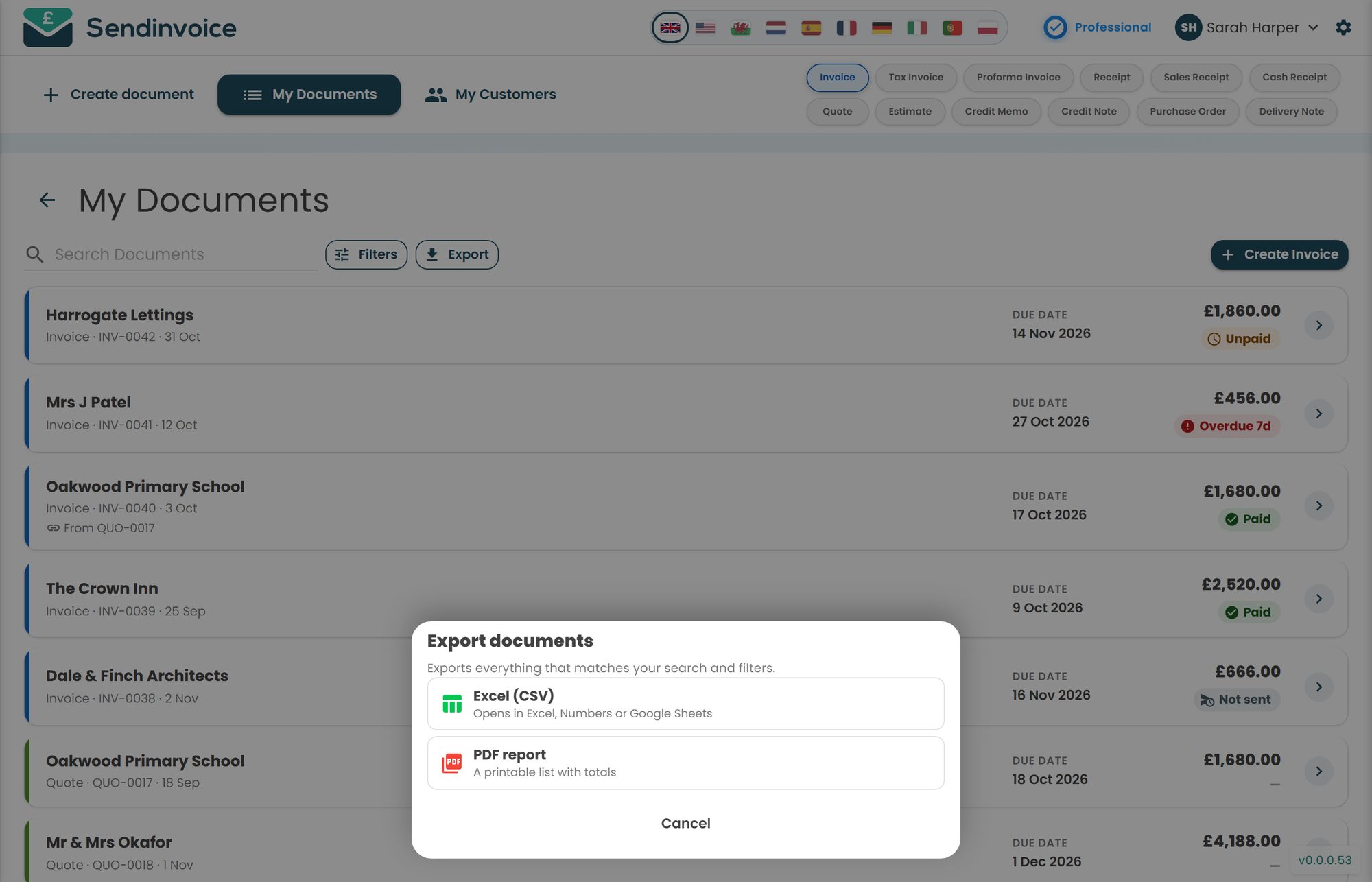
If your invoices live in one place with the sends and reminders dated, assembling this is twenty minutes, not a weekend. From My Documents you can pull a PDF report or an Excel export of a customer's documents to attach to the claim.
Step five: when you win and they still do not pay
A judgment is an order to pay, not a payment. Most defendants pay at this point because of the CCJ. If they do not, you apply to enforce, and each route has its own fee that is added to the debt:
- Warrant of control: county court bailiffs attend to collect payment or seize goods. The usual first step for a business debtor with premises or vehicles.
- Attachment of earnings: for an employed individual, deductions from their wages through their employer.
- Third-party debt order: freezes and takes money from the debtor's bank account, if you know where it is.
- Charging order: secures the debt against property they own; it is paid when the property is sold, which can take years, but it does not go away.
Pick the route that matches what you know about them. This is where the "can they pay?" question from step one comes home.
Making sure you rarely need any of this
Hannah's company, in hindsight, should have been invoiced in two stages, first fix and completion, so that the exposure at any point was half the job. Working for landlords and agents has its own habits, covered in invoicing landlords and letting agents: purchase order numbers, the property address on every invoice, and 30-day terms that you actually chase on day 31.
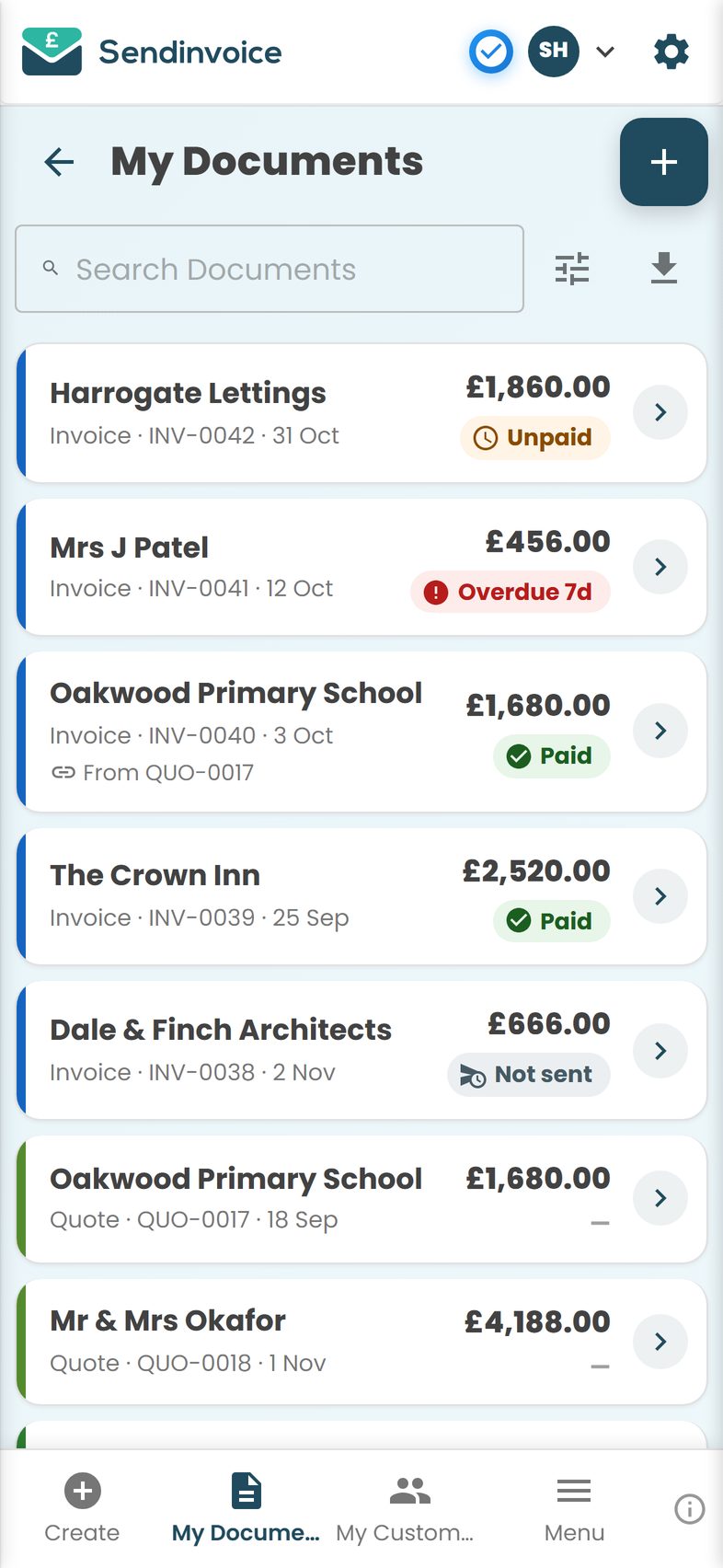
Beyond that, the things that stop invoices reaching this page are dull and effective: a Pay button in the invoice email, reminders that go out on their own, and a red Overdue badge on your phone each morning so a late invoice gets a nudge at seven days rather than a letter at seven months.
Hannah's claim form went in on a Tuesday evening from her kitchen table. Parade Properties paid in full, with interest and the fee, nine days after it was served. That is the usual ending: most people pay when they realise you know the route and are prepared to walk it.
Do this in SendInvoice
Keep every quote, invoice, send and reminder dated in one place, pull a PDF report of a customer's documents for your evidence bundle, and put a Pay button on every invoice so most of them never get near a court. Free to create and preview; £5 a month to send, remind and get paid by card.
Create a free invoice See the £5/month planFrequently asked questions
What is the small claims limit in the UK?
In England and Wales, claims up to £10,000 are usually allocated to the small claims track, which is designed for people without a solicitor. Scotland uses Simple Procedure for claims up to £5,000, and Northern Ireland has its own small claims process with a lower limit. Limits change, so check GOV.UK, the Scottish Courts website or nidirect before you start.
How much does it cost to take someone to small claims court?
There is a court fee that depends on the amount you are claiming, from around £35 for the smallest claims at the time of writing, rising in steps with the claim value. You add the fee to the claim, so if you win the customer pays it. If the case goes to a hearing there may be a further hearing fee. Check the current fee table on GOV.UK.
Do I need a letter before action first?
Yes. The court expects you to have tried to settle the debt before claiming, and a letter before action is how you show it. If your customer is a private individual, the Pre-Action Protocol for Debt Claims sets out what the letter must contain and gives them 30 days to reply. For a business customer, a clear letter giving 14 days is common practice.
Can I claim interest on top of the invoice?
If the customer is a business, yes: statutory interest at 8% above the Bank of England base rate under the Late Payment of Commercial Debts (Interest) Act 1998, plus a fixed sum of £40, £70 or £100 depending on the debt size, at the time of writing. If the customer is a private homeowner, you can ask the court for interest under the County Courts Act, typically 8%, at the judge's discretion, and the fixed sums do not apply.
What evidence do I need for a small claim?
The quote the customer accepted, any message saying go ahead, the invoice, proof it was sent, every reminder with its date, photos of the finished work, and any messages about extras or complaints. A simple timeline of dates helps the judge. You do not need a mountain; you need a clear, dated story that matches your invoice.
What happens if I win but they still do not pay?
A judgment is an order, not a payment. If the customer ignores it you apply to enforce it, usually by sending county court bailiffs with a warrant of control, or by an attachment of earnings order, a third-party debt order against their bank account, or a charging order on property. Each has a fee, and none works on someone with nothing, so check they can pay before you start.