An invoice, a receipt and a credit note are the three pieces of paper that follow a sale around. They look alike, they share most of their fields, and they get muddled constantly: receipts sent before anyone has paid, invoices quietly edited after the fact, "credit notes" that are really just a discount scribbled on the next bill. Here is what each one is for, when to issue it, and the one rule that keeps your records honest.
The short version
- An invoice says "you owe me this".
- A receipt says "you paid me this".
- A credit note says "you owe me less than I said".
They happen in that order, and each points back to the one before it. Seen as a chain rather than three separate forms, most of the confusion goes away.
The invoice: asking for money
An invoice is a formal request for payment for goods or services you have supplied. It is issued after the work (or at agreed stages), and it is the document HMRC cares about most, because it is the record of your sales.
In the UK an invoice must include:
- a unique, sequential number;
- your name or business name and address;
- the customer's name and address;
- the invoice date;
- a clear description of what you supplied;
- the amount due, and when it is due.
If you are VAT registered, add your VAT number, the VAT rate and amount per line or in total, the tax point and the net total. If you are not VAT registered, leave VAT off entirely. You are not allowed to charge it, and a customer who sees "VAT" on your invoice may try to reclaim money HMRC never received.
Payment terms are yours to set. If you do not state any, the law assumes 30 days, and after that the Late Payment of Commercial Debts (Interest) Act 1998 gives you the right to statutory interest and a fixed fee. Seven or fourteen days is perfectly normal for small jobs.
The receipt: confirming payment
A receipt is proof that money changed hands. It is issued after payment, never before, and it is for the customer's benefit more than yours: they need it to claim expenses, reconcile their books or simply feel reassured that the £310 they transferred went where it should.
A receipt should show:
- its own number (REC-0009, say);
- the date payment was received;
- who paid and who was paid;
- the amount received and how it was paid (card, bank transfer, cash);
- which invoice it settles, if there was one;
- VAT details if you are registered, so the customer can use the receipt as evidence.
No UK law forces you to issue a receipt for every sale, but customers are entitled to proof of payment and a receipt is the cleanest way to give it. For a café or a shop, the till slip is the receipt. For a service business, you issue one when asked or whenever a business customer pays you.
SendInvoice has three flavours, receipt, sales receipt and cash receipt, which differ mainly in the wording; use whichever matches how you got paid.
The credit note: reducing what is owed
A credit note cancels all or part of an invoice. You issue one when you have invoiced too much, when the customer returns something, when you agree a discount after the fact, or when the invoice itself was simply wrong.
The key thing to understand is that a credit note is a document in its own right. It has its own number, its own date, and it refers to the invoice it corrects. It does not replace the invoice; it sits alongside it, and the two together show the true amount.
A credit note must show:
- a unique number (CN-0003);
- the date;
- your details and the customer's details;
- the invoice number it relates to;
- what is being credited and why;
- the amount, and the VAT rate and amount if you are registered.
In the US the same document is often called a credit memo. The credit note page has the layout, and SendInvoice offers both names as document types.
At a glance
| Invoice | Receipt | Credit note | |
|---|---|---|---|
| Says | You owe me £X | You paid me £X | You owe me £X less |
| Issued | After the work, before payment | After payment | After an invoice, when it needs reducing |
| Points to | The quote, if there was one | The invoice it settles | The invoice it corrects |
| Own number? | Yes, sequential | Yes | Yes |
| VAT? | Required if registered | Show it if registered | Required if registered (reduces VAT charged) |
| Changes your sales total? | Increases it | No (records cash) | Decreases it |
Worked example: the Crown Inn, one invoice, three documents
Hannah runs a one-woman coffee roastery. She supplies the Crown Inn with beans every fortnight. Here is one delivery, start to finish.
1. The invoice. Hannah delivers on the 4th and sends INV-0039 the same afternoon.
| Description | Qty | Price | Amount |
|---|---|---|---|
| House espresso blend, 1 kg | 8 | £24.00 | £192.00 |
| Single-origin filter, 1 kg | 4 | £29.50 | £118.00 |
| Total due (14 days) | £310.00 | ||
Hannah is not VAT registered, so there is no VAT line.
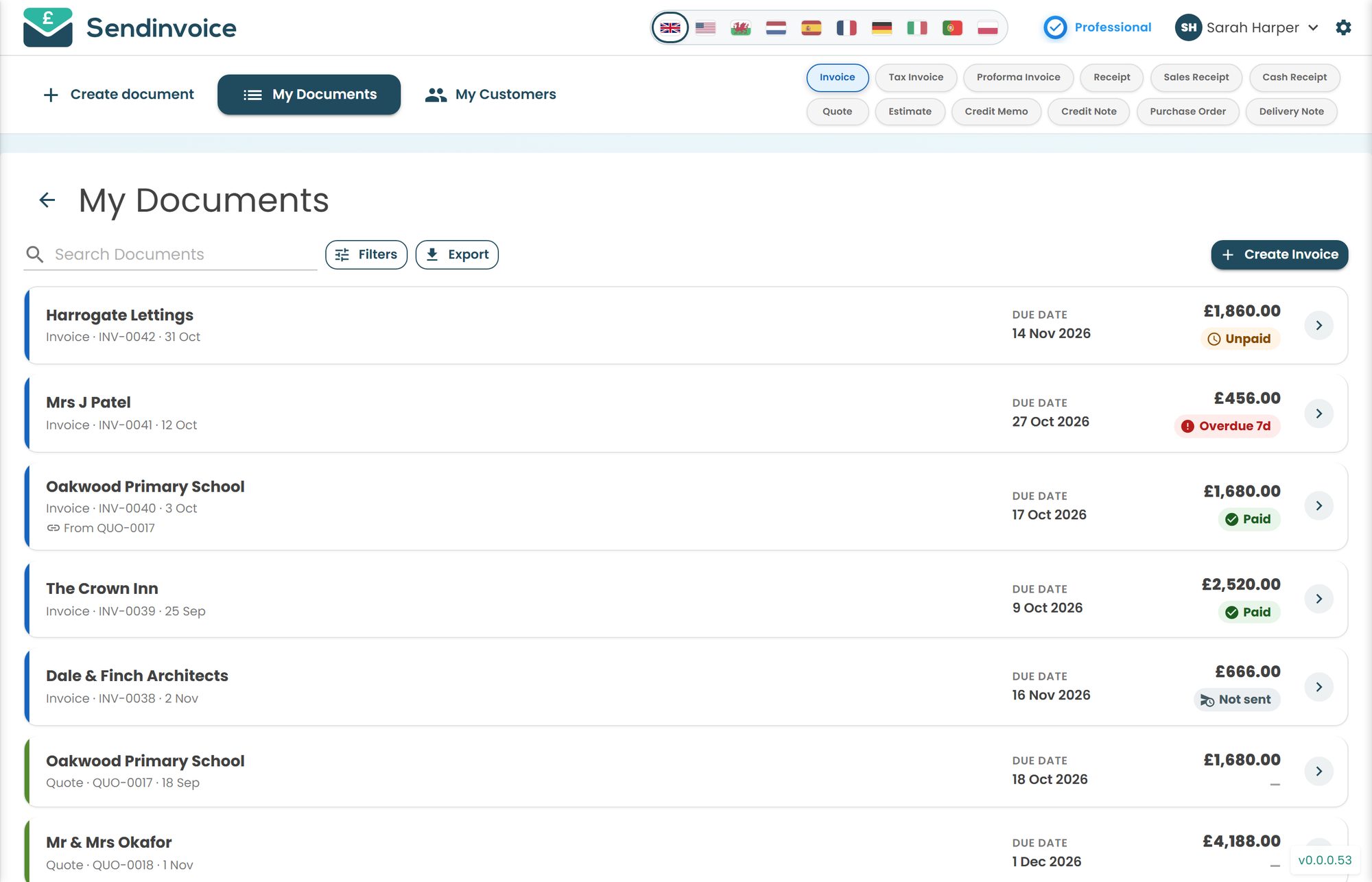
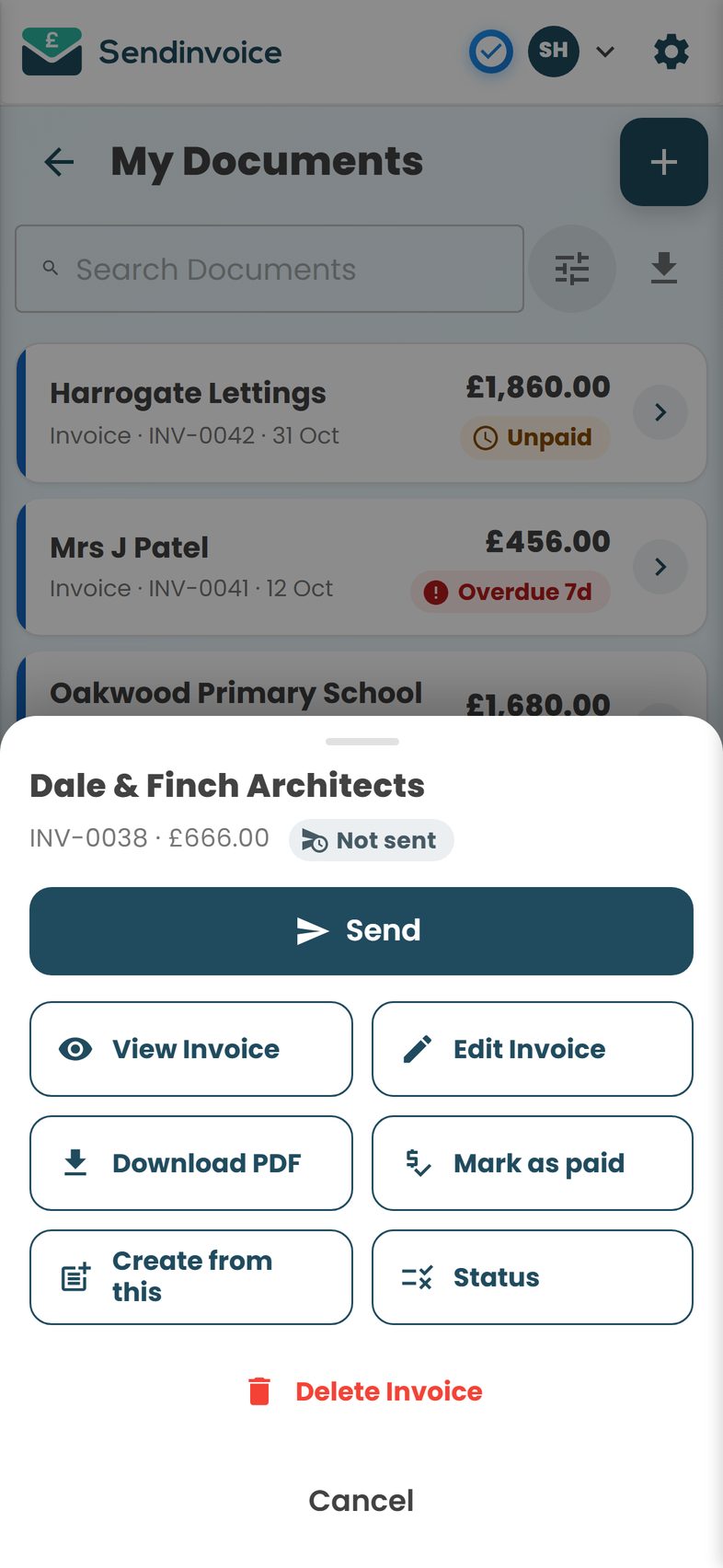
2. The receipt. On the 11th the Crown Inn's manager taps Pay on the email and pays £310 by card. INV-0039 flips to Paid in Hannah's My Documents. The pub's bookkeeper asks for a receipt for their records, so Hannah opens the paid invoice, taps Create from this and chooses Receipt. REC-0009 is created with the same customer and items, marked "Paid by card, 11th", and linked back to INV-0039. Two taps, no retyping.
3. The credit note. On the 13th the manager rings: one of the single-origin bags was split in transit and had to be thrown away. Hannah's first instinct is to open INV-0039 and change the quantity from 4 to 3. She does not do that. Instead she opens the invoice, taps Create from this, chooses Credit note, deletes the espresso line, sets the filter quantity to 1 and adds "Damaged in transit, 1 kg single-origin filter" to the description. CN-0003 for £29.50 goes out, linked to INV-0039. Because the pub has already paid, Hannah also refunds the £29.50, and notes the refund on the credit note.
Now the records tell the whole story: an invoice for £310, a receipt for £310, a credit note for £29.50. Hannah, the pub, an accountant or HMRC can see exactly what happened and when.
Why you never edit or delete a sent invoice
This is the rule that catches people out, so it deserves its own section.
Once an invoice has been sent, it exists in two places: your records and the customer's. If you change yours, theirs is now different, and the same number means two different things. If the customer paid the original amount, their payment no longer matches your invoice. If they have put it through their accounts, their books and yours disagree. If either of you is VAT registered, the VAT returns disagree too.
Deleting is worse. Your invoice numbers must run in sequence, and a missing INV-0039 is exactly the kind of gap HMRC asks about. "I deleted it because it was wrong" is an honest answer, but it is not one you want to be giving.
So the discipline is simple:
- Not sent yet? Edit freely. Nobody else has seen it.
- Sent and wrong? Issue a credit note for the wrong part (or the whole thing), then a new invoice for the right amount if there is still something to pay.
- Sent by mistake entirely? Credit note for the full amount. The invoice and the credit note cancel each other out and the sequence stays intact.
It feels like more paperwork. It is less, because you never have to explain why the customer's copy does not match yours.
Keeping the three together
Keep them. HMRC expects you to hold your records for at least 5 to 6 years, and the invoice, receipt and credit note for one job are far more useful together than apart. Numbering each type in its own sequence (INV-, REC-, CN-) and linking each to the one it came from means "what did the Crown Inn pay in March?" is one search rather than a drawer.
If you are self-employed with income over £50,000, Making Tax Digital for Income Tax applies from April 2026 (over £30,000 from April 2027, at the time of writing) and asks for digital records of your sales. A tidy set of numbered invoices and credit notes is most of that already. Check with your accountant or HMRC for what applies to you. For the documents that come before the invoice, see quote vs estimate vs invoice.
Do this in SendInvoice
Make the receipt or the credit note from the invoice in one tap, with the details carried over and a link back to the original, so a sent invoice never needs editing. Invoices, receipts and credit notes are all included.
Create a free invoice See the £5/month planFrequently asked questions
Is a receipt the same as an invoice?
No. An invoice asks for payment and is issued before the money arrives. A receipt confirms that payment has been received and is issued afterwards. A paid invoice marked "Paid" can serve as proof of payment, but a separate receipt is clearer for the customer's records.
Do I have to give a receipt in the UK?
There is no general legal duty to issue a receipt for every sale, but customers are entitled to proof of payment and many will ask for one, especially businesses claiming expenses. Issuing one on request costs nothing and looks professional.
What must a credit note include?
Its own unique number, the date, your business details, the customer's details, the number of the invoice it relates to, a description of what is being credited and why, the amount, and the VAT rate and amount if you are VAT registered.
Can I just edit an invoice if I made a mistake?
If the invoice has not been sent, yes, edit away. Once it has been sent, no: issue a credit note for the wrong amount and, if needed, a fresh invoice for the right one. Editing a sent invoice leaves you and the customer with two different versions of the same number.
Can I delete an invoice I sent by mistake?
You should not. Your invoice numbers need to run in sequence with no gaps, and HMRC can ask why one is missing. Cancel it with a credit note for the full amount instead, so the records show what happened.
What is the difference between a credit note and a refund?
A credit note is the document that records the reduction. A refund is the money going back. Sometimes both happen (you credit and repay); sometimes only the credit note is needed, because the customer had not paid yet or will use the credit against their next invoice.
Does a credit note affect VAT?
If you are VAT registered, yes. A credit note reduces the VAT you have charged, so it must show the VAT rate and amount being credited, and you adjust it on your VAT return. If you are not registered, there is no VAT on either document.
Is a credit memo the same as a credit note?
Yes. Credit memo is the term used more in the US; credit note is the usual UK term. They do the same job and SendInvoice offers both as document types.