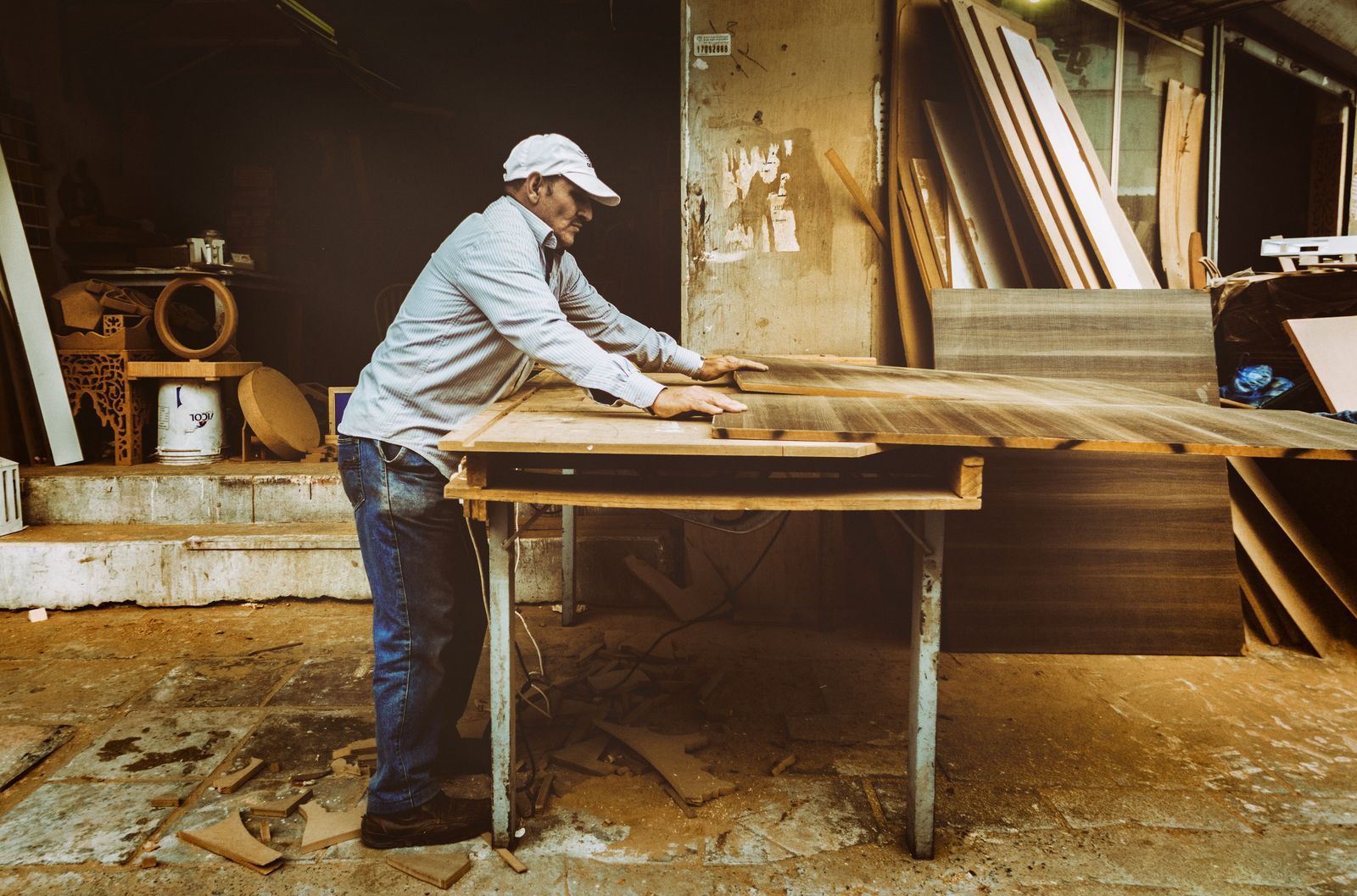
Owen's workshop outside Shrewsbury smells of oak and spray lacquer. On the bench are two alcove units, carcasses and doors, built over three days for a Victorian terrace in town and due to be fitted on Thursday. The job is £3,312 including VAT, and Owen has already spent £860 on sheet material, oak and hinges that nobody else could use if the customer changed her mind. That is the thing about carpentry and joinery: unlike most trades, you make something that fits one house and no other. Your invoicing has to reflect that, from the first deposit to the final balance.
Bespoke means money up front
A plumber can return a boiler. A joiner cannot return an alcove unit cut to a wonky Victorian chimney breast. So the first rule of invoicing bespoke work is that materials are paid for before the saw starts. Nothing in UK law sets a maximum deposit for work for a homeowner; the convention in joinery is 40% to 50% for fitted furniture, or the full material cost plus a share of the workshop time for a staircase or a run of windows.
Make the deposit part of the paperwork, not a conversation:
- The quote states the deposit and what it covers ("40% deposit to cover materials and secure the workshop slot").
- When the customer accepts, raise a proforma invoice for the deposit: a request for payment, not a VAT invoice, and something to pay against.
- Order timber once the deposit has cleared, and say so: "Deposit received, thank you. Oak and board ordered; workshop build starts Monday."
- The final invoice shows the whole job and deducts the deposit by its proforma number.
Keep deposit money accessible; if you cannot do the job, it is still owed back. Our post on deposits and staged payments covers longer jobs; a kitchen or a staircase usually wants a deposit, a payment when the pieces are made, and the balance on fitting.
Quoting bespoke work so the invoice writes itself
The quote for fitted joinery is a small specification, and the better it is, the less the invoice has to explain. Include:
- What is being made, with sizes: "Pair of fitted alcove units either side of chimney breast, each 1,100 wide x 2,400 high x 400 deep, base cupboards with shelving above."
- Materials and finish: "18 mm moisture-resistant MDF carcasses, oak-veneered shelving, solid oak face frames and doors, soft-close hinges, brushed brass handles, spray-finished in satin to a colour to be confirmed."
- Workshop time and site time as separate lines.
- What is not included: decorating the surrounding wall, electrics for lighting, removing the old shelving, making good plaster.
- Deposit, stages, payment terms and how long the quote is valid, because timber prices move.
- A drawing or sketch, attached to the quote email. The sketch is the thing the customer says yes to.
When the quote is this specific, the invoice is the same lines with two additions: extras agreed during the job, and the deposit deducted. Our guide to writing a trade quote covers exclusions and validity in more depth.
Workshop time, fitting time and materials
Several kinds of cost go into a piece of joinery, and the invoice reads best when each has its own place:
- Materials. Sheet material, solid timber, ironmongery, finishes. Enough detail to be believed ("18 mm MR MDF, 4 sheets; European oak; soft-close hinges, 8") but not a merchant's delivery note. A markup is normal: you sourced them, cut them and stand behind them.
- Workshop time. The build, in days or a fixed sum, described by what was made. Design and survey time as its own line if it was significant; for bespoke work it usually is.
- Site time. Fitting, scribing, hanging doors. A separate line, because a customer who later asks for a shelf is really asking for more site time, and you want a figure to point at.
- Finishing. Spraying or hand painting is often a third of the job's value and sometimes done by someone else. Its own line.
If you are VAT registered, VAT applies to all of it at the standard rate: labour, materials, finishing, the lot. One quiet complication: receiving a deposit normally creates a tax point for VAT, so the VAT on the deposit belongs in the period you received it, not the period you invoice the balance. Check that with your accountant rather than with us. If you are not registered, none of this appears; see invoicing when not VAT registered.
Worked example: fitted alcove units
Here is Owen's final invoice. His firm is VAT registered. The customer paid a 40% deposit against a proforma three weeks earlier, and during fitting asked for an extra adjustable shelf in each unit, agreed by text the same morning.
Owen Pryce Joinery Ltd, Unit 4, Hadnall Workshops, Shrewsbury SY4 4AB. VAT no. GB 987 6543 21
Invoice INV-0071, dated 6 November 2026. From QUO-0064. Payment due within 7 days.
Bill to: Dr L. Bennett, 19 Abbey Foregate, Shrewsbury SY2 6AE
Job: Pair of fitted alcove units, sitting room, as quoted and drawn.
| Description | Qty | Rate | Amount |
|---|---|---|---|
| Design, site survey and drawing | 1 | £120.00 | £120.00 |
| Materials: 18 mm MR MDF carcasses, oak-veneered board, solid European oak face frames and doors, soft-close hinges, brushed brass handles, fixings | 1 | £860.00 | £860.00 |
| Workshop: build two carcasses, four doors and face frames | 3 days | £260.00 | £780.00 |
| Site fitting, scribing to chimney breast and walls, hanging and adjusting doors | 2 days | £260.00 | £520.00 |
| Spray finish: primer and two coats satin, colour Farrow and Ball Railings | 1 | £480.00 | £480.00 |
| Extra: one additional adjustable oak-veneered shelf per unit, agreed by text 6 Nov | 2 | £45.00 | £90.00 |
| Net total | £2,850.00 | ||
| VAT at 20% | £570.00 | ||
| Total | £3,420.00 | ||
| Less deposit received 14 Oct (PRO-0038) | -£1,325.00 | ||
| Balance due | £2,095.00 | ||
Notes: Deposit of £1,325.00 included VAT and was accounted for on receipt. Workmanship guaranteed for 5 years; timber is a natural material and small movement with the seasons is normal. Pay by card using the Pay button or by bank transfer to the details below.
The materials line is specific enough to be trusted without being a shopping list. Workshop and site days are separate, so the extra shelf has an obvious home. The deposit is deducted against its proforma number, with the VAT handling noted. And the note about timber movement is a tiny piece of expectation management that saves a call in February when the heating goes on.
Extras, and the shelf that became a desk
Bespoke work invites change. The customer sees the carcass in place and wants a drawer, a lamp hole, a deeper top. Say yes, usually, but price it first and get a yes back in writing, even if that is a text with a number in it. Then it is a line on the invoice with the date, as Owen's shelves are. What you want to avoid is three small "while you're here" requests becoming a day of work nobody agreed to pay for; the script is in invoicing variations and extras. The flip side: a piece remade because of your mistake is yours. A piece remade because the customer changed the colour after spraying is a line.
Site carpentry for builders
If you do first and second fix for a builder, you are a subcontractor and the Construction Industry Scheme applies: the builder deducts 20% of your labour (30% if you are not registered, 0% with gross payment status) and pays it to HMRC against your tax. Materials and VAT are not deducted from. Show labour and materials separately, add the deduction line and your UTR. The builder is a business, so statutory late payment interest applies if they are slow; with Dr Bennett it does not. The worked example is in our CIS invoice guide.
From the workshop to paid
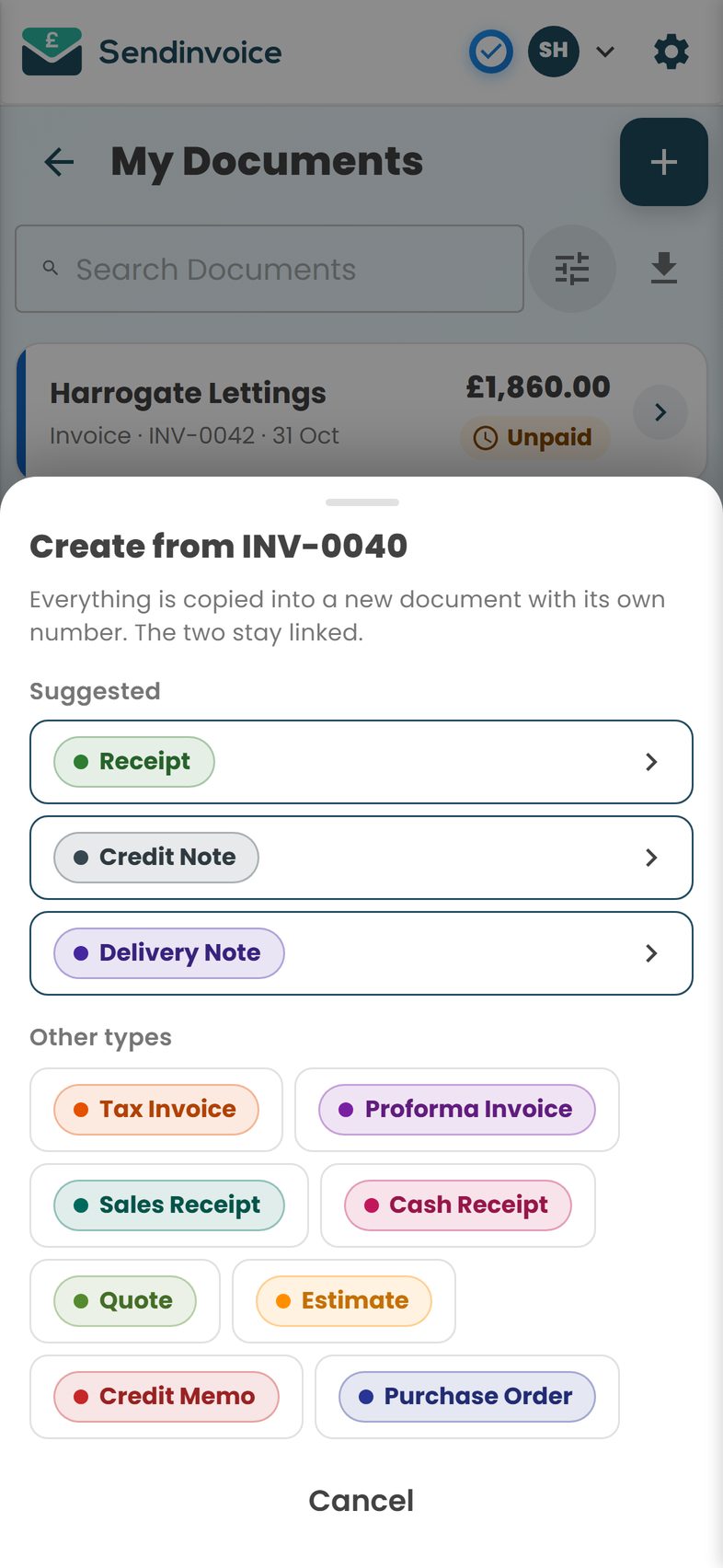
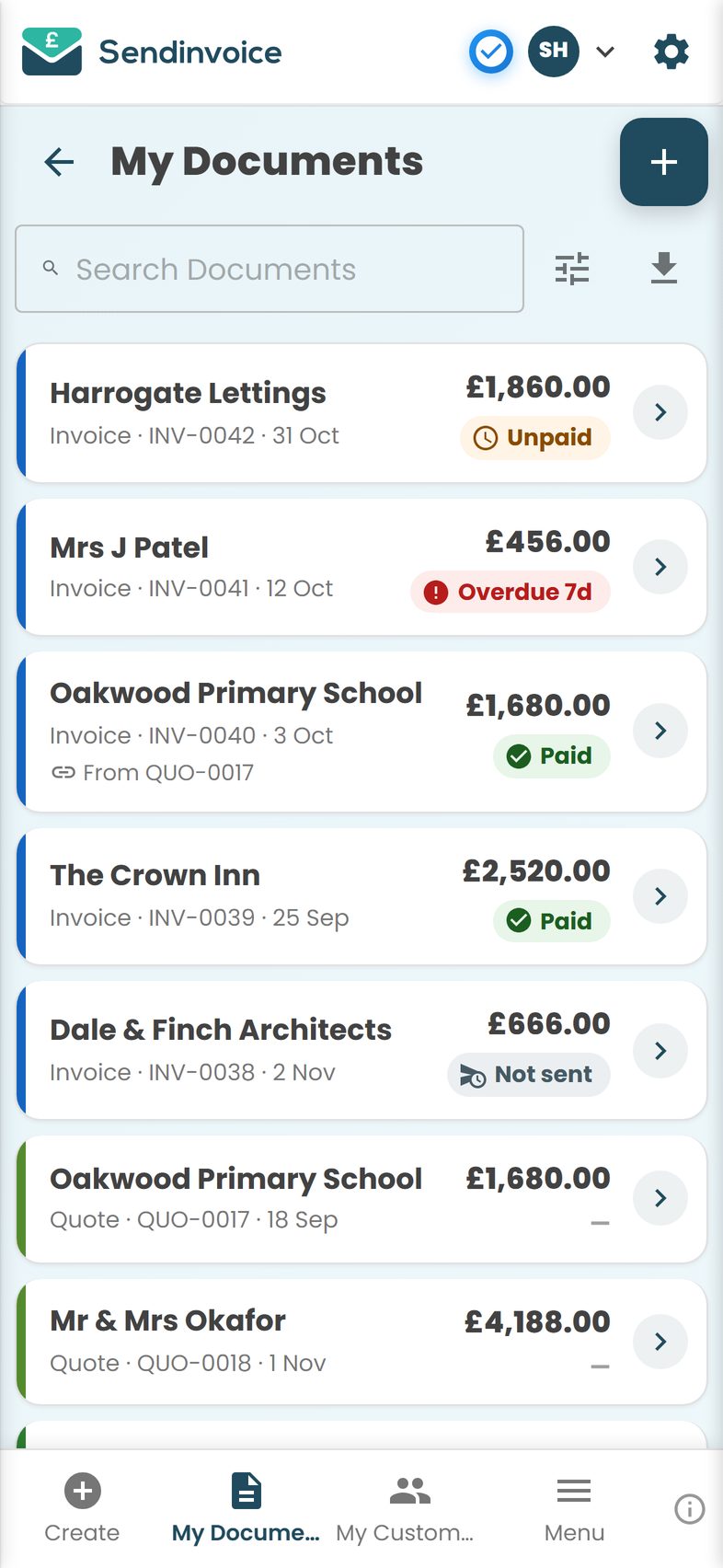
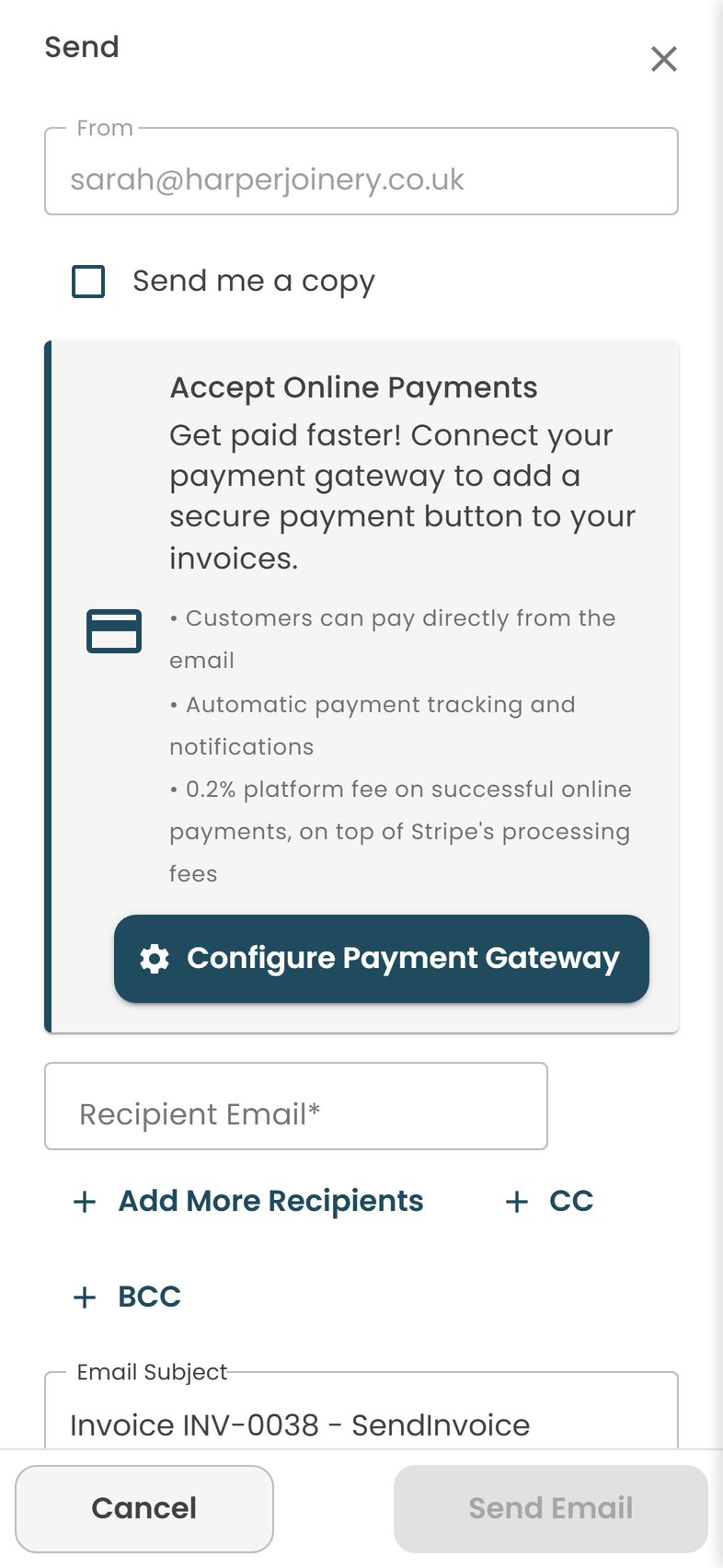
The invoice for fitted furniture should go out the day it is fitted, while the customer is running a hand along the oak. In SendInvoice the accepted quote becomes the proforma for the deposit and then the invoice for the balance, each with a new number and a "From QUO-0064" link: one customer, three linked documents. The email carries the PDF and a Pay button; a card payment flips it to Paid on its own, and reminders chase the balance if it drifts, which with bespoke work it occasionally does, because the customer already has the furniture.
Joinery is a trade of specifics: sizes, species, finishes, hinges. Let the invoice be as specific as the work, and the money follows it as neatly as the doors follow the frames.
Do this in SendInvoice
Turn the accepted quote into the deposit proforma and then the final invoice without retyping a line, keep timber and ironmongery as saved items, and send the balance with a Pay button the day you fit. Free to create and preview; £5 a month to send, remind and get paid by card.
Create a free invoice See the £5/month planFrequently asked questions
How much deposit should a joiner take for bespoke work?
Enough to cover the timber, sheet material and ironmongery you have to buy before you start, which for fitted furniture is often 40% to 50% of the price. There is no legal maximum for a homeowner job. Put the deposit on the quote, raise a proforma invoice for it and order materials only once it has cleared.
Should I separate workshop time from fitting on the invoice?
Yes. Workshop days and site days have different costs and customers understand them differently. A line for the build ("Workshop: carcasses, doors and face frames, 3 days") and a line for fitting ("Site fitting and scribing, 2 days") shows where the price comes from and makes a later variation easier to price.
Can a customer cancel a bespoke order after paying a deposit?
Consumers have a 14-day cancellation right for contracts agreed in their home, but there is an exception for goods made to the customer's specification. The rules have detail in them, so do not rely on the exception alone: get the customer's written request to start within the 14 days, and keep the deposit terms clear on the quote.
Do I charge VAT on joinery?
Only if you are VAT registered. If you are, VAT applies at the standard rate to the whole supply, labour and materials, and the invoice needs your VAT number, the rate and the VAT amount. Taking a deposit normally creates a tax point for VAT, so account for it in that period; check with your accountant. If you are not registered, show no VAT at all.
How do I turn a joinery quote into an invoice?
The invoice should carry the quote's lines unchanged, plus any extras agreed in writing and a deduction for the deposit received. In SendInvoice you tap Create from this on the accepted quote, choose Invoice, and the lines, customer and details carry over with a new number and a link back to the quote.
What if I work for a builder rather than a homeowner?
First and second fix carpentry for a builder is construction work under the Construction Industry Scheme. The builder deducts 20% (30% if you are not registered) from the labour part of your invoice and pays it to HMRC against your tax. Show labour and materials separately, add the deduction line and your UTR, and keep the deduction statements.