
Consulting is a job made of conversations, and the worst conversation is the one about money. The deposit you did not ask for, the milestone you forgot to bill, the "just following up on this" email you rewrote four times. Here is a month where the paperwork does the asking and you do the work.
A day in the life
Meet Amara. Freelance marketing consultant in Manchester, mostly three-month engagements with small firms who have never had a marketing person before. She is brilliant in a workshop and allergic to chasing. Last year she finished a project in June and was paid in October, because she felt rude asking twice.
Day one, 10:00am, the kick-off call ends
New client, a regional accountancy practice, a £6,000 three-month engagement. Before the call she had already decided this one would be different: a 30% deposit up front, two milestone invoices, no invoice sitting unsent because she "didn't want to seem pushy".
The call ends, the proposal is accepted, and she opens SendInvoice on the laptop. She picks Proforma invoice, types "Marketing engagement, deposit (30%)", £1,800, due on receipt. Her consultancy details and bank details come from Settings. There is a Pay button in the email. She sends it at 10:12, while the goodwill is warm, and feels oddly grown-up about it. The finance partner pays by card before lunch.
Week five, 4:30pm, the first milestone
The audit and strategy phase is signed off. Amara creates an Invoice, "Phase 1: audit and strategy", £2,100, 14-day terms, with a short line in the terms about statutory interest that she has never once needed to enforce but likes having there. Numbered INV-0031, in sequence with the rest of her year.
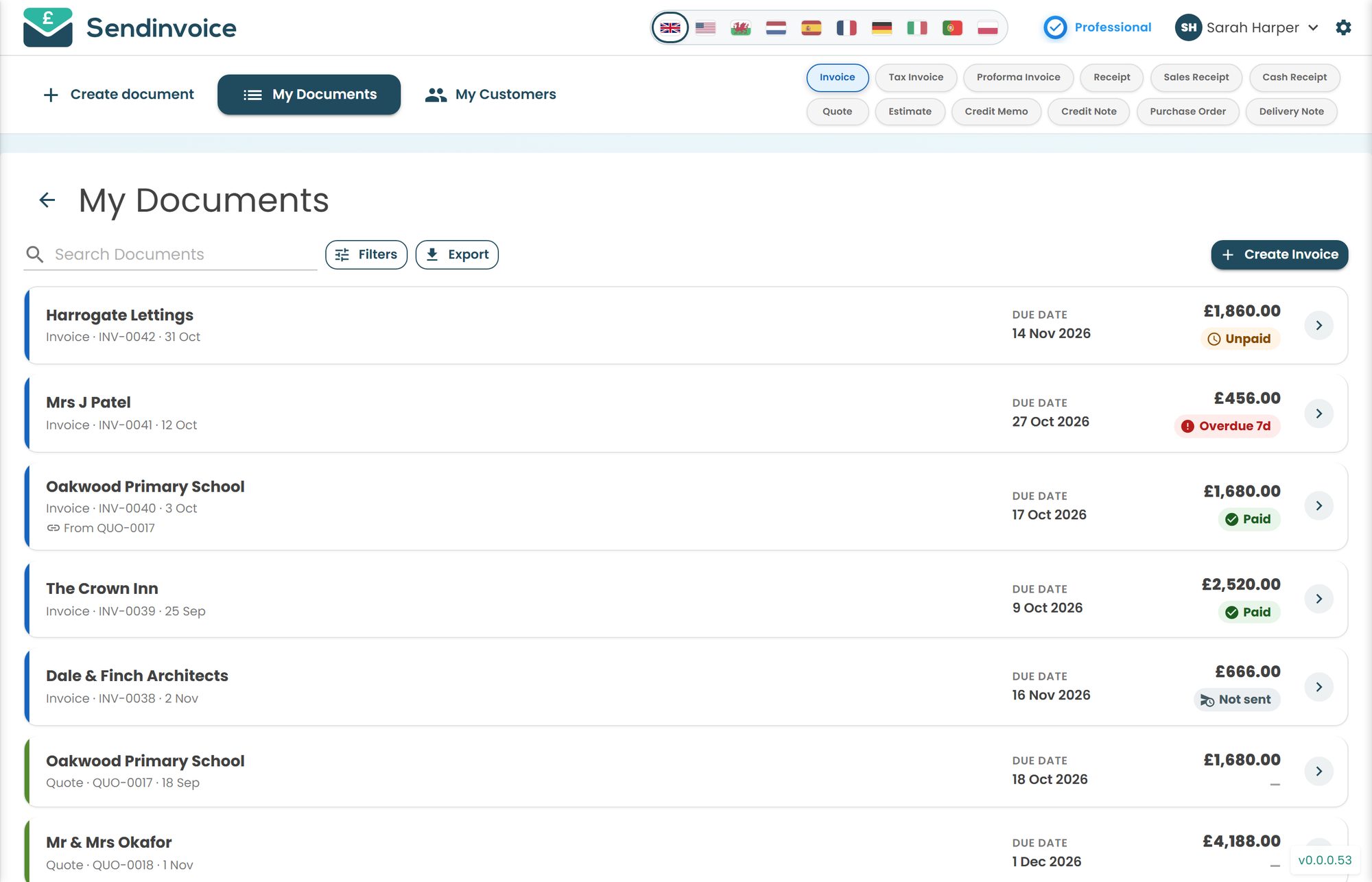
She opens My Documents to check the other engagements. The view is the honest version of her month: Paid in green, Unpaid, one Overdue in red from a coaching client who always pays, just late. She knows where she stands without opening the bank app, which matters when you are deciding whether you can take a week off in August.
Week seven, 8:50am, the awkward email that is not awkward
The coaching client is now three weeks late on £450. Old Amara would have drafted something, deleted it, drafted it again, added "no rush!" and sent nothing. New Amara taps the invoice, sends the friendly reminder, and goes to make coffee. It arrives branded with her business, with the PDF and the Pay button, and it reads as what it is: a system doing its job. The client pays that afternoon and apologises, which is a sentence she did not have to write.
If it had stayed unpaid, the next reminder is firmer. The escalation is built in, which means the decision to escalate is not a personal one. That turns out to be the whole trick with awkward emails: not writing them.
Month end, 9:00pm, the accountant wants a list
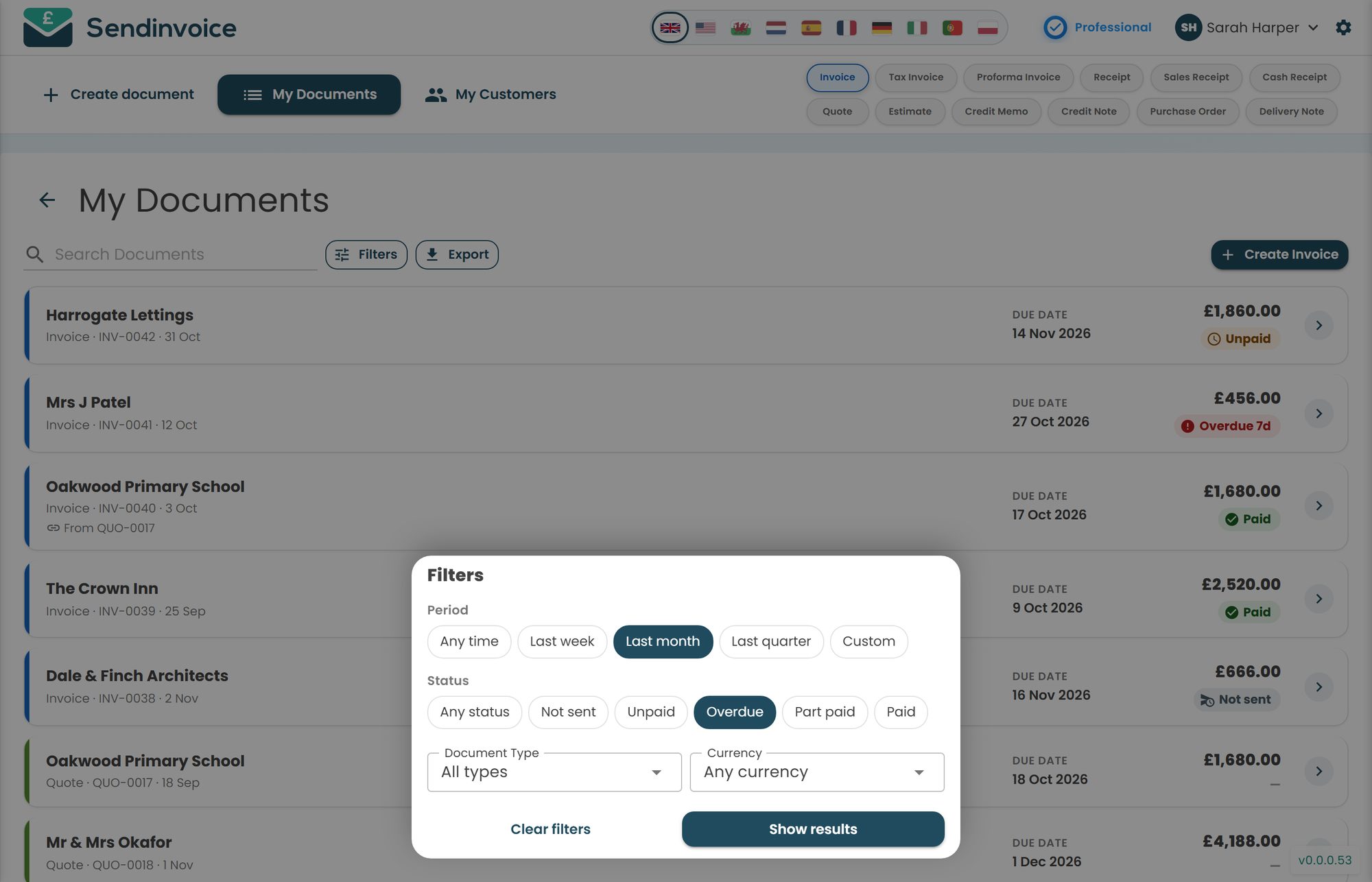
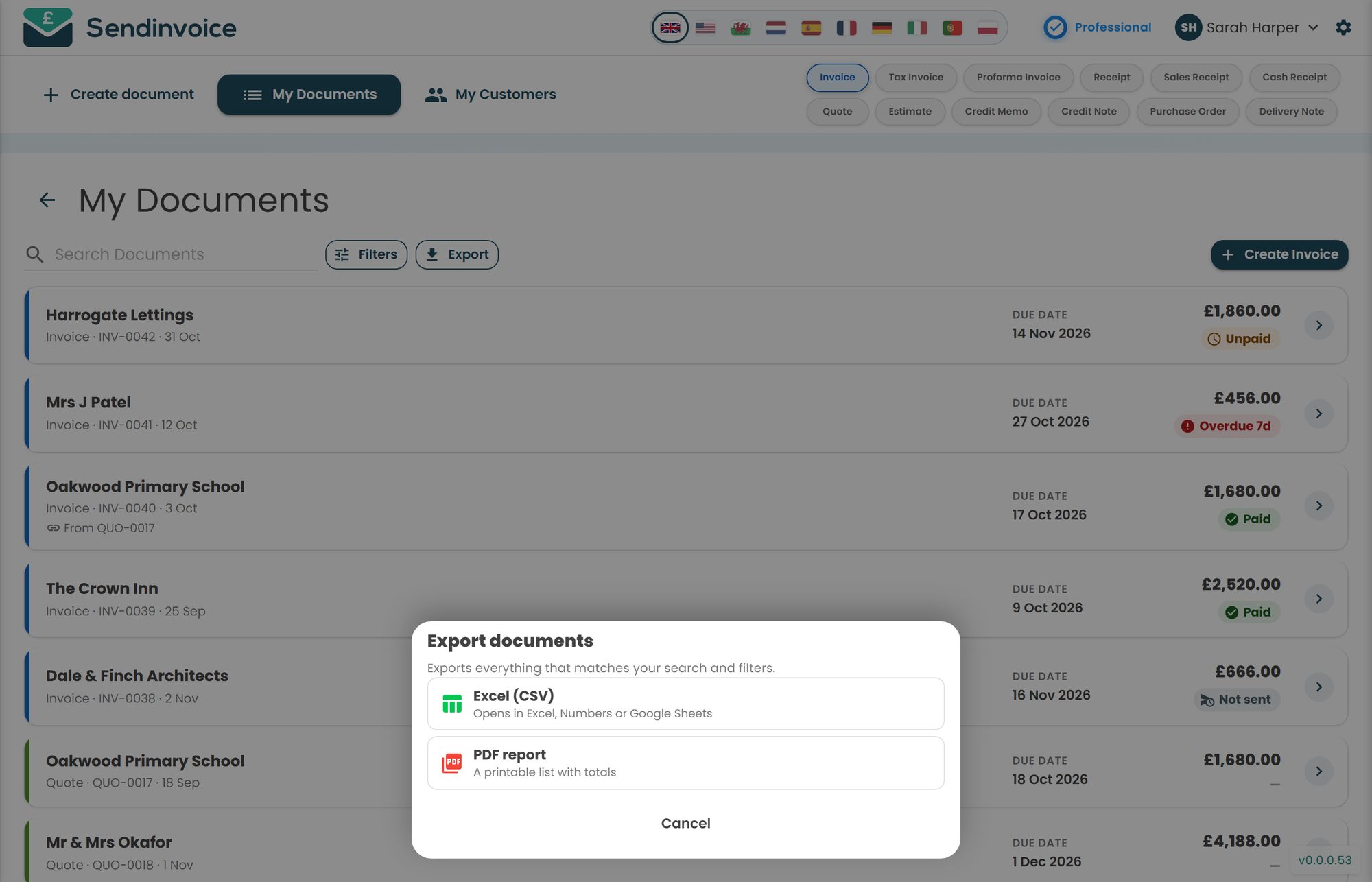
Her accountant asks for the quarter's invoices. Amara filters My Documents to the last quarter, Paid and Unpaid, Invoice and Proforma, and exports to Excel. Thirty seconds. Then a PDF report of the overdue ones for herself, because there is one client she needs to have a conversation with.
What you get
- Deposits as proformas. A proforma invoice for money up front, with a Pay button, then a proper invoice when the work is done.
- Milestone invoices in sequence. Running numbers per document type (INV-0031, INV-0032) so phases stay in order.
- Part paid status. For the client who pays half now and half "when the board signs it off".
- Escalating reminders. Friendly, then firmer, branded with your business, PDF and Pay button included.
- Terms with formatting. Payment terms, a late-payment line and your cancellation policy, saved once and shown on every document.
- Pay by card from the email. Stripe-powered; the invoice flips to Paid automatically. Bank transfers you mark paid by hand.
- Filters and export. Period, status, type and currency; export to Excel (CSV) or a PDF report.
- My Customers. Every client and their details, suggested as you type on the next invoice.
- Quotes that become invoices. Send a quote for the engagement and create the invoice from it when they say yes.
- Credit notes. Scope reduced after invoicing? Issue a credit note from the invoice rather than editing history.
What it costs
The free preview is £0 and needs no card. You can create, customise, download and print any document type with a preview watermark, which is enough to see how your invoices would look.
Sending by email, the Pay button, reminders, Paid/Unpaid/Overdue/Part paid tracking, My Documents and My Customers with filters and export, saved items and premium templates are on the Professional plan at £5 a month, cancel any time. Card payments carry a 0.2% platform fee on successful online payments plus Stripe's own fee: £3.60 on a £1,800 deposit. Bank transfers cost nothing extra.
For a consultant sending a handful of larger invoices a month, that flat fee is the cheaper shape. Tools charging 2.5% to 2.9% per card payment, at the time of writing, would take £45 or more off the same deposit. What you do not get is accounting, time tracking or recurring invoices. If you need those, SendInvoice sits alongside them rather than replacing them.
Do this in SendInvoice
Send the deposit proforma while the kick-off call is still warm, invoice each milestone in sequence, and let the reminders have the awkward conversation for you.
Create a free invoice See the £5/month planFrequently asked questions
Should the deposit be a proforma or an invoice?
A proforma invoice is the usual choice for money requested before work starts: it asks for payment without being a final tax document. When the project completes, you issue the real invoice. SendInvoice creates both in a tap and keeps them in the same list. If you are VAT registered, ask your accountant how they want deposits treated for the tax point.
Can I invoice in stages for a longer project?
Yes. Create a separate invoice for each milestone, for example "Phase 1: audit" and "Phase 2: strategy". Running numbers keep them in order and the client's name links them in My Customers. Part paid status covers an invoice settled in instalments.
How do reminders work?
Open an unpaid invoice and send a reminder. The first is friendly; later ones are firmer. They go out branded with your business and include the PDF and the Pay button. SendInvoice does not send them on a schedule by itself; you choose when.
Can I charge interest on a late payment?
For business customers, the Late Payment of Commercial Debts (Interest) Act 1998 allows statutory interest at 8% plus the Bank of England base rate and fixed compensation of £40, £70 or £100 depending on the debt size, at the time of writing. Mention it in your terms. Check with your accountant before you apply it.
Can I get a month's invoices out for my accountant?
Yes. Filter My Documents by period and export to Excel (CSV) or a PDF report. Your accountant gets a tidy list; you get your evening back.
Does it do time tracking or retainers?
No. SendInvoice is an invoicing tool, not time tracking or accounting. Many consultants add a line such as "Retainer, November" with a saved item and send it at the start of each month.