Search for "small business documents" and you get lists of forty things: statements, remittance advices, debit notes, packing slips, timesheets, all presented as if a wedding photographer with a Nikon and a diary needs an accounts department. She does not. Most one-person businesses need about six documents, and two of those only if you sell physical things. Here is the honest list, what each must say, and the ones you can cheerfully ignore.
The principle: one document per moment
Every piece of paperwork answers one question at one moment in a job. Before: what will it cost? After: what do you owe me? Later: did you pay? Later still: did I get it wrong? If a document does not answer a question you are being asked, you do not need it.
Meet Leah, who photographs weddings and the occasional corporate headshot day. She is not VAT registered (yet).
The six you need
1. A quote (or an estimate)
When: before the work, when a customer asks "how much?".
What must be on it: your business name and contact details, the customer's name, what is included (and what is not), the price, whether VAT is included if you are registered, how long it is valid for, and a reference number. A quote is a fixed price; an estimate is a best guess that may change. Pick the one that matches how sure you are, and say which it is on the document.
Example: "QUO-0031: Full-day wedding coverage, Saturday 14 June, 10 hours, online gallery, 400 edited images: £1,650. Valid 30 days. 25% deposit to secure the date."
Leah quotes everything, having once been burnt by a verbal "about fifteen hundred" remembered as twelve.
2. An invoice
When: after the work, or at agreed stages. The one that gets you paid, and the one HMRC cares about.
What must be on it: a unique sequential number, your name or business name and address, the customer's name and address, the date, a description of what you supplied, the amount and when it is due. If you are VAT registered, add your VAT number, the VAT rate and amount, the tax point and the net total; that version is sometimes called a tax invoice, and every invoice a registered business sends needs to be one. If you are not registered, do not show VAT at all. Add bank details and payment terms (the law assumes 30 days if you say nothing).
Example: "INV-0074: Wedding photography, 14 June, as per QUO-0031: £1,650.00. Less deposit paid (PRO-0012): £412.50. Balance due within 14 days: £1,237.50."
Leah makes the invoice from the quote with Create from this, so the details match and the invoice shows "From QUO-0031".
3. A receipt
When: after the customer has paid, if they want proof. Business customers nearly always do.
What must be on it: its own number, the date payment was received, who paid and who was paid, the amount, how it was paid, and which invoice it settles. VAT details if you are registered. A receipt, sales receipt or cash receipt are the same idea with different wording.
Example: "REC-0040: Received with thanks £1,237.50 by card on 20 June, in settlement of INV-0074."
Leah only issues receipts for the headshot days, where the office manager needs one for expenses.
4. A credit note
When: after an invoice, when you need to reduce it: you overcharged, something was returned, you agreed a discount, or the invoice was wrong. Issue one of these instead of editing or deleting a sent invoice, so the numbers stay in sequence and the customer's copy still matches yours.
What must be on it: its own number, the date, your details and the customer's, the invoice it relates to, what is being credited and why, the amount, and the VAT if you are registered. In the US this is a credit memo; the credit note page has the layout.
Example: "CN-0006 against INV-0074: Second shooter not required on the day, as agreed: credit £150.00."
Leah has issued three in four years.
5. A proforma invoice (for deposits)
When: before the work, when you want money up front: a deposit to hold a date, a part-payment for materials. A proforma looks like an invoice and can carry a Pay button, but it is not a real invoice: it does not go into your sales and, if you are VAT registered, does not create a tax point. The proper invoice comes at the end and shows the deposit already paid.
What must be on it: the same details as an invoice, clearly labelled "Proforma", with the amount requested and what it is for.
Example: "PRO-0012: 25% deposit to secure 14 June, as per QUO-0031: £412.50."
Once the proforma is paid, Leah can turn down other enquiries for 14 June without worrying.
6. A purchase order and a delivery note (only if you buy or ship goods)
If you sell services, skip this section with a clear conscience.
A purchase order is what you send a supplier to order goods: a numbered list of what you want, at what price, delivered where and when. It stops "I ordered twelve" / "you said ten" arguments. Larger customers sometimes insist on sending you one; if so, put their PO number on your invoice.
A delivery note goes with goods you send out: what is in the box, how many, who it is for, no prices. It proves what was delivered if there is a dispute.
Example: "PO-0003: 2 boxes A3 fine art paper, 310gsm, £118 each, deliver by 28 June." Leah has sent two, both for album stock. She has never needed a delivery note; galleries go by link.
The six you do not need (yet, or ever)
Real documents with real uses, mostly in businesses with a finance team. For one person they are overhead.
- Customer statements. A monthly list of everything a customer owes you. Useful when one customer has twelve open invoices; with one or two, a reminder on the specific invoice does the job better.
- Remittance advice. A note from the payer saying "we have paid invoices X, Y and Z". You might receive these from big companies. You will never send one.
- Debit notes. The opposite of a credit note: asking for more than the original invoice. Just send another invoice for the extra.
- Packing slips. A delivery note's cousin, for warehouses. A delivery note or a line on the invoice covers it.
- Timesheets as a customer document. Keep one for yourself if you bill by the hour; the customer just needs "Headshot day, 7 hours at £95" on the invoice line.
- A separate terms and conditions contract. For most small jobs, the terms on the quote and invoice are the contract: when payment is due, what happens if it is late, what the deposit covers. Twelve pages nobody reads protect you less than a clear sentence everybody reads.
None of these is wrong. They are answers to questions nobody is asking you.
At a glance
| Document | When | Points back to | Needed by |
|---|---|---|---|
| Quote / estimate | Before the work | Nothing | Everyone |
| Proforma invoice | Before the work, for a deposit | The quote | Anyone who takes deposits |
| Invoice | After the work | The quote and any proforma | Everyone |
| Receipt | After payment | The invoice | Anyone with business customers |
| Credit note | When an invoice needs reducing | The invoice | Everyone, occasionally |
| Purchase order / delivery note | When ordering or shipping goods | Each other | Only if you buy or ship goods |
Twelve types, grouped so you are not scrolling
SendInvoice offers 12 document types: Invoice, Tax invoice, Proforma invoice, Quote, Estimate, Receipt, Sales receipt, Cash receipt, Credit note, Credit memo, Purchase order and Delivery note. That covers all six above plus their regional names (tax invoice for the VAT-registered, credit memo for American clients, three receipts depending on how you were paid).
Twelve is a long list to scroll on a phone, so the type picker groups them: Invoices, Quotes, Receipts, Credits and Other. Leah has never opened Other.
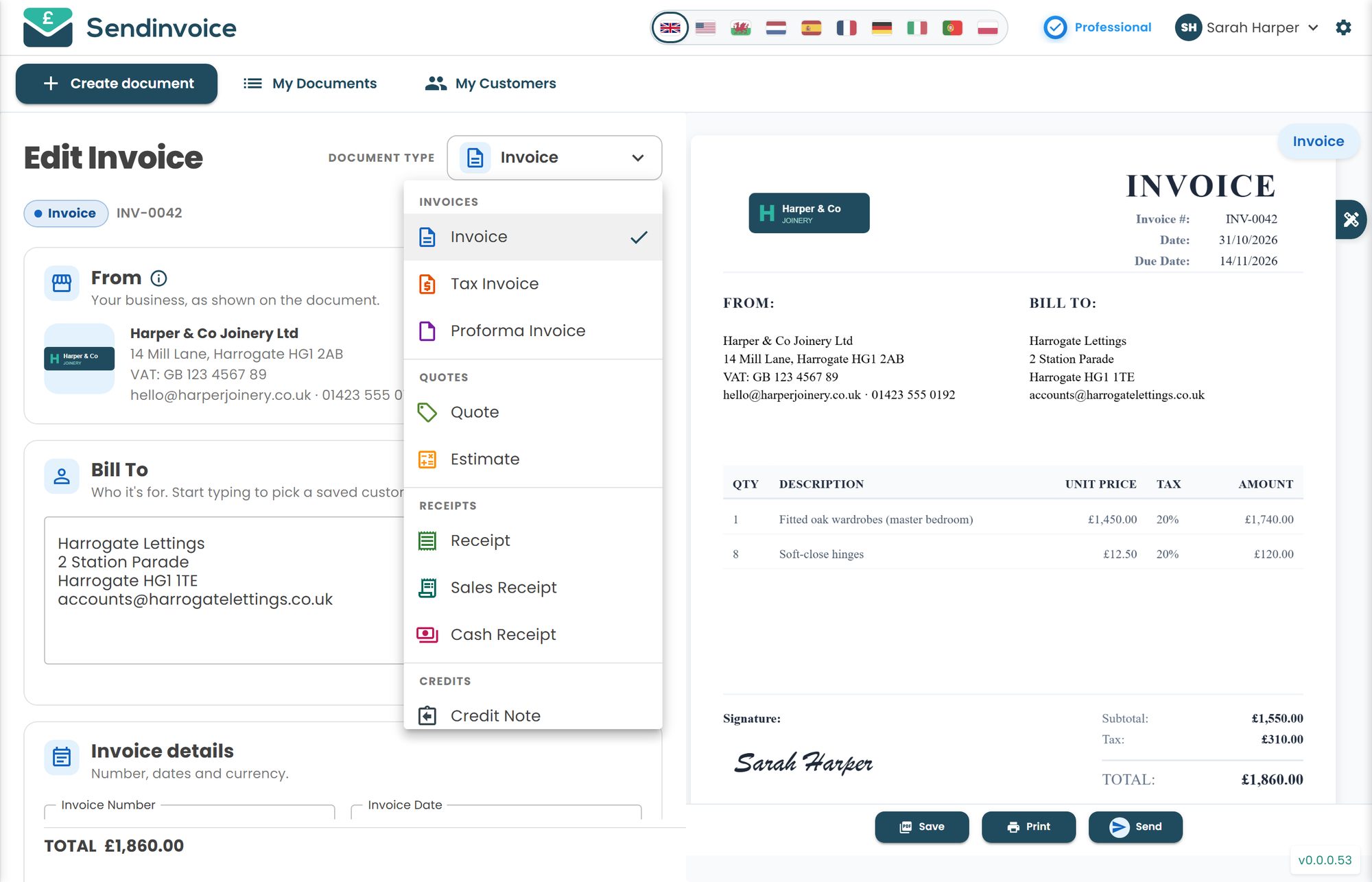
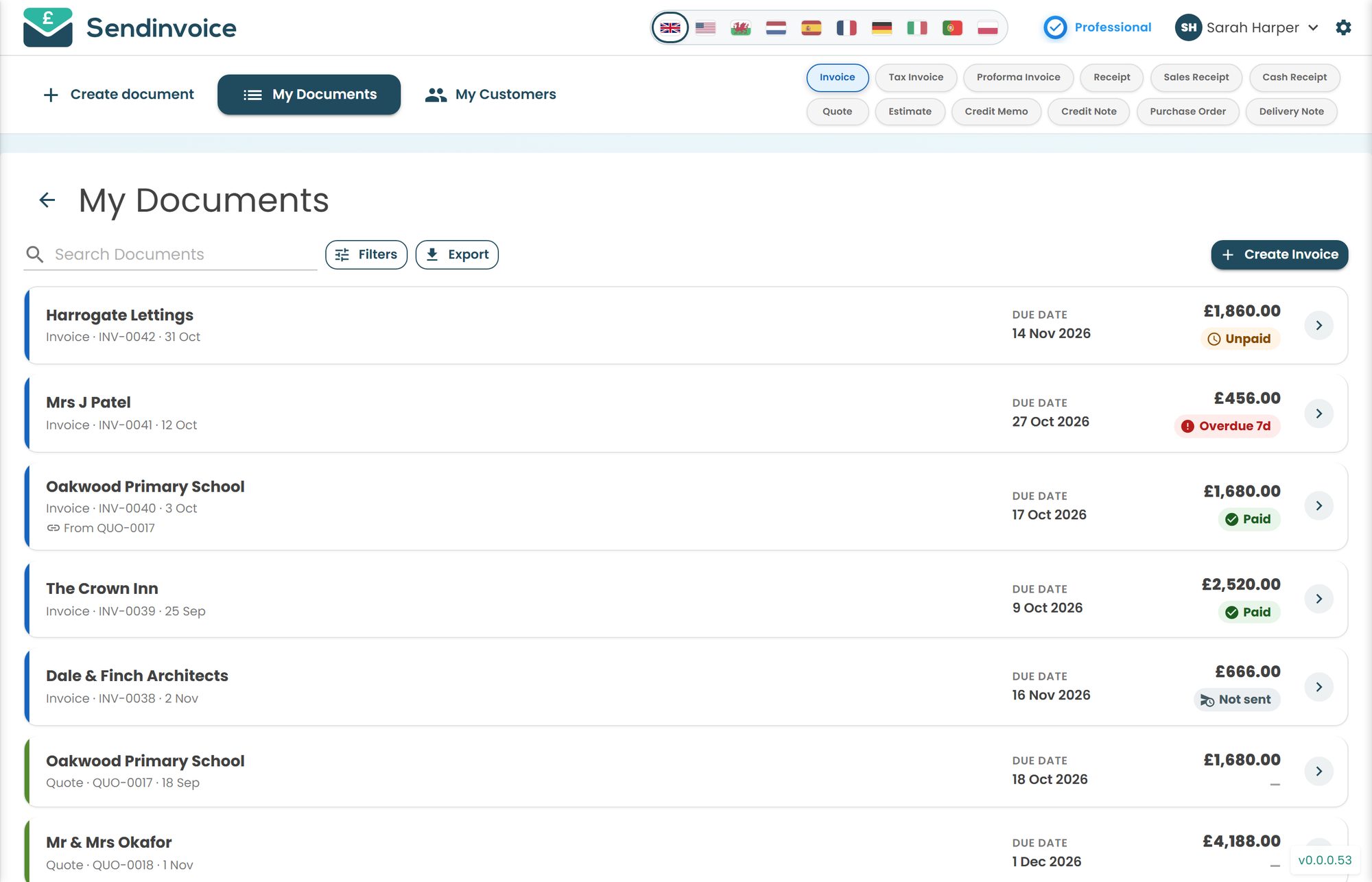
Each type keeps its own number sequence (QUO-, PRO-, INV-, REC-, CN-), and because any document can be created from another with Create from this, the chain for a job writes itself: proforma from the quote, invoice from the quote, receipt from the invoice. Each shows where it came from, so My Documents tells a job's whole story in a few rows.
Keeping them, and the one tax thing to know
Keep a copy of everything you issue. HMRC expects sales records (mostly invoices and credit notes) kept for at least 5 to 6 years; quotes, proformas and receipts are worth keeping alongside because they explain the invoices. A searchable list you can export to Excel or PDF is enough.
If you are self-employed with income over £50,000, Making Tax Digital for Income Tax applies from April 2026, with lower thresholds following in 2027 and 2028 at the time of writing. It asks for digital records, not new documents; numbered invoices in one place are most of the way there. Check with your accountant or HMRC for what applies to you.
Do this in SendInvoice
All twelve document types are included, grouped in one picker, each with its own numbering, and any document can be created from another in one tap. Set your details once and every quote, invoice and receipt carries them.
Create a free invoice See the £5/month planFrequently asked questions
Do I need a quote and an estimate, or just one?
One. Use a quote when you can give a fixed price and an estimate when you cannot. Most businesses settle on whichever fits their work, and only switch for the odd job where the scope is unusually certain or unusually vague.
Is a tax invoice different from a normal invoice?
A tax invoice is simply an invoice that shows the VAT details HMRC requires: your VAT number, the rate, the VAT amount, the tax point and the net total. If you are VAT registered, every invoice you send needs these, so "tax invoice" is really just the name for a VAT-compliant invoice. If you are not registered, you never need one.
Do I need a proforma invoice for a deposit?
It is the cleanest way. A proforma asks for payment before the work without creating a real invoice or, for VAT-registered businesses, a tax point. When the job is done you issue the proper invoice showing the deposit already paid.
When would a one-person business use a purchase order?
Only if you buy goods from suppliers regularly, or if a larger customer insists on issuing one to you before they will accept your invoice. Many sole traders go years without needing one, and that is fine.
Do I need to send customer statements?
Rarely. A statement lists all of a customer's invoices and payments over a period. If you have a handful of customers each with one or two invoices, a reminder on the specific overdue invoice does the job better. Statements earn their keep when a customer has many open invoices at once.
What records do I legally have to keep?
Copies of every invoice you issue and receive, plus records of money in and out. Keep them for at least 5 to 6 years. Quotes, receipts and credit notes are worth keeping with them, because together they explain the invoices.
Does SendInvoice have all these document types?
Yes. There are 12 types: Invoice, Tax invoice, Proforma invoice, Quote, Estimate, Receipt, Sales receipt, Cash receipt, Credit note, Credit memo, Purchase order and Delivery note. They are grouped in the type picker so you are not scrolling past ones you never use.